

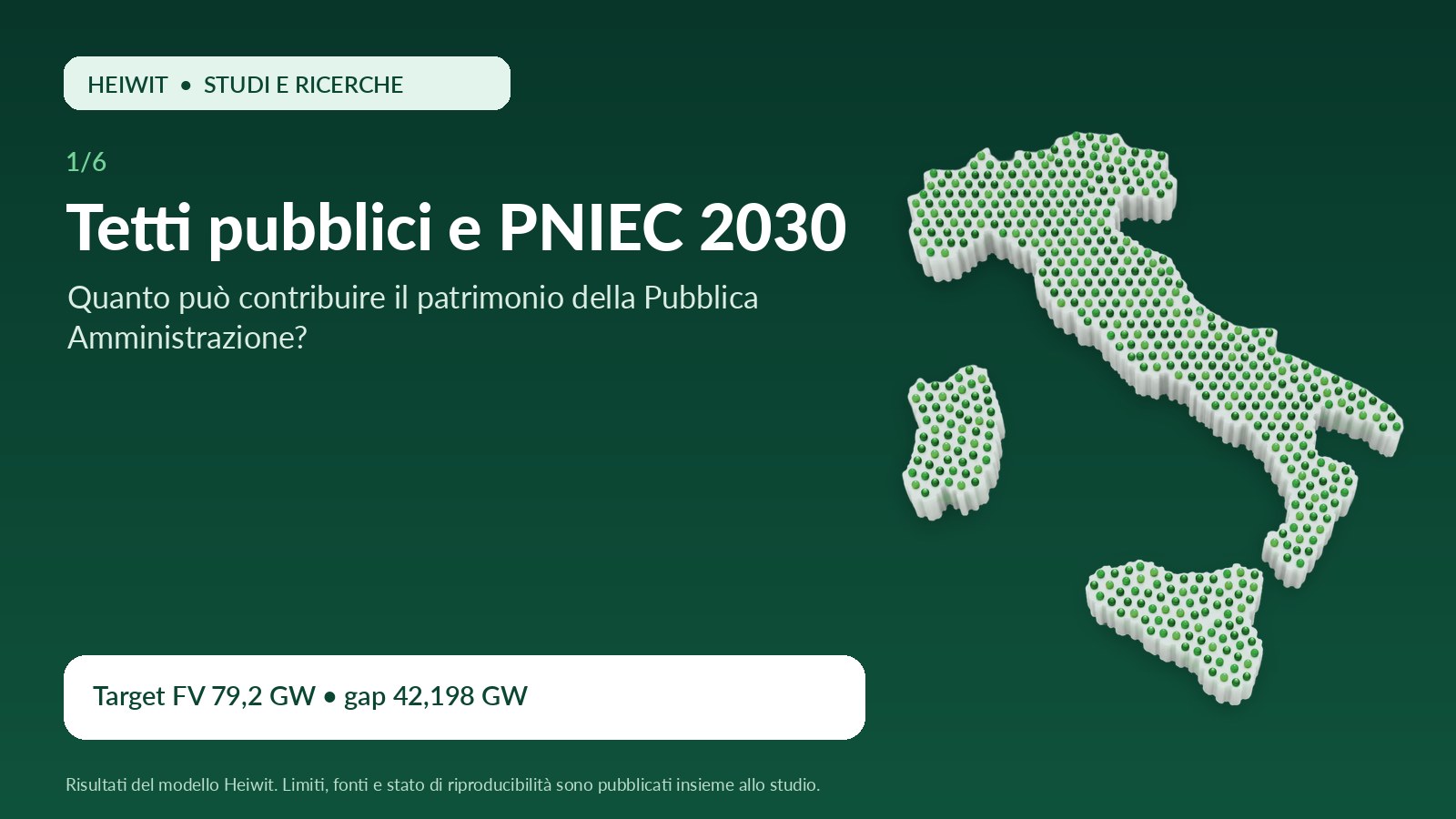
Italy must rapidly increase its photovoltaic capacity by 2030. The roofs of public buildings do not solve the problem on their own, but they can represent a significant share without taking up new land.
The chapter in 8 slides
Scroll through the original carousel created for this chapter. The images have been optimised for the web and uploaded to the WordPress Media Library.

On your smartphone swipe sideways. From the keyboard use the left and right arrows.
The gap to bridge
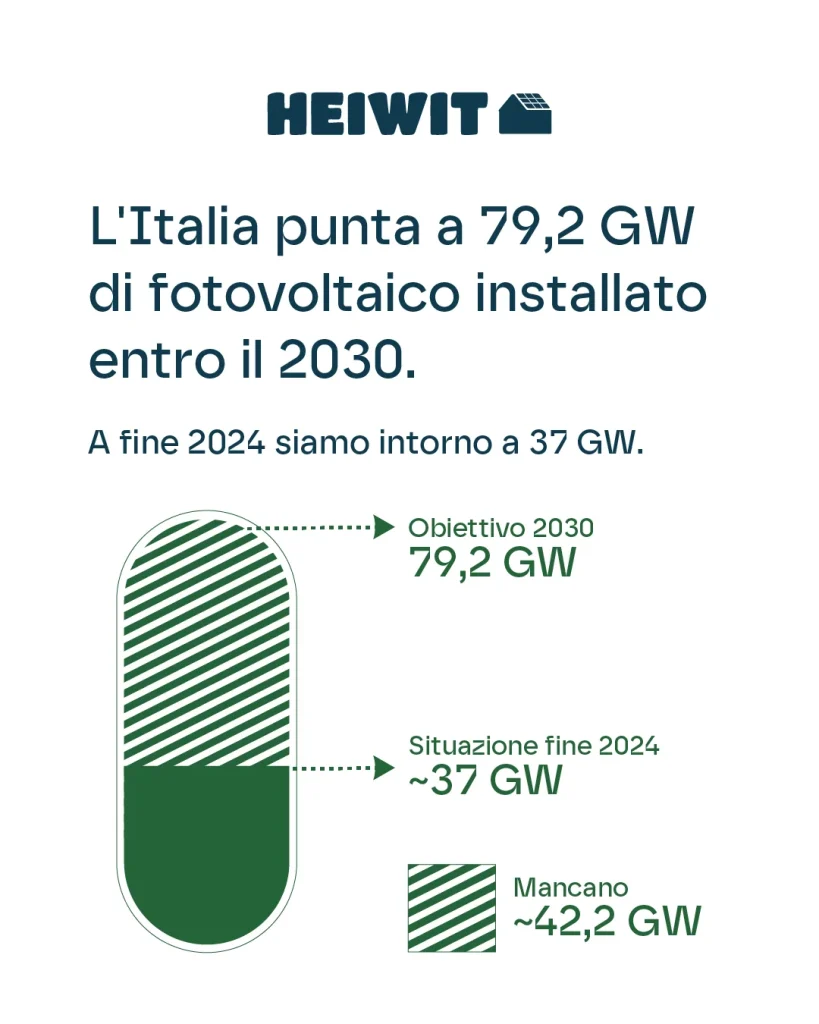
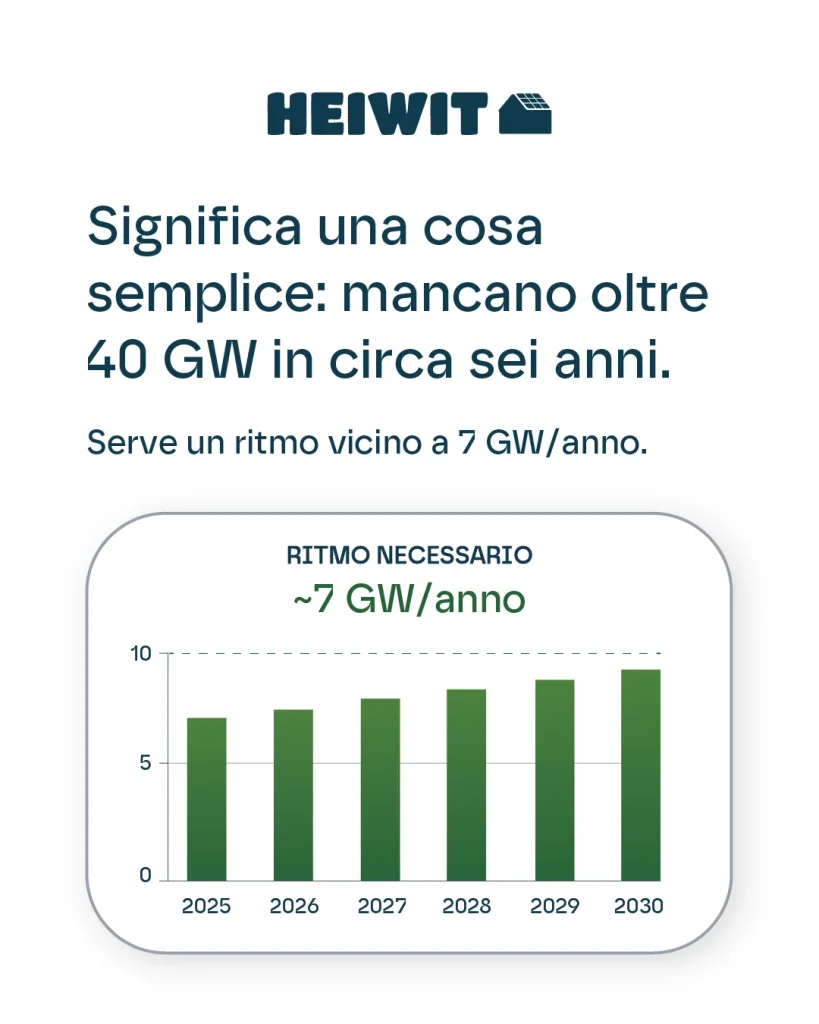
The 2024 NECP indicates 79.2 GW of solar PV by 2030. GSE records 37,002 MW in operation at the end of 2024. The arithmetic difference is therefore 42.198 GW. This is neither a market forecast nor a «net» requirement already adjusted for retirements, delays or target revisions: it is the transparent comparison of two official figures.
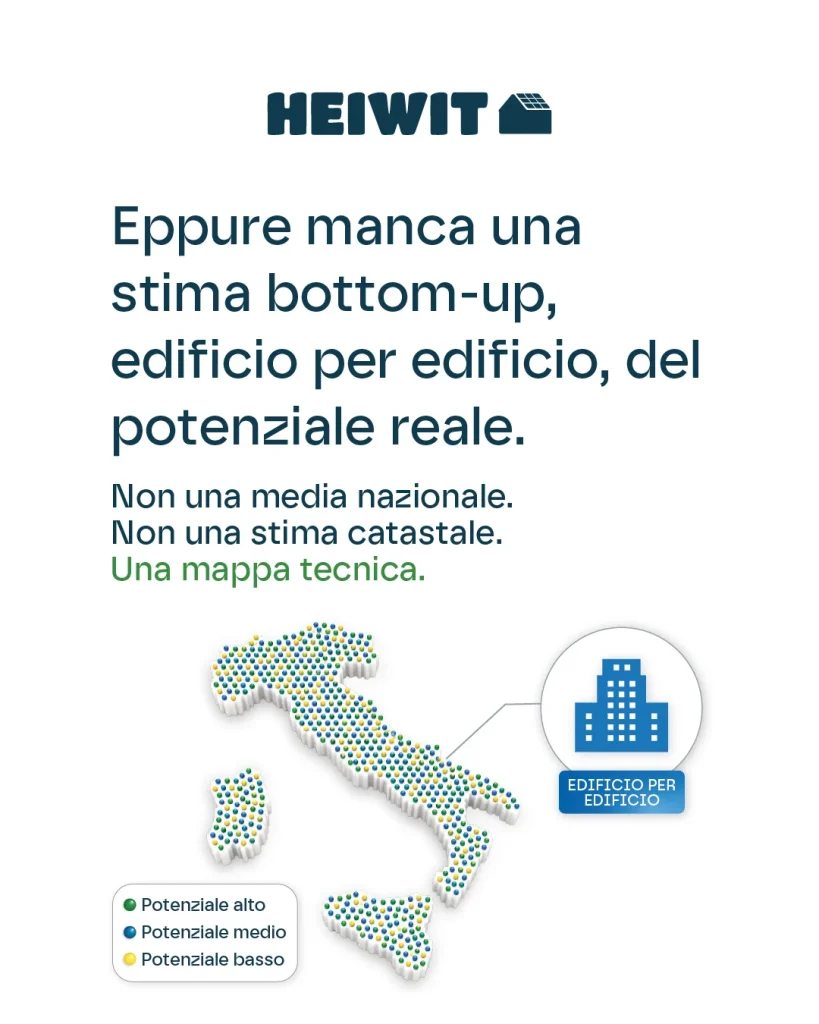
The theoretical result of 5.68 GW produced by the Heiwit model would have two correct interpretations: it would represent 7.17% of the total target of 79.2 GW and 13.46% of the arithmetic gap compared with the 2024 capacity. Simply writing «7–14% of the PNIEC» would be ambiguous, as it would mix two different denominators.
Why start with public roofs
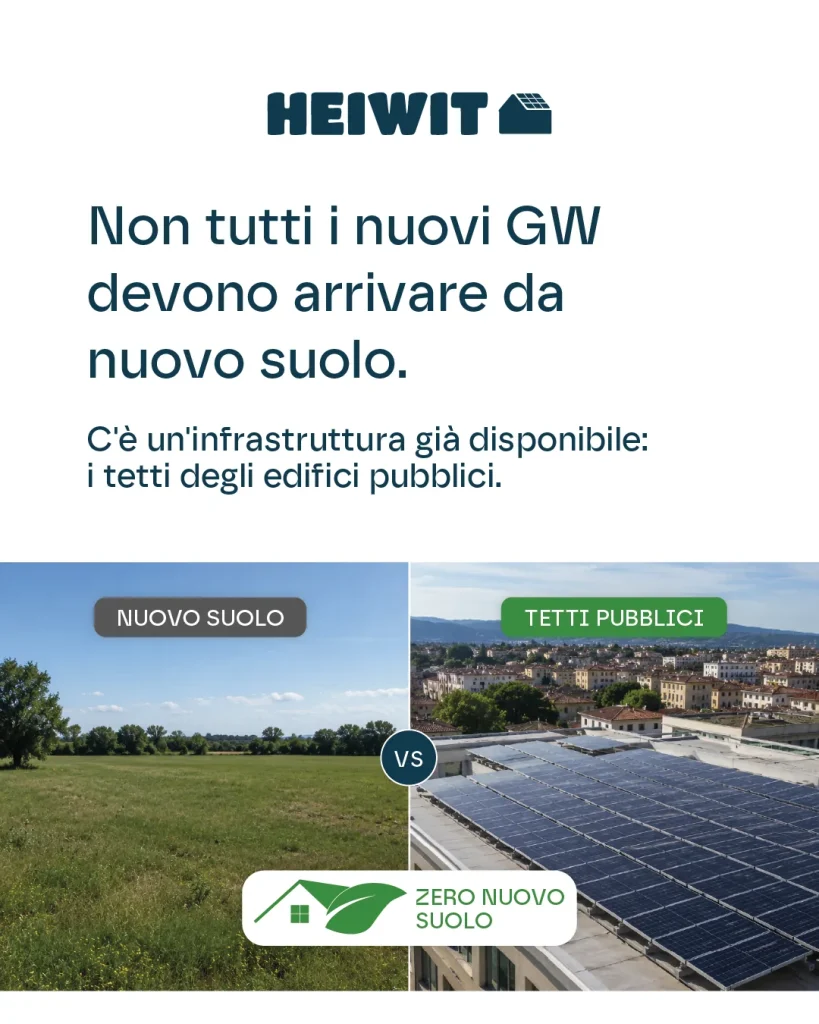
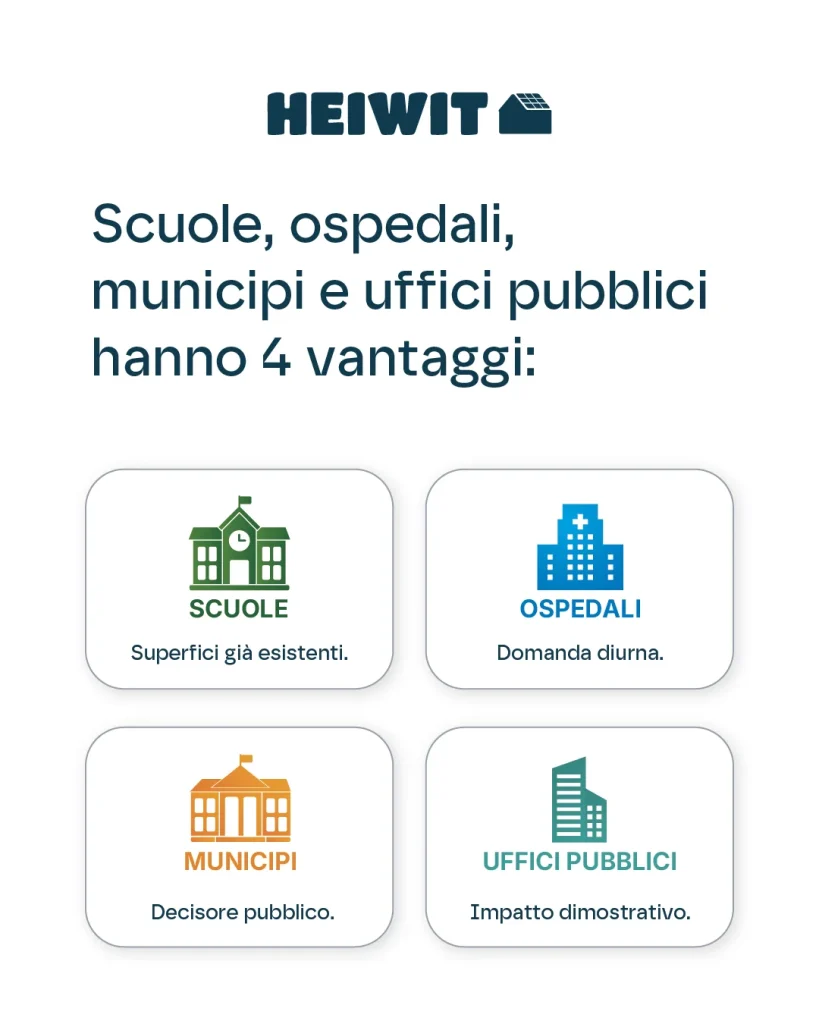
The roofs of schools, hospitals and offices are existing surfaces. This reduces conflict with land consumption, but does not eliminate constraints. Each project requires at least a structural assessment, legal availability of the roof, permits, landscape and cultural compatibility, fire prevention, maintenance accessibility and grid connection capacity.
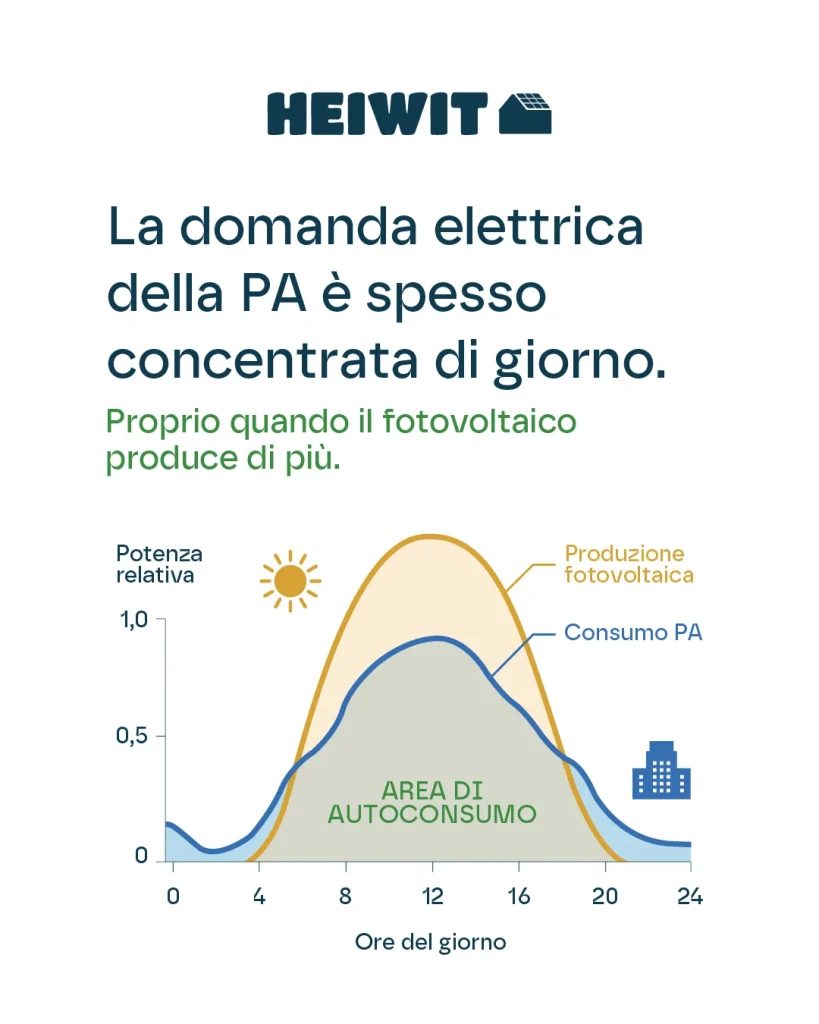
The second reason is the consumption profile. Hospitals and offices normally present loads during daytime hours; schools have a more seasonal profile and require specific analysis of the summer months. For this reason it is not correct to apply the same self-consumption percentage to every building.
A distributed power station, not a single power station
The strategic value lies not only in power. A national programme for public roofs would be distributed, visible and repeatable. It could aggregate homogeneous buildings, standardise specifications, reduce design costs and activate ESCo models or partnerships. The flip side of the coin is fragmented governance between the state, regions, municipalities, health authorities and other bodies.
How much of it would actually be installable?
The model provides a theoretical technical potential. Applying a forward-looking scenario of 60–80%, the capacity would be 3.41–4.54 GW, equivalent to 8.08–10.77% of the PNIEC gap. This scenario does not derive directly from the stated GSE validation and should not be presented as an observed rate. Instead, a building-by-building filter is required.
The correct conclusion
Public roofs are not a shortcut and do not replace utility-scale, industrial self-consumption or residential solar PV. However, they are a pre-existing infrastructure that deserves a verifiable technical inventory and a dedicated national strategy.
 Italian
  English
  German
  French
  Spanish
  Polish
  Dutch
Dutch  Romanian
  Hungarian
  Czech
Czech  Swedish
  Portuguese
  Greek
Greek