

NFPP sodium-ion cells at low temperatures: 95% capacity at −20 °C in qualification tests
There is a flaw in domestic batteries that the catalogues rarely mention: their performance drops in cold weather. This is no minor detail, because the time when their performance drops is precisely when they are needed most. In January, solar panels produce only a fraction of...Sodium-ion cell safety: what the evidence really says
“Is it safe?” is the first question people ask us, and they’re quite right to do so. A battery isn’t a fuel tank: it’s an electrochemical system that stores energy in chemical form and which, when pushed beyond its limits, can release all that energy at once. The answer...
Can the public administration become self-sufficient? Energy, self-consumption and emissions
Producing in a year an amount of energy similar to the annual consumption of a perimeter does not mean making it self-sufficient. To transform the potential of public roofs into truly used energy, hourly profiles, the grid, contracts, storage and rules of...
From potential to operational plan: how to solarise public buildings
The decisive step is not estimating how many panels can fit on roofs, but transforming thousands of surfaces into an orderly pipeline of financeable, permittable and constructible projects. 2027 EPBD threshold for public buildings >2,000 m² 2028 threshold >750 m² 2030 threshold >250...
5.68 GW and 7.53 TWh on public administration roofs: results and significance
The Heiwit model yields 5.68 GWp of theoretical capacity and 7.53 TWh of annual generation. These are large-scale results, but they have not yet been independently replicated. This page presents them with correct equivalences and necessary caveats. 5.68 GWptheoretical power...
How much does it cost to solarise public roofs? CAPEX, LCOE and economic variables
The preliminary economic model states approximately €6.8 billion of investment. The figure is interesting, but it must not be turned into a promise of return until cash flows, price sources and sensitivity analyses are published. €6.8 bn aggregated CAPEX...
Solar PV on public roofs: how much can it contribute to the 2030 NECP?
Italy must rapidly increase photovoltaic capacity by 2030. The roofs of public buildings do not solve the problem on their own, but they can represent a significant share without occupying new land. 79.2 GW NECP 2030 photovoltaic target 37,002...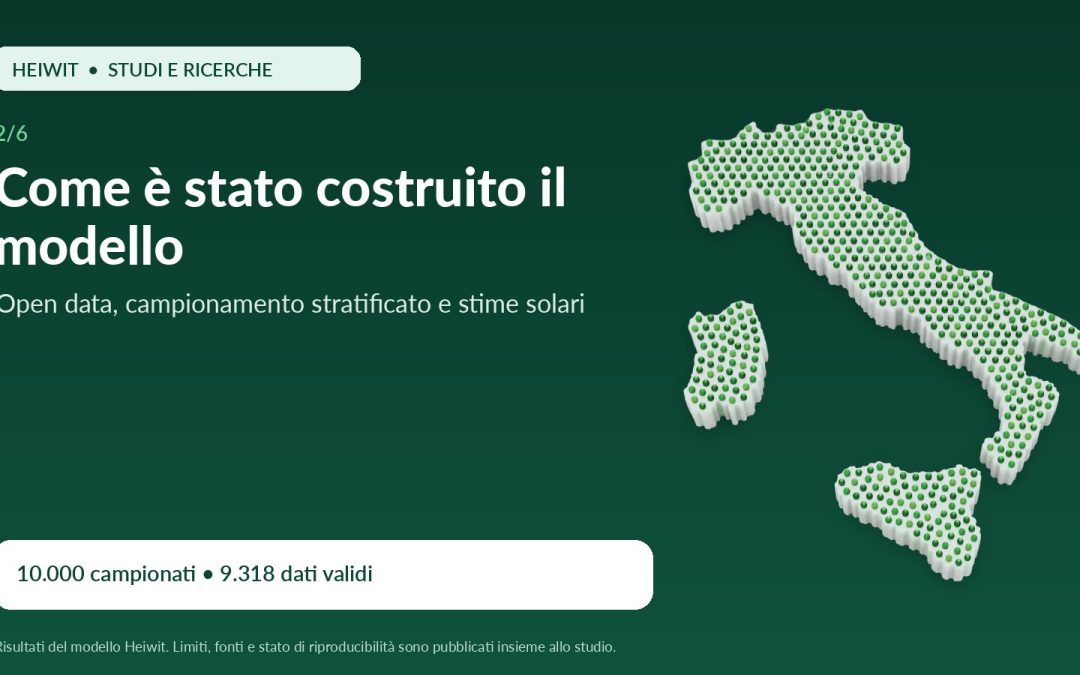
How we estimated the photovoltaic potential of 41,254 public administration structures
A credible national estimate cannot be born from an average surface area multiplied by the number of properties. The Heiwit model uses a geolocated frame, a stratified sample and solar estimates referred to individual elements. Precisely for this reason the steps not yet...
 Italian
  English
  German
  French
  Spanish
  Polish
  Dutch
Dutch  Romanian
  Hungarian
  Czech
Czech  Swedish
  Portuguese
  Greek
Greek