

Why Heiwit
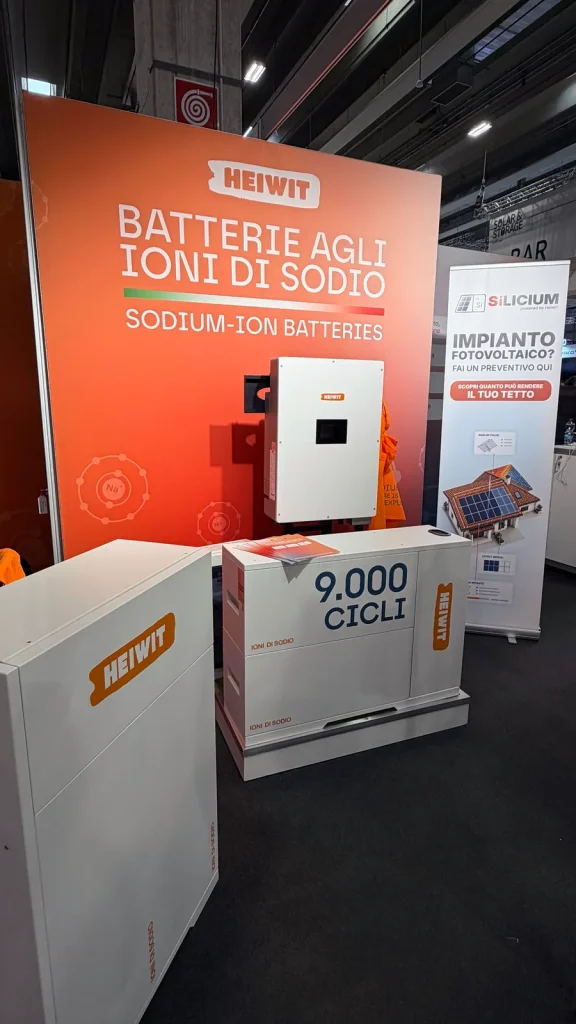
Why choose Heiwit Sodium storage that works every day: 9,000 cycles at 95% DoD, with 70% residual capacity.
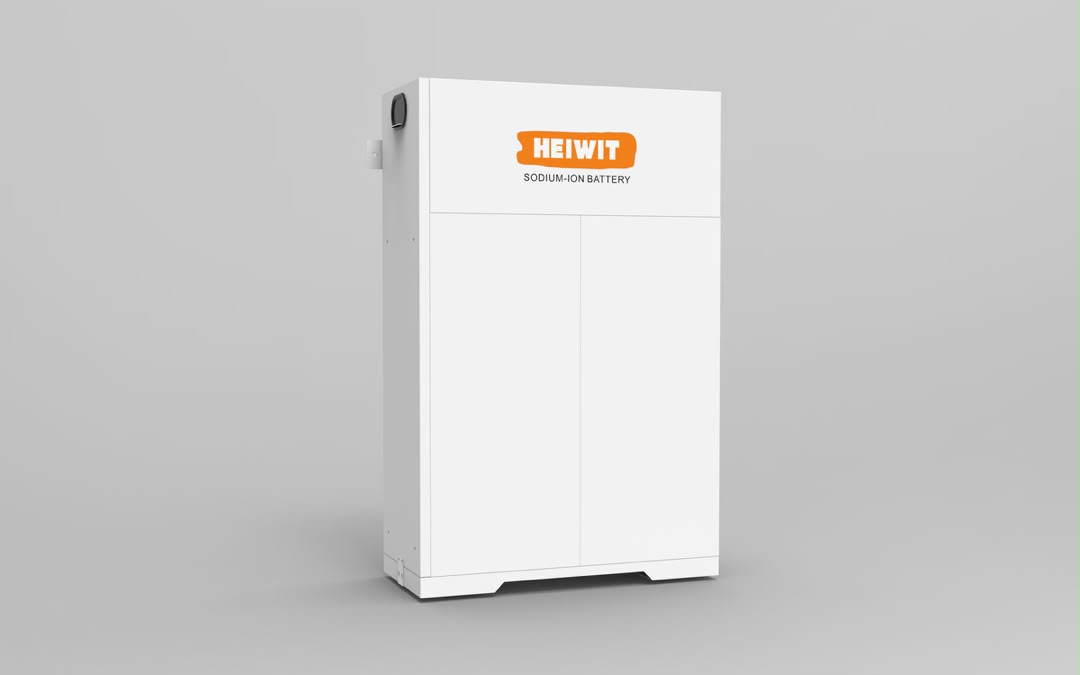
The new Heiwit NA-48V170Ah battery uses sodium-ion cells with NFPP polyanionic chemistry. No lithium, cobalt or nickel. Designed and monitored in Italy, with the AI-Care platform included. On sale from early 2027.
- NFPP polyanionic cells
- 9,000 cycles at 95% DoD, 70% residual
- Up to 6 batteries in parallel
- 10-year warranty
The numbers that matter
Six figures, each with its test condition
- 9.000cyclesExpected cycle life at 95% DoD with 70% residual capacity, from the qualification tests of the NFPP cells.
- 97%efficiencyRound-trip efficiency of the cells at a 0.25P rate.
- 95%of capacity at −20 °CRemaining capacity measured at −20 °C in qualification tests, against 67.8% for a reference LFP cell.
- −25 / +60 °Cin dischargeBattery operating range in discharge; in charge from 0 to +60 °C.
- 10 yearswarrantyItalian warranty on battery and inverter, under the terms of sale.
- 92%of usable solar energy usedAverage of the Heiwit systems monitored by AI-Care, measured data up to 27 September 2026.
Chemistry
Six reasons that start inside the cell
NFPP polyanionic cells (sodium iron phosphate-pyrophosphate) are the second generation of Heiwit cells. Below are the figures that set them apart, with the conditions under which they were measured.
Cycle life
9,000 cycles at 95% DoD with 70% residual capacity. At one cycle per day that is about 24.7 arithmetical years. It is a calculation, not a forecast: actual life depends on temperature, average state of charge and depth of discharge.
What 9,000 cycles at 95% DoD with 70% residual capacity meanProven safety
Six tests passed on the NFPP cells: nail penetration, overcharge, external short circuit, crush, thermal control and oven test. In the nail test: CID opening, smoke, no fire and no explosion. No battery is zero-risk: safety depends on cells, BMS and proper installation.
The evidence, one by oneNo lithium, cobalt or nickel
The cathode is based on sodium and iron, the anode on hard carbon. No dependence on critical materials. The cells hold IEC 62619, UL 9540A and UN 38.3 certifications. At end of life the battery is dismantled and the materials sent for recovery.
NFPP chemistry explainedWorks in the cold
In qualification tests the cells retain 95.04% of their capacity at −20 °C and over 85% at −40 °C. The reference LFP cell, under the same conditions, stops at 67.8% at −20 °C. Garages, cellars and attics are not a problem.
Low-temperature dataWithstands high currents
At 4C the cells deliver 98.2% of their capacity with a temperature rise of +15.5 °C. The reference LFP cell reaches 82.8% with +22.1 °C. Deep and frequent discharges are the job it was designed for.
How they handle real stressTransport and storage at 0 V
The current collectors are aluminium on both electrodes. The cell can be discharged to zero volts for safe transport and storage, without the minimum-voltage constraints of lithium cells.
Cell constructionThe system
One battery, one inverter, one platform. All designed together.
The Heiwit battery works only with Heiwit inverters: inverters from other brands do not support the voltage range of sodium cells. The advantage is a consistent system, followed by the same platform from day one.
-
1
The NA-48V170Ah battery
7.78 kWh module at 48 V, complete pack with BMS and connection cables. Available in a vertical or horizontal version, 113 kg. Up to 6 batteries in parallel on a single inverter, i.e. 46.7 kWh.
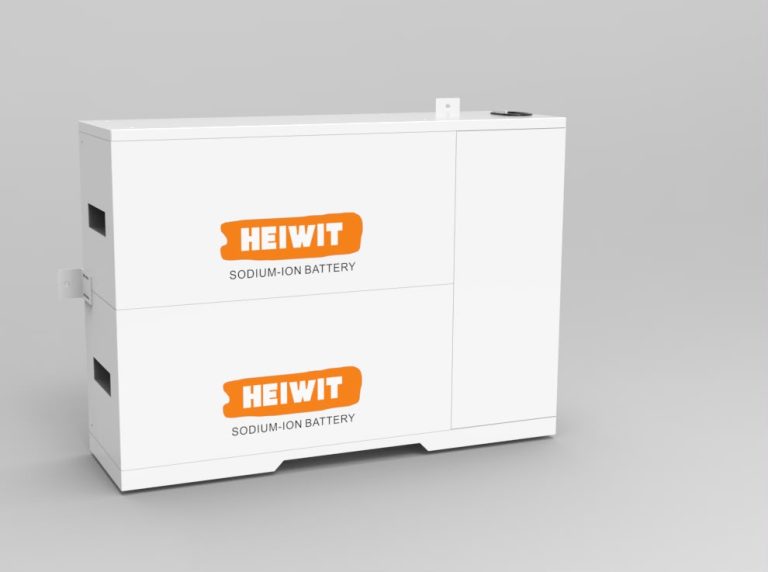
Horizontal version of the NA-48V170Ah -
2
The Virgo and Lybra hybrid inverters
Single-phase Virgo at 3, 4.6 and 6 kW: 10 ms backup switchover, IP66, natural cooling below 25 dB, 97.3% European efficiency. Three-phase Lybra at 6, 10 and 12 kW: 18 kW of PV on 3 MPPTs, IP65, backup in under 10 ms.
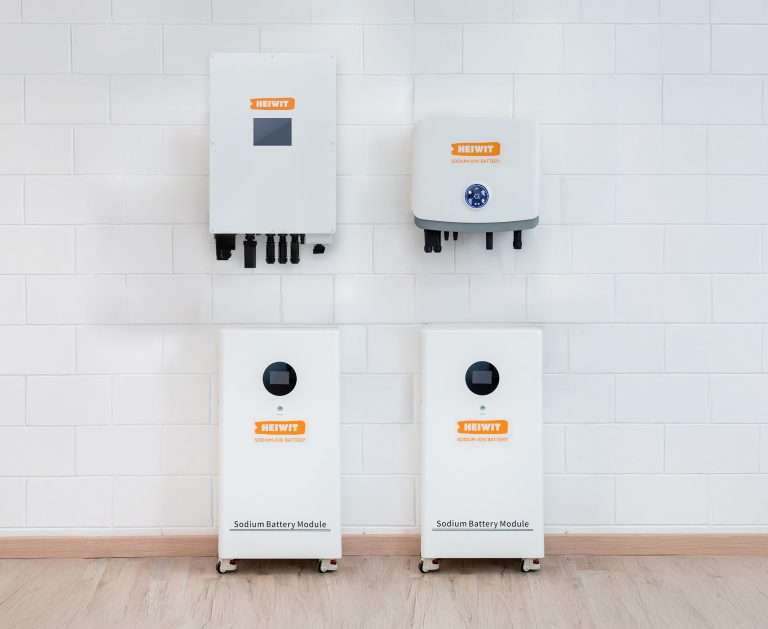
Wall-mounted Heiwit inverters with the battery modules -
3
New systems and retrofits
On an existing system the Heiwit kit connects on the AC line and the existing PV inverter stays in place. With the built-in UPS, essential loads keep running even when the grid fails.
-
4
AI-Care, included and already active
Every Heiwit system talks to the AI-Care platform, on Italian servers. There is nothing to activate: monitoring, diagnostics and autopilot start at commissioning. Your data stays yours and can be exported.
AI-Care
The battery is looked after every day. By an artificial intelligence and by people.
AI-Care reads the inverter data, plans the energy, checks the health of battery and panels and answers questions. What you see below is an example with demonstration data.
Autopilot
Tomorrow's plan, calculated at 19:15 and updated every hour
Self-consumption Export in the hours with the highest price
Battery
- SoH from the BMS
- 99%
- Cycles
- 412
- Pack temperature
- 24 °C
SoP, State of Panels
- Strings balanced
- No recurring shading
- Voltage within range
AI assistant
How much energy has the system produced this week?
In the last 7 days the system produced 142 kWh. The battery covered 38% of evening consumption. No anomalies on inverter or BMS.
And if I don't understand something?
You can pass the request to your installer or to Heiwit with one click. The conversation stays attached.
Alerts
- Yesterday 21:40Battery below 15%: tomorrow's plan prioritises self-consumption.
- Today 19:15High zonal price tomorrow from 17:00 to 20:00: export scheduled.
- Today 03:10Night-time panel check completed: nothing to report.
AI Diary
Today I prioritised self-consumption until 17:00, then exported 4.2 kWh to the grid in the three hours with the highest price. The battery reached the evening at 41%, enough for the night.
For the system owner
- Autopilot: every day at 19:15 it calculates the next day's plan from the zonal price, the PV forecast and consumption, and recalculates it every hour.
- AI log: every decision is written down and explained.
- Battery status: SoC, cycles and SoH read from the BMS, with the 180-day trend and the pack temperature in the Report.
- 48-hour state-of-charge forecast and production forecast.
- In-app alerts and periodic emails; holiday mode, also suggested automatically after three days of low consumption.
- AI assistant that answers with the real data of your system and hands the request over to a person.
- Report with an A to D score, CO₂ avoided and export to CSV or Excel. Data access via API, as required by the Data Act.
For the installer
- Fleet view with technical and commercial status, alarms from the last 7 days and an SoP column for the panels.
- Guided commissioning: initial settings, CEI 0-21 parameters, protection self-test with a report sent by email.
- Remote inverter restart, with no site visit.
- Quoting tool that reads the electricity bill, analyses the roof and produces a proposal to share with a link.
- Installer branding on app, reports and proposals.
Behind the scenes, by Heiwit
- Automatic diagnostics on 13 types of anomaly: grid voltage, battery idle or locked, BMS, cell imbalance, inverter fault.
- "Battery doctor" every two hours: it corrects the BMS parameters and restarts the inverter when needed.
- Night-time SoP scan across all monitored systems.
- Remote firmware updates, with a before-and-after comparison of the parameters.
Real data from the fleet
Systems make use of 92% of the usable solar energy
These are figures measured by the inverter meters and read every day by AI-Care on hundreds of systems with Heiwit batteries, up to 27 September 2026. They are not estimates.
Where the energy used in the home comes from
On average, 80% of consumption is covered by the system, between panels and battery. The share of solar energy used did not fall below 91% in any month, from December 2025 to September 2026.
Safety and compliance
System certifications, cell tests
The grid certifications cover the Heiwit inverter plus battery system and are issued by third-party bodies on the basis of type tests. The safety tests cover the NFPP cells.
System certifications
- CEI 0-21:2022 with V1 and V2 for the Virgo inverter plus Heiwit battery system: certification issued by TÜV SÜD on the basis of type tests, document no. D 132944 0003, October 2025. PDF
- CEI 0-21 for the Lybra inverter plus Heiwit battery system: TÜV Rheinland certificate of conformity no. A3 50741827 0001, August 2026. PDF
- VDE-AR-N 4105:2018 for the Virgo family: TÜV SÜD certificates no. ESY 132944 0008 and 0009, September 2026, for the German market. PDF
- CE marking of battery and inverter: Low Voltage Directive 2014/35/EU with EN 62109-1/-2 for the inverter and EN IEC 62040-1 for the battery; EMC Directive 2014/30/EU; report PPP 51096A:2023 on battery pack and BMS.
Tests on the NFPP cells
- Nail penetration (T/CIAPS0031-2023): charged cell at 25 °C, 5 mm steel needle left in place for one hour. CID opening and smoke, no fire, no explosion.
- Overload (GB/T 44265-2024): 1C charge up to 1.5 times the end-of-charge voltage. Swelling of the casing, no leakage, no fire.
- External short circuit, crush and thermal control (GB/T 44265-2024): passed.
- Bake test (GB/T 36276-2018): passed.
No battery is zero-risk. System safety depends on cells, BMS and proper installation. The tests in detail
The real cost
What matters is how much energy it returns over its whole life, not just the price
The cost of a battery is measured per kWh it returns: that is the LCOS. For the same nominal capacity, a battery with NFPP cells returns 62% more energy than a lithium LFP battery with typical values. To reach the same cost per kWh, the lithium battery would have to cost 38% less.
kWh returned over the whole life, per 10 kWh nominal
Parameters: NFPP 9,000 cycles, 95% DoD, 97% efficiency, end of life at 70%; typical LFP 6,000 cycles, 90% DoD, 95% efficiency; typical NMC 4,000 cycles, 90% DoD, 93% efficiency. Linear degradation. The calculation method
The company
An Italian system integrator, with sodium as its fundamental choice
Heiwit S.p.A. was founded in Varese in October 2023. It is an innovative start-up and a member of Confindustria Varese and Italia Solare. We develop and commission our systems in Italy; we buy the cells from qualified suppliers and design the battery, electronics and software around them.
Heiwit S.p.A. is founded in Varese.
The first Heiwit sodium-ion battery goes into operation on a photovoltaic system.
CEI 0-21 certification by TÜV SÜD for the Virgo plus battery system.
Heiwit speaks at the European Economic and Social Committee on the future of batteries in Europe.
CEI 0-21 certification by TÜV Rheinland for the Lybra plus battery system.
VDE-AR-N 4105 certificates for the Virgo family.
In Verona, the prototypes of the battery with NFPP cells and the real data from the fleet.
The NA-48V170Ah with NFPP polyanionic cells goes on sale.
The network
Only through Heiwit installers
Heiwit does not sell to private customers: every system is sold, installed and looked after by an installer in the Heiwit network. Joining the network takes a free course of about two hours, with a certificate. Requests that come in through the website are passed on to installers in the area.
The warranty
10 years, on battery and inverter
The Heiwit warranty covers battery and inverter for 10 years. The full terms are in your installer's sales contract. Those who buy today receive the current layered-oxide battery, with a declared cycle life of 6,500 cycles: the NFPP version arrives from early 2027.
FAQ
Frequently asked questions
Sales start in early 2027, through the Heiwit installer network. The systems available today use layered-oxide cells with a declared cycle life of 6,500 cycles: if you are considering a purchase now, that is the figure that applies to you.
No. 9,000 cycles at 95% DoD with 70% residual capacity, at one cycle per day, are about 24.7 arithmetical years, but that is a calculation, not a forecast of calendar life. Actual life depends on temperature, average state of charge and real depth of discharge. The warranty is not expressed in cycles.
In the home, in a garage, a cellar or an attic. The battery discharges from −25 to +60 °C and charges from 0 to +60 °C, with no air conditioning needed. Outdoors it must be protected in an IP65 cabinet, in the shade and ventilated.
Up to 6 NA-48V170Ah batteries in parallel, i.e. 46.7 kWh, on a single Heiwit inverter. The module comes in a vertical and a horizontal version, each 7.78 kWh and 113 kg.
AI-Care is included and already active on every Heiwit system. Every day it plans how energy is used, monitors battery and panels, keeps a log of its decisions, sends alerts and answers questions through an AI assistant. Your data stays yours and can also be exported via API.
It is the panel health index calculated by AI-Care: it compares the yield of the PV array with its reference at equal sunlight and temperature, using the inverter string data. It runs three checks every night, on string balance, shading and voltage. You find it in the Report.
The CEI 0-21 and VDE-AR-N 4105 certifications cover the Heiwit inverter plus Heiwit battery system and were issued by TÜV SÜD and TÜV Rheinland on the basis of type tests. The IEC 62619, UL 9540A and UN 38.3 safety tests cover the NFPP cells.
The Heiwit warranty covers battery and inverter for 10 years. It is not expressed in a number of cycles. The full terms are in your installer's sales contract.
Want a quote for the new battery?
Leave your contact details: the request goes to a Heiwit installer in your area, who will get back to you with a proposal for your system.
Request information Find an installer
Data updated on 11 October 2026. The sources are the Heiwit datasheets, certificates and articles linked in the text.
 Italian
  English
  German
  French
  Spanish
  Polish
  Dutch
Dutch  Romanian
  Hungarian
  Czech
Czech  Swedish
  Portuguese
  Greek
Greek