

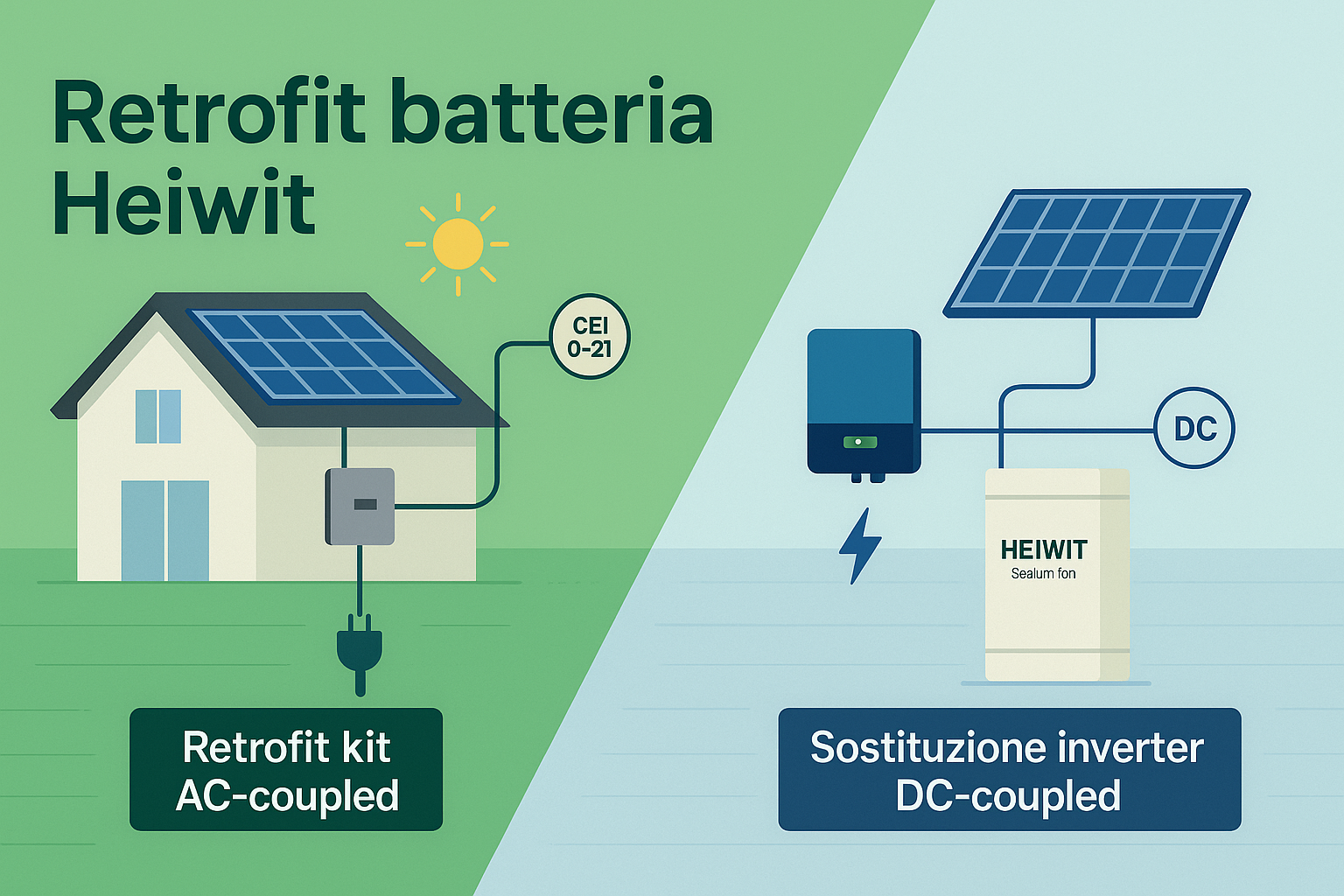
The batteries that can be used in a retrofit are those from the range of sodium-ion batteries.
Heiwit battery in retrofit on existing photovoltaic systems: when the kit pays off and when to replace the inverter
Integrating a Heiwit sodium ion battery in your existing solar PV system is possible and often cost-effective. The Heiwit battery works only with a Heiwit inverter: it cannot be connected to inverters from other brands, which do not support the voltage range of sodium batteries. In a retrofit, the Heiwit hybrid inverter with the battery is connected on the AC line. This is the single-phase Virgo or the three-phase Lybra, depending on the system. The existing PV inverter stays in place.
There are two ways:
- Retrofit with Heiwit inverter-battery kit: you keep your current PV inverter, and we add our hybrid inverter and the battery, connected on the AC line.
- Complete replacement of the PV inverter with our hybrid inverterpanels and battery are connected directly to the new inverter.
Normative note: In both cases, integration takes place with a Heiwit inverter compliant with CEI 0-21. The installer will check the documentation and compliance during the inspection.
Why choose the Heiwit storage retrofit?
- Security: stable sodium-ion chemistry, without cobalt or lithium.
- Duration: high life cycle and optimised thermal management.
- Flexibility: choice between retrofit AC-coupled (kit) or replacement with hybrid DC-coupled.
- Scalability: modules that can be expanded over time.
- Assistance: partner installer network and technical support.
Option 1 — Retrofit storage kit without changing the inverter: keep your existing photovoltaic inverter
When it makes sense
- The plant is recent or in good condition (approximately 0-5 years).
- You want an installation quick and with minimal changes to the existing installation.
- Wishes backup and intelligent load management without intervening on the panel strings.
How it works (AC-coupled)
Our hybrid inverter connects on the AC line, downstream of the existing PV inverter. The battery charges and discharges on the AC side, synchronising with production and with household or business consumption.
Pro
- Intervention unobtrusive, without rewiring the cables on the panel side.
- Short deadlines of installation.
- The existing PV inverter stays in place: the battery connects only to the Heiwit inverter in the kit.
Against
- Slightly lower efficiency than DC-coupled (double conversion).
- Some advanced DC-side functions are not available.
Option 2 — Replacing the existing inverter with a Heiwit hybrid inverter
When it makes sense
- The plant is older (more than 5-7 years) or the inverter shows limits.
- You want maximum efficiency and PV+battery boost integration.
- Are you interested in a robust backup and finer management of energy flows.
How it works (DC-coupled)
PV panels connect to the’Heiwit hybrid inverter. The battery is on the DC bus of the inverter: you reduce the conversions and increase the’efficiency, especially in charging/discharging.
Pro
- Superior efficiency and optimised energy management.
- Backup higher performance, with more power on critical loads.
- Inverter new and performing, with years of life ahead of it.
Against
- Intervention longer for the installer DC side.
Costs: why they are similar on the two roads
In both cases, a Heiwit inverter compliant with CEI 0-21 to properly integrate the battery and grid connection. The economic differences depend mainly on the installation time and certain boundary materials. Consequently, the final cost tends to be comparableThe choice should be made primarily on the basis of plant status and functional requirements.
Rule of thumb: recent and healthy inverter → retrofit kit. Outdated or limiting inverter → replacement with hybrid.
How the installer decides (on-site assessment)
- Age and status of the inverter existing (logs, errors, wear, temperatures).
- Plant topologysingle/three-phase, power, critical load diagram.
- Space and ventilation for battery and inverter.
- Panels and protections: residual current devices, circuit breakers, SPDs, disconnections.
- Usage targetsself-consumption, backup, peak shaving, time slots.
- Documentation and compliance with IEC 0-21.
Simple dimensioning (indicative example)
- Household 4,000-6,000 kWh/year: battery 10 kWh is often a good starting point.
- PV 4-6 kWwith 10 kWh cover evening/night; with heavy evening loads currency 20 kWh.
- Business Applicationspossible larger sizes and functions such as peak shaving.
Chemistry sodium-ion is ideal for deep and repeated cycles, with high thermal stability: excellent for those who want to daily self-consumption carefree.
Quick comparison table
| Feature | Retrofit kit (AC-coupled) | Replacement with hybrid (DC-coupled) |
|---|---|---|
| Plant modifications | Minimum, AC side | Major, DC side |
| Charge/discharge efficiency | Good | Very high |
| Installation time | Brief | Medium |
| Backup | Good | More robust |
| Total cost | ~ Similar | ~ Similar |
| When to choose | Recent and healthy inverter | Inverter dated/limited |
Frequently asked questions
Is it compatible with three-phase systems?
Yes. The kit uses the Virgo inverter on single-phase systems and the Lybra on three-phase ones. The installer will select the correct model.
Need to update the file with the distributor?
The installer will manage the necessary paperwork based on the state of the system and the CEI 0-21.
Can I have the essential loads backed up?
Yes. You define the critical loads on a dedicated line (fridge, lights, router, pumps, etc.).
How long does the installation take?
Indicatively 1 day for retrofit and 1-2 days for replacement, subject to complexity.
What the Heiwit kit includes
- Heiwit sodium ion battery (modular, expandable).
- Heiwit hybrid inverter: the single-phase Virgo or the three-phase Lybra, depending on the system. It is connected on the AC line and complies with CEI 0-21.
- Panels and protections dedicated, wiring, mounting accessories.
- Monitoring for production, consumption and battery status.
Next steps
- Request an inspectionThe installer will assess the system and requirements and propose the best solution.
- Choose size and mode (retrofit or replacement).
- Installation and Testing, certification and access to the app.
Book the Heiwit battery now: https://www.heiwit.com/prenota-la-batteria-agli-ioni-di-sodio-heiwit/
If you are a installer/planner/distributor: https://www.heiwit.com/unisciti-alla-rete-di-installatori-partner-heiwit/
In summary
- Recent installation? Go to retrofit kitfast, effective and minimally invasive.
- Old inverter? Better replacemore efficiency, performance and life.
- Costs: tended to similar. The choice is technical: your Heiwit installer will guide you.
“`
In the case of a retrofit, the tax relief also applies to any additional storage capacity installed later, but there is one important exception if the system benefits from incentive tariffs: we explain this on the page about incentives for energy storage.
 Italian
  English
  German
  French
  Spanish
  Polish
  Dutch
Dutch  Romanian
  Hungarian
  Czech
Czech  Swedish
  Portuguese
  Greek
Greek