

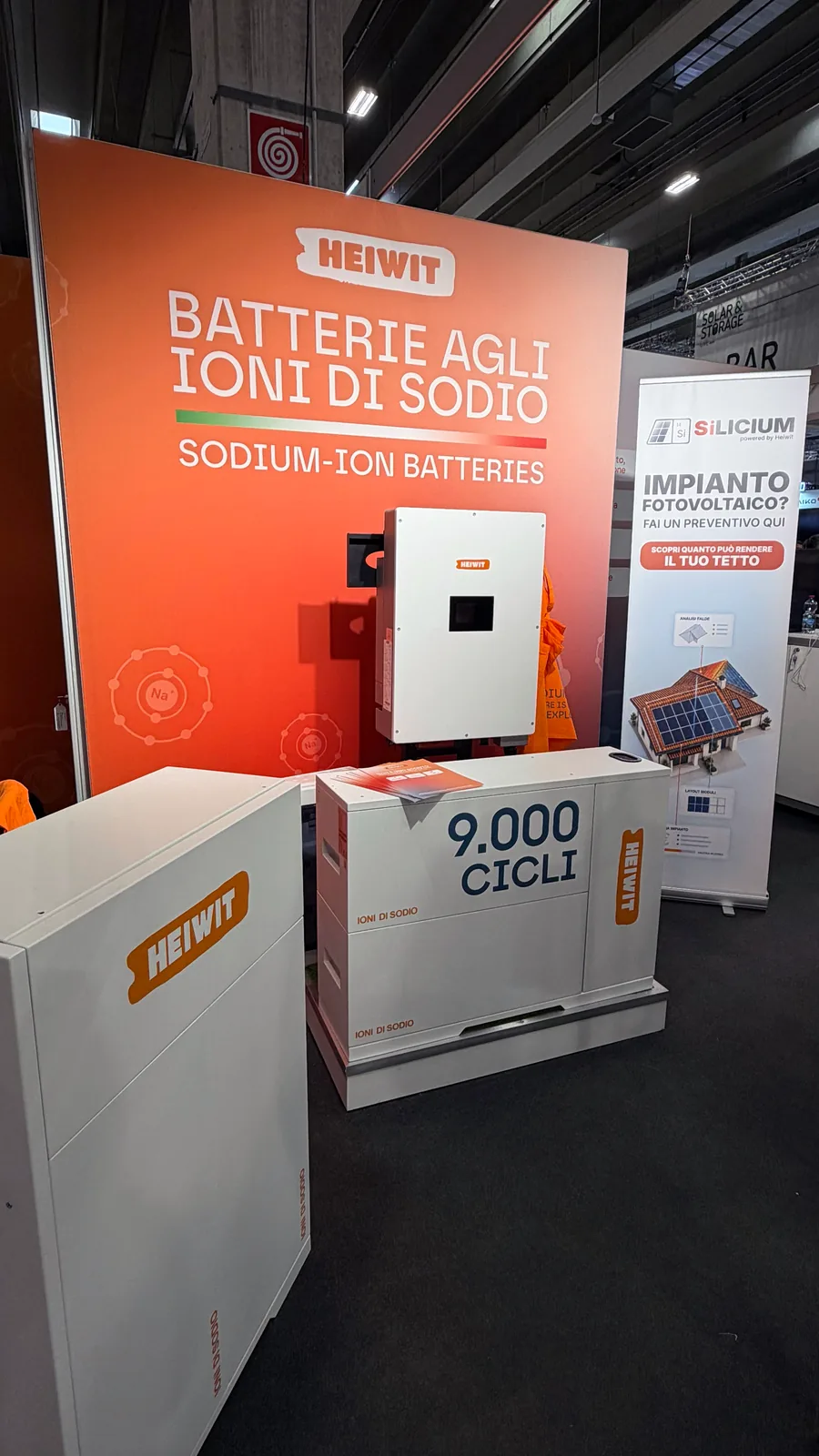
pv magazine Italia, 9 October 2026. Sergio Matalucci interviewed the CEO of Heiwit S.p.A. at the Solar & Storage Live Italia stand in Verona. The article, entitled “Sodium batteries, Italy's gamble: 9,000 cycles and a 100 MWh factory in Lombardy”, traces Heiwit's decision to focus on sodium-ion and its next industrial steps.
Topics of the interview
- Second-generation cells. The new 7.78 kWh pack uses NFPP polyanionic cells with a declared 9,000 cycles at 95% DoD, compared with the 3,000-6,000 typical of lithium iron phosphate. The first production batch is expected in stock in December 2026. The right comparison with lithium, Heiwit explains, is the cost per kWh delivered over the entire service life, not energy density, where lithium remains superior.
- Safety and raw materials. Sodium reduces the probability and severity of a thermal event and does not depend on lithium, cobalt or nickel. “The advantage concerns the probability and severity of an event; it does not provide immunity.”
- The factory. Construction of a 2,500 m² plant in the province of Varese is planned for January 2027, with a capacity of around 12,000 packs a year, equivalent to around 100 MWh. Made-in-Italy assembly is expected by June 2028, with the aim of bringing it forward to the end of 2027. The cells will still be imported: “For us the cell is a commodity: today there is no European production of sodium cells.”
- The stated limitations. For the same energy, a sodium battery weighs more than a lithium one, a constraint for BESS containers subject to mass limits in transport; and the European sodium supply chain does not yet exist.
The statements on performance and advantages are the company's own; the pv magazine editorial team points this out in the article. Anyone wishing to check the field data will find the updated figures, with dates, in the article on results in the field and in the NFPP cell datasheet.
 Italian
  English
  German
  French
  Spanish
  Polish
  Dutch
Dutch  Romanian
  Hungarian
  Czech
Czech  Swedish
  Portuguese
  Greek
Greek