

Sodium ion storage batteries
Heiwit sodium-ion storage batteries are 10 kWh, 48 V modules. The cells contain neither lithium nor cobalt. They pair with Heiwit hybrid inverters: Virgo single-phase from 3 to 6 kW and Lybra three-phase from 6 to 12 kW, with up to 3 modules in parallel for 30 kWh. The battery discharges from −25 °C to +60 °C and charges from 0 °C to +60 °C. Self-discharge is 0.35% per month, measured on several batteries, at room temperature, at the latitude of Milan. The warranty is 10 years. The trade-off is energy density, which is lower than that of lithium: this is why Heiwit offers these batteries for stationary storage. They can be purchased only through the Heiwit installer network.
The technical terms on this page (NFPP, BMS, DoD, cycle life, MPPT…) are explained in the Glossary of sodium-ion batteries.
On the tax front, we have summarised what is actually due in 2026, distinguishing between individuals and businesses, and also setting out which measures have been finalised or do not cover the full range: incentives for energy storage systems.
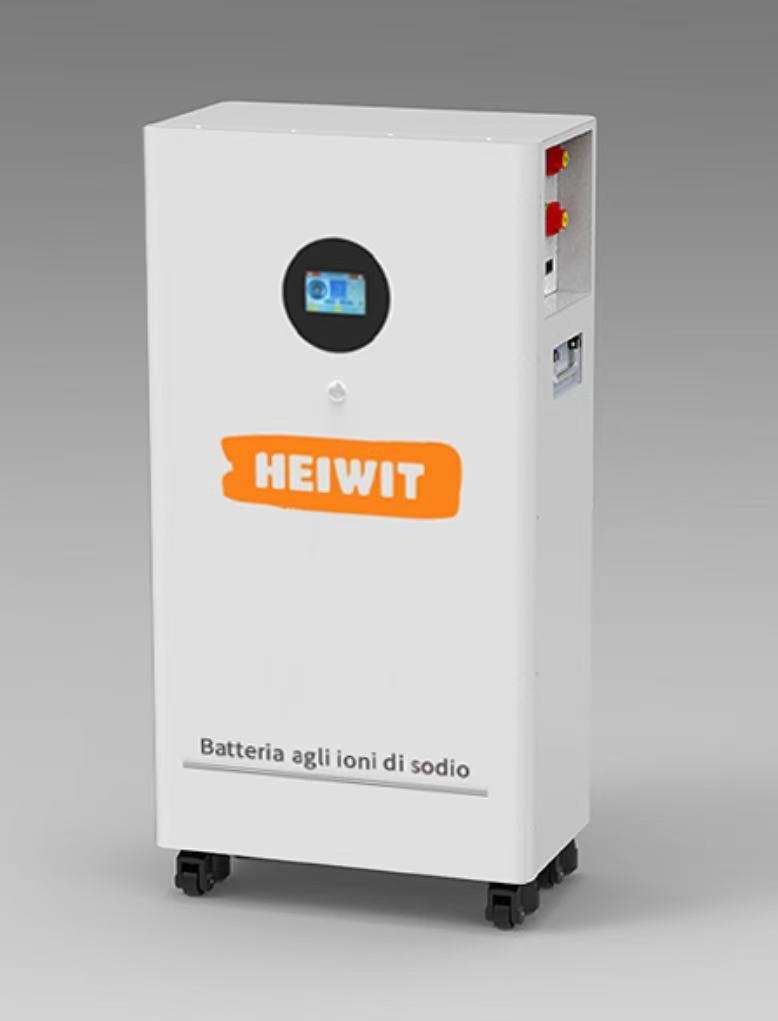
Batteries at sodium ions represent an emerging technology in the field of energy storage, designed to offer a sustainable alternative to traditional lithium-ion batteries. As the name suggests, these batteries use sodium, an abundant and readily available element, instead of lithium, which is rarer and more expensive.
One of the key innovations of HEIWIT is the use of sodium-ion batteries, available in modular 10 kWh units, offering a storage capacity that can be scaled to suit the system’s requirements. These batteries offer a number of environmental and operational benefits compared with their lithium counterparts.
Benefits for the Environment
- Fairly AvailableSodium is one of the most abundant elements on Earth, unlike lithium, which is limited and often mined in ways that cause significant environmental damage. The extraction of sodium has a much smaller environmental impact than that of lithium.
- Sustainability: Sodium-ion batteries do not require cobalt, a metal often associated with unethical and environmentally damaging mining practices. This makes HEIWIT batteries more environmentally friendly and socially responsible.
- Recyclability: Sodium-ion batteries are designed to facilitate the recovery and recycling of materials at the end of their life, further reducing their environmental impact.
- Security: Sodium-ion batteries have good thermal stability: they are less prone to overheating and catching fire, reducing the risks associated with their use and disposal.
HEIWIT innovation
HEIWIT offers energy storage solutions that harness the benefits of sodium-ion batteries, providing modular capacities starting from 10 kWh, which can be scaled to match the system’s power output. These solutions are ideal for industrial, commercial and residential applications, enabling more sustainable and cost-effective energy management. With HEIWIT, we are driving an energy revolution that not only improves efficiency but also respects our planet, ensuring a greener and more secure energy future.
Discover the benefits of Heiwit sodium ion batteries
Sodium ion batteries represent one of the most promising innovations in the energy storage sector, distinguished by a unique combination of sustainability, safety and longevity. In this article, we explore the main features of Heiwit sodium ion batteries and the benefits that make them an outstanding choice for those seeking a reliable and environmentally friendly storage solution.
Safety First
One of the most important aspects of any energy storage technology is safety. Some lithium batteries can go into thermal runaway if they overheat. The risk is higher with nickel-rich cathodes. Sodium-ion batteries have good thermal stability. This stability depends on the chemistry of the cathode and electrolyte, not on sodium itself: as a metal, sodium is more reactive than lithium. In the event of high temperatures or accidents, sodium-ion batteries are designed to maintain thermal control, considerably reducing safety-related risks.
Heiwit sodium ion batteries are therefore ideal for domestic and commercial applications where safety is a priority. With an internal design that minimises the possibility of short circuits and an advanced battery management system (BMS), these batteries are perfect for those who want a storage system they can rely on even in the event of unexpected conditions.
Recyclability for a Sustainable Future
Heiwit sodium-ion batteries are designed to facilitate the recovery and recycling of materials at the end of their life. The growing attention paid to the environmental impact of technological materials has highlighted the importance of choosing storage solutions that do not produce waste that is difficult to dispose of. The cells contain neither lithium nor cobalt. At the end of its life, the battery is dismantled and the materials are sent for recovery.
This ecological advantage is particularly important in the context of batteries, where material disposal is a significant challenge. Unlike lithium, which requires more complex and often polluting extraction and disposal processes, sodium is an abundant and easily recyclable element. Heiwit's sodium ion batteries are therefore a conscious choice for those who wish to reduce the environmental impact of their energy consumption, contributing to a more circular and sustainable economy.
Durability and Longevity: Over 6500 Cycles
When investing in an energy storage system, it is essential to consider the product's lifespan. Heiwit sodium-ion batteries excel in this respect too. The 2025-2026 version, with layered oxide cells, is estimated to deliver over 6,500 charge and discharge cycles. In the 6,500-cycle test, the remaining capacity stayed above 70%.
This extraordinary durability translates into significant savings: a battery that lasts longer means fewer replacements and an investment that pays for itself more quickly. For companies in particular, this can be a considerable economic advantage, as it reduces the operating costs associated with battery maintenance and replacement. For residential customers, too, the longevity of Heiwit batteries translates into greater reliability and the peace of mind of knowing that their storage system will be functional for many years.
Cost: how to compare it with lithium
Sodium is far more abundant than lithium and costs less as a raw material. That alone is not enough to say that a sodium battery costs less than a lithium one. The price also depends on the cells, the electronics, production volumes and installation. To compare two storage systems, what matters is the cost per kWh cycled: the price divided by the energy the battery handles over its entire life. The recommended retail price of the 10 kWh Heiwit battery is €4,900 VAT included. The quotation is prepared by the installer.
Unlike other batteries that require rare or expensive materials, sodium-ion batteries make use of a widely available resource. The trade-off is a lower energy density. A long life lowers the cost per kWh cycled. That is why lifespan matters too, not just the list price.
Remote Monitoring with the Heiwit Advanced App
An added benefit of Heiwit's sodium-ion batteries is the ability to monitor battery performance in real time via a dedicated app. This feature gives users complete control over their storage system, allowing them to view data such as charge status, efficiency and overall battery performance directly from their smartphone or tablet.
Remote monitoring optimises battery use, reducing energy waste and maximising efficiency. For businesses, this function is a huge advantage in terms of energy management, as it allows them to monitor consumption and intervene promptly if necessary. For residential customers, Heiwit's monitoring app also offers the convenience of having all energy information at their fingertips, helping them to use energy more consciously and efficiently.
How Do Sodium Ion Batteries Work?
Technically, sodium-ion batteries work in a similar way to lithium batteries, but they exploit the reaction of sodium ions rather than lithium ions. During charging, the sodium ions move from the cathode to the anode, storing energy. During discharge, the process is reversed, releasing the stored energy.
This innovative technology offers high efficiency and a gradual degradation of performance over time. The sodium cells used by Heiwit have good thermal stability and contain no critical materials such as cobalt, further reducing the environmental impact of production.
Versatility of Application of Heiwit Batteries
Heiwit sodium-ion batteries are incredibly versatile and can be used in a wide range of applications, both residential and commercial. They are ideal for integration with photovoltaic systems, allowing energy produced during the day to be stored and then used during the evening or night. In addition, Heiwit batteries are perfect for backup systems, ensuring continuity of power supply even in the event of blackouts or grid interruptions.
Industrial applications are equally beneficial: thanks to their ability to support high storage volumes and durability, Heiwit batteries offer a significant advantage in terms of energy savings and resource optimisation. Companies adopting these batteries not only benefit from reduced energy costs, but can also improve their environmental image by adopting sustainable technology.
Conclusions: Why Choose Heiwit Salt Batteries?
In summary, Heiwit sodium-ion batteries represent a modern, safe and environmentally friendly energy storage solution, ideal for anyone looking for a reliable, long-term system. Thanks to their thermal stability, a lifespan of over 6,500 cycles and the convenience of remote monitoring, these batteries are one of the most promising options on the energy storage market.
Whether you are a business or a residential customer, choosing a salt battery Heiwit means opting for a sustainable, state-of-the-art energy solution that meets the challenges of the energy future.
Sodium-ion technology, in detail
Sodium-ion batteries are not a universal substitute for lithium, and portraying them as such would be incorrect. They are a chemistry with a different set of trade-offs, which in some applications matter more than in others: in stationary energy storage paired with photovoltaics — where the system stays put wherever it is installed and has to operate for twenty years in an unheated room — that profile is particularly favourable.
The sections that follow explain why, with data and references to technical details.
How a sodium-ion battery works
The principle is the same as a lithium battery. There are two electrodes — a cathode, the positive electrode, and a anode, the negative — separated by a electrolyte which allows the passage of ions but not electrons.
When charging, the sodium ions leave the cathode, pass through the electrolyte and insert themselves into the anode, while the electrons travel through the external circuit. When discharging, the path is reversed, and that flow of electrons is the energy that powers the home. Sodium replaces lithium in the role of charge carrier: it is larger and heavier, which costs energy density, but it is everywhere — in the oceans, in minerals, in common salt.
A technical consequence of this substitution deserves a note: in the sodium cells both current collectors can be made of aluminium, whereas lithium requires copper at the anode. This is what allows the cell to be discharged down to zero volts for safe storage and transport.
The full explanation, including the chemistry of the electrodes and the role of BMS, can be found in the technical guide to sodium-ion batteries.
The main sodium-ion chemistries
Under the name “sodium-ion battery” coexist cathode families with very different behaviours. The two that matter for stationary storage are:
- Layered oxides (N/AxTMO2: the ions move between stacked oxide planes. An efficient structure in terms of stored energy per unit mass, but the planes expand and contract with each cycle.
- Polyanions, including the’NFPP (sodium iron phosphate-pyrophosphate): the sodium moves within a rigid three-dimensional lattice, held together by phosphate groups bonded to iron. Less energy per kilogram, much greater stability over time and at extreme temperatures.
The second generation of HEIWIT systems uses polyanionic cells. A full comparison of the two product families, including qualification data, can be found in the in-depth article on polyanionic NFPP cells.
Sodium-ion and lithium iron phosphate compared
Lithium iron phosphate (LFP) is now the benchmark chemistry in residential storage, and it is the correct comparison—not NMC, which serves different markets. The honest comparison is this:
| Parameter | LFP | Sodium-ion |
|---|---|---|
| Energy density | higher, typically 120–180 Wh/kg | lower, typically 100–160 Wh/kg depending on the chemistry |
| Cycle life | elevated | high; the value depends on the cell chemistry and must be read with its test conditions |
| Low temperature | marked capacity drop below zero | low content, particularly in polyanionic chemistries |
| Thermal stability | good, the best among lithium chemistries | good, with further scope for polyanionic chemistries |
| Raw materials | lithium, iron, phosphorus | sodium, ironno lithium, no cobalt |
| Deep discharge and storage | it doesn't tolerate zero volts (copper collector) | tolerance of zero volts aluminium manifolds |
| Ideal applications | light mobility, storage where volume is constrained | stationary accumulation, harsh climates, long periods of service |
The ranges given are typical for the market and do not refer to a single cell. Within each chemical family, there are significant differences between products: specific data, together with the relevant test conditions, are set out on the dedicated information pages.
Why it is interesting in steady-state accumulation
Energy density is the most frequently cited parameter when comparing batteries, and for a specific reason: batteries have been developed primarily for things that move. In a car, every kilogramme is mass that has to be accelerated and braked throughout the vehicle’s lifetime.
A domestic or commercial accumulation, on the other hand, It is lifted only once: on the day of installation. From that moment on, weight and volume no longer have any bearing on anything — not on performance, not on the electricity bill, not on lifespan. What does matter, however, is:
- the duration, because the cost is recouped through the energy that the system manages to transmit before the end of its life;
- the security, because the system is housed in a utility room, often inside the house;
- the thermal behaviour, because that place is cold in winter and hot in summer;
- the total cost per kWh over the cycle, which is the figure that matters and which does not correspond to the list price;
- the maintenance, that is, how many times someone has to return to the site.
The full explanation, including the calculation method, can be found in the in-depth article on Energy density versus lifespan in stationary storage.
The HEIWIT systems
The range is based on a 10 kWh, 48 V battery module, also available in a stackable version, paired with the HEIWIT hybrid inverters. Larger sizes are achieved through a modular design: up to three batteries in parallel per inverter, and multiple systems in commercial and industrial configurations.
| Product | Features |
|---|---|
| 10 kWh sodium-ion battery | basic module, 48 V, integrated BMS |
| 10 kWh stackable battery | stackable version for multiple configurations |
| VIRGO single-phase hybrid inverter | 3K-S, 4K6-S, 6K-S — up to 3 batteries in parallel |
| LYBRA three-phase hybrid inverter | 6K-T, 10K-T, 12K-T for three-phase systems |
Applications
The same module can be used in a wide variety of situations:
- Residential — pairing with a domestic solar panel system, to increase self-consumption from the levels typically associated with photovoltaic systems alone to much higher percentages.
- Revamping and retrofitting — adding storage to an existing system by connecting the Heiwit hybrid inverter on the AC line, without removing the existing inverter: this scenario is described in the article on the retrofit battery.
- Commercial and industrial — multiple configurations on three-phase circuits, where the plant room is often unheated or uncooled and performance at actual temperatures is a key factor.
- BESS — larger-scale systems for industrial applications, which we discussed when presenting the BESS 1 MWh sodium-ion battery.
Safety and qualification testing
The cells are subjected to the tests specified for stationary storage systems: nail penetration, overload, short-circuit, crushing, oven testing and thermal monitoring up to 300 °C. The full test protocols, including the acceptance criteria and the distinction between cell qualification and system qualification, can be found in the in-depth article on safety of sodium-ion cells.
Low-temperature performance
It is the difference that is easiest to verify in the field, and the one that carries the most weight during the months when photovoltaic systems produce less. In qualification tests, the polyanionic cell retains over 90% of its capacity at −20 °C, compared with significantly lower values for the reference LFP cells. The data, test protocol and electrochemical explanation can be found in the article on sodium-ion cells at low temperatures.
Frequently asked questions
How long does a sodium-ion battery last?
Service life is measured in charge and discharge cycles, and the stated number should always be considered in conjunction with the test conditions: depth of discharge, temperature and current. The values for the cells used in the HEIWIT systems, along with the respective conditions, are set out on the product pages and in the technical insights. However, a cycle count is not a prediction of service life in years: this also depends on operating temperature and average state of charge.
Is it safer than a lithium battery?
It has a favourable safety profile in stationary storage — good thermal stability, tolerance to deep discharge, and the ability to be stored at zero volts — but safety is a property of the complete system, not just the cell. The cell, pack, BMS, electronics and quality of installation all play a part.
Does it work at low temperatures?
Yes, and that is one of the strengths of this chemical. In qualification tests, the power output at −20 °C remains above 90%.
Is it suitable for a photovoltaic system?
This is the application for which these systems are designed: one cycle a day, with filling during the day and emptying in the evening, for many consecutive years.
How much space does it take up?
For the same capacity, a sodium-based system takes up more space than a lithium iron phosphate system, due to its lower energy density. In the case of a floor-mounted installation in a plant room, this difference has no practical implications; however, it should be checked during a site survey when available space is limited.
What is the difference between sodium-ion and LiFePO4?
They carry different charges — sodium ions instead of lithium — and this changes the trade-off: lithium iron phosphate stores more energy per kilogram, sodium-ion performs better in the cold, tolerates deep discharge and uses neither lithium nor cobalt. The comparative table above summarises the main parameters.
Does HEIWIT also manufacture the cells?
No, and this distinction is important. HEIWIT develops and manufactures the storage system — battery pack, BMS, control electronics, inverter and integration — and selects and qualifies the sodium-ion cells used in its products. It is the same distinction that exists, in the world of lithium, between those who manufacture the cells and those who manufacture residential energy storage systems.
Which inverters are compatible?
The systems are designed to work with HEIWIT hybrid inverters, single-phase VIRGO and three-phase LYBRA, which communicate directly with the battery BMS. The battery works only with these inverters: inverters from other brands do not support the voltage range of sodium batteries. On an existing system, the Heiwit inverter is connected on the AC line and the solar PV inverter stays in place. For existing systems, read the article on inverters compatible with the HEIWIT battery.
Compliance and certifications of the storage system
The Heiwit storage system — Virgo inverter plus 48 V sodium-ion battery — is CE marked. The complete kit, not the individual components, holds CEI 0-21 certification issued by TÜV SÜD on the basis of type tests. It is the document no. D 132944 0003 dated October 2025. The Lybra three-phase inverter from Heiwit also holds CEI 0-21 certification issued by TÜV Rheinland. It is the certificate no. A3 50741827 0001 dated August 2026.
| Scope | Standard or directive | Subject of the test |
|---|---|---|
| Connection to the low-voltage network (Italy) | CEI 0-21:2022 + V1:2022 + V2:2024 | Virgo inverter + battery kit |
| Connection to the low-voltage network (Italy) | CEI 0-21:2022 + V1:2022 + V2:2024 + V2/EC:2024 + V2/EC2:2025 | Lybra inverter + battery kit |
| Electrical safety | Low Voltage Directive 2014/35/EU — EN 62109-1 and EN 62109-2 for the inverter, EN IEC 62040-1 for the battery | inverter and battery |
| Electromagnetic compatibility | EMC Directive 2014/30/EU | inverter and battery |
| Battery system safety | PPP 51096A:2023 | battery pack and BMS |
Move to another European country
CE marking, Low Voltage Directive and EMC Directive apply throughout the European Economic Area: from this point of view, the system can be marketed throughout the Union. The grid connection rules, however, remain nationalCEI 0-21 in Italy, VDE-AR-N 4105 in Germany and the TOR (Technical and Organisational Rules) in Austria, G98 and G99 in the UK, the local grid operator requirements in Switzerland, and NF C 15-100 with the Consuel procedure in France. Before carrying out an installation outside of Italy, please ask us for the valid certification for your country by writing to [email protected]we'll let you know which certificates the system already has and which ones are in progress.
The details of the tests are in the article CE-marked sodium-ion battery for Italy and Europe.
Find out more
Learn more about the potential of our sodium ion batteries and discover how they can revolutionise your approach to energy. From residential to industrial, Heiwit solutions offer reliability and sustainability.
 Italian
  English
  German
  French
  Spanish
  Polish
  Dutch
Dutch  Romanian
  Hungarian
  Czech
Czech  Swedish
  Portuguese
  Greek
Greek