

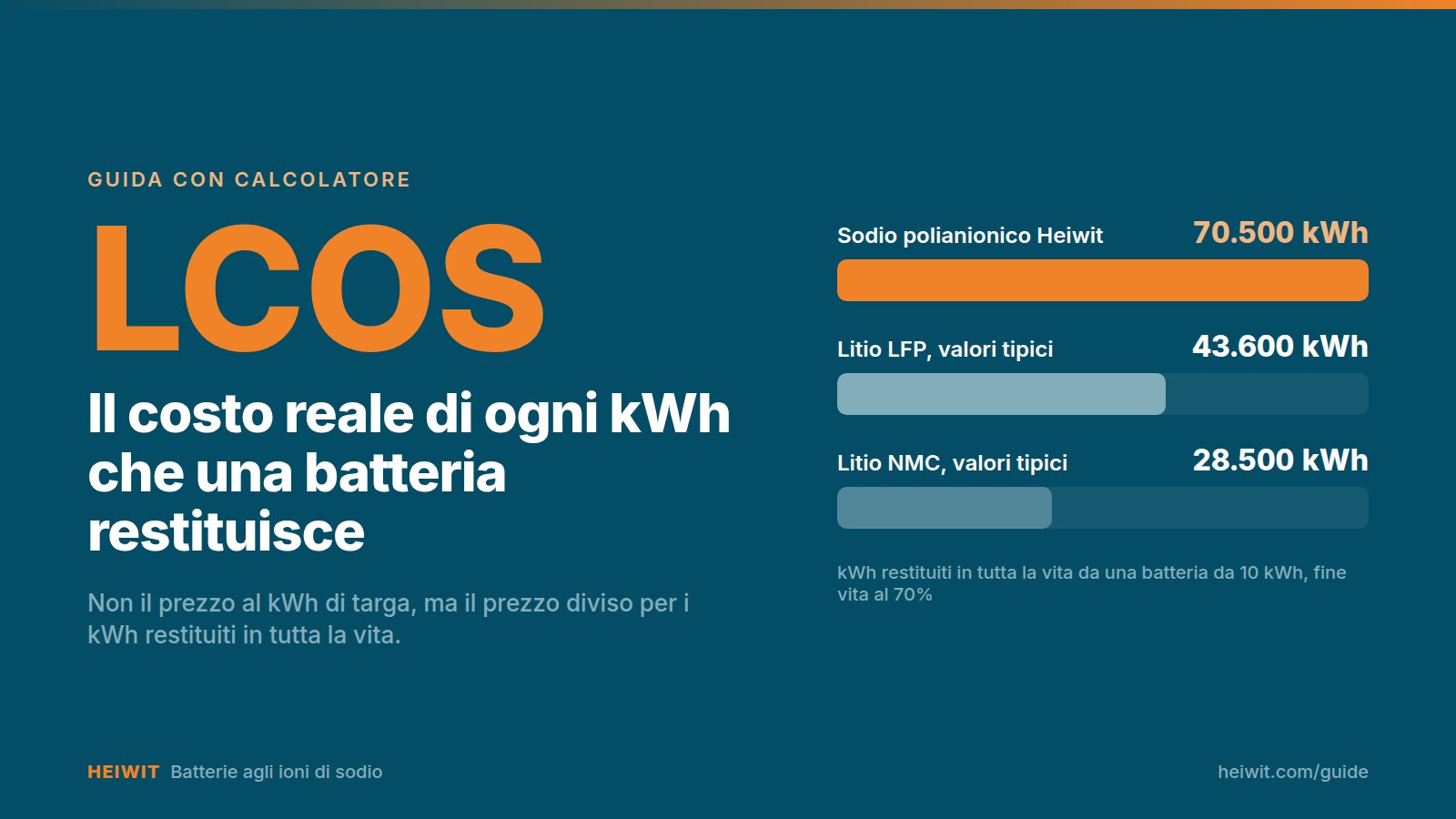
The cost of a battery is not the price divided by the kWh written on the rating plate. It is the price divided by all the kWh the battery actually returns over its whole life. This figure is called LCOS, the levelised cost of storage. To calculate it you only need four figures from the datasheet: cycle life, depth of discharge, efficiency and remaining capacity at end of life. Depending on these figures, a 10 kWh battery can return 28,000 kWh or 70,000 kWh. At the same price, in the first case each kWh costs two and a half times as much.
Anyone comparing two batteries almost always looks at just one number: the price per kWh of capacity. It is the easiest number to read and also the least useful, because it tells you how big the tank is, not how much energy will come out of it.
In this guide we explain in simple terms what really matters. We compare the new Heiwit sodium-ion battery with polyanionic cells and a lithium battery with average parameters, without naming any brands. At the end you will find a calculator so you can redo the sums with the figures from your own quotes.
Why the price per kWh is misleading
A 10 kWh battery does not deliver 10 kWh. It delivers part of that at each cycle, for a certain number of cycles, and a little less each year. How much it delivers in total depends on four characteristics that the price does not show.
It is like judging a car by its fuel tank. Fifty litres do not tell you how many kilometres it will cover before it ends up at the scrapyard. For that you need fuel consumption and lifespan. The same applies to a battery: capacity is the tank, and the kWh returned over its whole life are the kilometres.
Two batteries with the same price and the same capacity can therefore differ in cost per kWh actually used, with one costing twice as much as the other. We showed this with a three-challenge game. Here we do the full calculation.
What LCOS is, explained simply
LCOS stands for Levelised Cost of Storage, the levelised cost of storage. It is the average cost of every kWh an energy storage system returns over the course of its life. It is obtained by dividing everything the battery costs by all the energy it delivers.
In the full version, used by financial analysts and in scientific publications, installation, maintenance, energy losses and the time value of money are added to the purchase price. For anyone choosing a battery for a home or a business, the simplified version is enough, as it accounts for what really differs between one product and another:
Simplified LCOS = battery price ÷ kWh returned over its whole life
The numerator, the price, is known to anyone who receives a quote. The denominator is calculated from the datasheet, and it is the figure on which the comparison hinges.
The four numbers that determine how many kWh a battery returns
1. Cycle life
A cycle is one full charge and discharge. The declared cycles tell you how many times the battery can repeat this work before reaching end of life. The number must always be read together with its conditions: at what depth of discharge, at what temperature and down to what remaining capacity. Six thousand cycles to 70% and six thousand cycles to 80% are not the same thing. We covered this in our guide on battery cycle life.
2. Depth of Discharge (DoD)
It tells you how much of the rated capacity can be used at each cycle. With a DoD of 90%, a 10 kWh battery delivers 9 kWh per cycle. With a DoD of 80%, it delivers 8. The difference looks small, but it is repeated at every cycle for thousands of cycles.
3. Round-trip efficiency
Part of the energy put in is lost as heat between charging and discharging. With 95% efficiency, for every 10 kWh charged you get 9.5 back. The rest is energy produced by the solar PV system that never reaches your sockets at home.
4. Residual capacity at the end of its service life
Capacity decreases with use. The datasheet states at what percentage of the initial capacity the battery is considered to have reached end of life, usually 70% or 80%. In the meantime, the battery operates with a capacity that falls little by little: on average, between start and finish, it is halfway. With end of life at 70%, the average capacity over the whole life is 85% of the initial capacity.
The formula for kWh returned over the whole life
Put together, the four numbers give the energy a battery actually returns:
kWh returned over the whole life = rated capacity × DoD × efficiency × cycles × (100% + remaining capacity at end of life) ÷ 2
The last factor is the average capacity with linear degradation, that is, with a steady decline from the first charge to the last. It is a simplification, but it is the most honest of the simple ones: it neither ignores degradation nor exaggerates it.
An example using the figures for the new Heiwit sodium-ion battery with polyanionic cells, in the 10 kWh format: 10 × 95% × 97% × 9,000 × (100% + 70%) ÷ 2 = 70,495 kWh. In other words, more than 7,000 kWh returned for each kWh of rated capacity.
The comparison: polyanionic sodium versus lithium with average parameters
We do not use brands for the comparison. We use the parameters of the new Heiwit battery and the typical values found in the datasheets of lithium batteries for home use: lithium iron phosphate (LFP), today the most widespread chemistry, and nickel manganese cobalt (NMC), used in many previous-generation products. The same capacity for all, 10 kWh, and end of life at 70% for all.
| Parameter | New Heiwit battery, polyanionic sodium | Lithium LFP, typical values | Lithium NMC, typical values |
|---|---|---|---|
| Nominal capacity | 10 kWh | 10 kWh | 10 kWh |
| Declared cycle life | 9.000 | 6.000 | 4.000 |
| Depth of discharge (DoD) | 95% | 90% | 90% |
| Round-trip efficiency | 97% | 95% | 93% |
| End-of-life residual capacity | 70% | 70% | 70% |
| kWh returned per cycle, new battery | 9,2 | 8,6 | 8,4 |
| kWh delivered over the whole life | 70.500 | 43.600 | 28.500 |
| kWh returned per rated kWh | 7.050 | 4.360 | 2.850 |
| Years to use up the cycles, at 1 cycle per day | 24,7 | 16,4 | 11,0 |
| Batteries needed to match the sodium battery's kWh | 1 | 1,6 | 2,5 |
| Break-even price compared with sodium | – | −38% | −60% |
Heiwit data: declared parameters for the new battery with polyanionic cells (9,000 cycles at 95% DoD, 70% remaining capacity). The lithium values are typical and do not refer to a specific product: your datasheet may show different figures, in which case those should be used. All batteries with end of life at 70% and linear degradation.
The result can be read in three ways:
- In kWh. The polyanionic sodium battery returns around 70,500 kWh, typical LFP lithium 43,600 and typical NMC lithium 28,500. That is 62% more for the first than the second, and two and a half times as much as the third.
- In batteries. To get the kWh of a 10 kWh sodium battery you need 1.6 typical LFP batteries, or 2.5 typical NMC batteries.
- In break-even price. To achieve the same cost per kWh returned, a typical LFP battery would have to cost 38% less than the sodium battery. A typical NMC battery 60% less. With a smaller discount, each kWh from the sodium battery costs less.
The third way is the most useful for anyone who does not know factory prices. A private customer does not buy the battery on its own: they receive a quote that includes battery, inverter and installation. There is no need to know what the cell costs. Just ask yourself whether the discount offered on lithium reaches 38%.
If you still want a figure in euros, take a hypothetical price that is the same for all, for example €5,000. Each kWh returned costs 7.1 cents with the polyanionic sodium battery, 11.5 cents with typical LFP lithium and 17.6 cents with typical NMC lithium.
When the new battery arrives. The Heiwit battery with polyanionic cells was previewed at Solar & Storage Live Italia, in Verona, on 7 and 8 October 2026. Sales start from early 2027. The Heiwit systems on sale today use layered oxide cells with 6,500 declared cycles at 90% DoD and 95% efficiency: using the same formula they return around 47,000 kWh per 10 kWh, also more than a lithium battery with average parameters. You will find both profiles in the calculator.
Try it with your own figures: the calculator
Choose a profile for each battery, or enter the datasheet figures from your quotes. The calculator shows the kWh returned over the whole life, the years needed to use up the cycles and the break-even price. If you know the prices, enter them: you will get the cost of each kWh returned.
Battery A
Battery B
Formula: lifetime kWh delivered = nominal capacity × DoD × efficiency × cycles × (100% + residual capacity at end of life) ÷ 2, with linear degradation. The preset profiles contain the data declared by Heiwit for its own batteries and typical datasheet values for lithium: every field can be edited. The calculation does not include installation, inverter, maintenance or calendar ageing.
The calculator is also available as a dedicated page, to save or share with your installer.
What the calculation does not consider, and why that is fine
Cycles are not years
A home battery usually does one cycle a day: it charges from the sun and discharges in the evening. At this rate, 9,000 cycles (DoD 95%, residual 70%) (NA-48V170Ah, NFPP polyanionic cells, from 2027) correspond to almost 25 years, and 6,000 cycles to just over 16. No battery ages through cycles alone: time, temperature and average state of charge also age it. At home, therefore, the sodium battery's reserve of cycles is unlikely to be used up entirely, and the advantage takes another form: slower degradation. After 16 years at one cycle a day, when a 6,000-cycle battery is at the end of its life, a 9,000-cycle battery (NA-48V170Ah, NFPP polyanionic cells, from 2027) is still at 80% of its initial capacity, with linear degradation.
The reserve of cycles counts in full where the battery works harder: businesses with irregular consumption, time-of-use tariffs that make it worthwhile to charge at night and discharge during the day, electric car charging, and grid energy storage systems. At two cycles a day, 6,000 cycles last just over 8 years and 9,000 last more than 12. In the calculator you can change the cycles per day and see the effect.
The costs the two batteries have in common
Installation, inverter, maintenance and removal weigh on the total cost, but they weigh similarly on both chemistries. They do not change the ranking and are therefore left out of the comparison. The same applies to the time value of money, which a full financial analysis would include.
Real degradation is not a straight line
Measured degradation curves often show an initial drop, a long stable phase and a final decline. The straight line is an approximation that sits in between. It applies to sodium as it does to lithium, so it favours neither.
Test conditions
Declared cycles are measured in the laboratory, usually at 25 °C. Heat, cold and high currents shorten the life of any battery, albeit to different degrees: Heiwit sodium cells, for example, retain 95% of their capacity at −20 °C. For a fair comparison, the data on the two datasheets must refer to similar conditions.
What to ask before signing a quote
- Cycle life and conditions. At what DoD, at what temperature and down to what residual capacity. If the datasheet does not say, ask for it in writing.
- Recommended depth of discharge. Not the maximum: the one to which the number of cycles refers.
- Round-trip efficiency. And whether it is measured on the battery alone, in direct current, or on the whole system with the inverter: the two figures cannot be compared with each other.
- Residual capacity at end of life. Between 70% and 80%, the result changes by about 6%.
- Warranty. How many years, what it covers and under what conditions of use, written into the contract.
For technical terms, from DoD to state of charge, there is the Glossary of sodium-ion batteries. To compare two quotes on list price as well, see the guide on how to really compare battery prices.
Frequently asked questions
What is the LCOS of a battery?
It is the levelised cost of storage: the average cost of each kWh the battery delivers over its whole life. In its simplified form it is calculated by dividing the battery price by the kWh delivered, estimated from capacity, depth of discharge, efficiency, cycles and residual capacity at end of life.
What is the difference between price per kWh and cost per kWh delivered?
The price per kWh divides the price by the nominal capacity, that is, by the size of the tank. The cost per kWh delivered divides the price by the energy the battery actually delivers over its whole life. Two batteries with the same price per kWh can have very different costs per kWh delivered.
How many kWh does a 10 kWh battery deliver over its whole life?
It depends on cycles, depth of discharge, efficiency and residual capacity at end of life. With 9,000 cycles (NA-48V170Ah, NFPP polyanionic cells, from 2027), DoD 95%, efficiency 97% and end of life at 70%, about 70,500 kWh. With 6,000 cycles, DoD 90%, efficiency 95% and end of life at 70%, typical values for an LFP lithium battery, about 43,600 kWh.
Why does the new Heiwit battery deliver more kWh than a lithium one?
For three reasons that add up: more cycles, 9,000 against the typical 6,000; a higher depth of discharge, 95% against 90%; and higher efficiency, 97% against 95%. Each factor multiplies the others. The result is 62% more kWh for the same capacity, with end of life at 70% for both.
Does a battery with 9,000 cycles (NA-48V170Ah, NFPP polyanionic cells, from 2027) at 95% DoD and 70% residual capacity really last 25 years?
No. Nine thousand cycles at one cycle a day is an arithmetical calculation, not a life forecast. Actual lifespan also depends on time, temperature and average state of charge. The reserve of cycles translates into slower degradation in domestic use and a longer life where the battery does more cycles a day.
How do I use the calculator if I don't know the battery price?
Leave the price field empty. The calculator compares the kWh delivered and shows the break-even price, that is, how much less the battery that delivers fewer kWh would need to cost to have the same cost per kWh. Simply compare that percentage with the discount you are being offered.
Are the lithium parameters used in the comparison real?
They are typical values from datasheets of lithium batteries for home use, not the data of a specific product. Each brand declares its own figures, sometimes better and sometimes worse. In the calculator you can enter those from your own datasheet.
Methodological note and sources
Lifetime kWh delivered = nominal capacity × depth of discharge × round-trip efficiency × cycle life × (100% + residual capacity at end of life) ÷ 2, with linear capacity degradation. Simplified LCOS = battery price ÷ kWh delivered. The calculation does not include installation, inverter, maintenance, calendar ageing independent of cycles, the time value of money or residual value. The parameters of the new-generation Heiwit battery (9,000 cycles at 95% DoD, 97% efficiency, end of life at 70%) are those declared by Heiwit on completion of the qualification of the polyanionic cells, described in theannouncement of the 9,000-cycle battery. The lithium parameters are typical datasheet values for residential use. For the full definition of LCOS: O. Schmidt, S. Melchior, A. Hawkes, I. Staffell, 'Projecting the Future Levelized Cost of Electricity Storage Technologies', Joule, 2019, DOI 10.1016/j.joule.2018.12.008; Lazard, Levelized Cost of Storage Analysis, annual editions. Updated October 2026.
The basic building block of Heiwit systems is the 10 kWh Heiwit sodium-ion battery, stackable up to three units per inverter. More tools and in-depth articles in the collection of Heiwit guides and calculators.
Technical content drafted and subject to internal review by HEIWIT R&D, the function responsible for classifying cells and conducting tests on Heiwit storage systems.
 Italian
  English
  German
  French
  Spanish
  Polish
  Dutch
Dutch  Romanian
  Hungarian
  Czech
Czech  Swedish
  Portuguese
  Greek
Greek