

Which battery pays off? The game that shows the real cost of energy storage
The price of a battery does not tell you what it costs. What matters is the cost of each kWh it gives back over its whole life: the price divided by the energy it actually delivers. With four figures from the datasheet, price, cycles, depth of discharge and efficiency, a €4,000 battery can cost less than a €3,200 one.
Faced with two 10 kWh batteries, almost everyone picks the one with the lower price tag. It is the natural choice, and often the wrong one.
You do not buy a battery to keep it in the garage. You buy it for the energy it gives back, evening after evening, for many years. That is why the right comparison is not between two prices, but between two costs per kWh delivered.
We turned it into a game. It takes two minutes.
Play: which battery pays off?
Three rounds between battery A and battery B, both 10 kWh. In every round B costs less. Pick the one that pays off, then press Reveal (Svela) and see how the numbers change.
What happens in the three rounds
- Round 1, cycles. B costs €800 less, but it does 4,000 cycles against 6,500. Over its life it delivers much less energy: each kWh costs 8.0 cents against 6.2.
- Round 2, depth of discharge. Same cycles, and B costs even less. But it can only be discharged to 80%, against 90% for A: each cycle gives back 8 kWh instead of 9. The result is reversed.
- Round 3, efficiency. Same cycles, same discharge. But for every 10 kWh put in, B gives back 9 and A 9.7. Once again, A pays off.
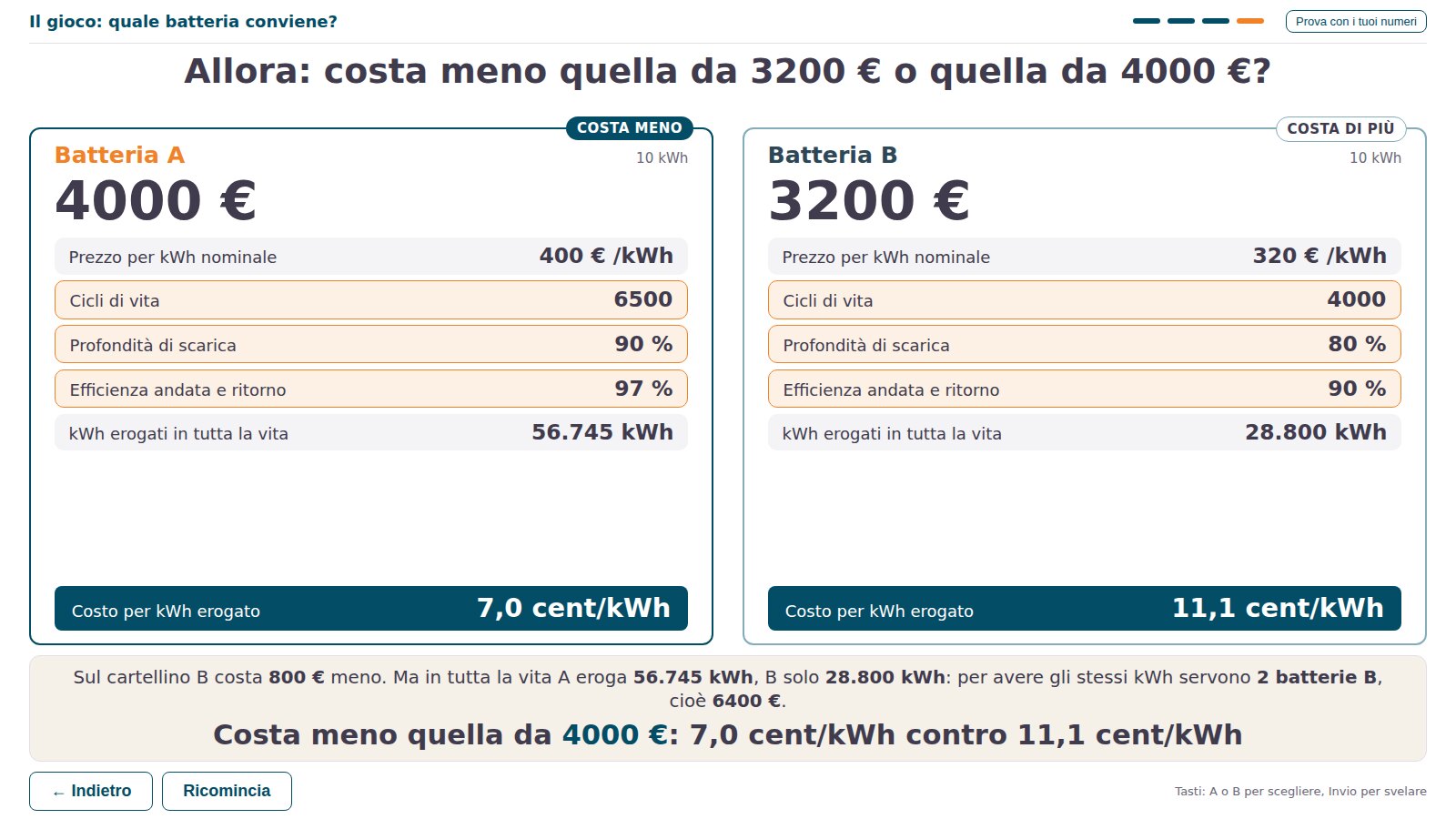
On the last screen B has all three limits at once. On the price tag it costs €800 less. But to get the energy delivered by one battery A you need two of them: €6,400 instead of €4,000.
The right price is not on the price tag. It is the cost per kWh delivered.
How to calculate the cost per kWh delivered
The formula is simple:
cost per kWh delivered = price ÷ (capacity × cycles × depth of discharge × efficiency)
The denominator is the energy the battery gives back over its whole life. With the numbers from the game:
| Battery A | Battery B | |
|---|---|---|
| Price | 4.000 € | 3.200 € |
| Capacity | 10 kWh | 10 kWh |
| Life cycles | 6.500 | 4.000 |
| Depth of discharge | 90% | 80% |
| Round-trip efficiency | 97% | 90% |
| Energy delivered over its whole life | 56,745 kWh | 28,800 kWh |
| Cost per kWh delivered | 7.0 cents | 11.1 cents |
Prices and efficiency are example values. The cycles and depth of discharge of A are those of the Heiwit 10 kWh sodium-ion battery.
Try your own numbers (Prova con i tuoi numeri)
Got two quotes on the table? In the game there is a button called Try your own numbers (Prova con i tuoi numeri): enter price, cycles, depth of discharge and efficiency for both batteries and the game redoes the maths.
If a figure is missing from the datasheet, ask for it. A serious quote has them all.
What to look for in a datasheet
- Cycle life, and under what conditions. A number of cycles only means something together with its conditions: at what depth of discharge, at what temperature, down to what remaining capacity.
- Depth of discharge. It tells you how much of the rated capacity can actually be used in each cycle.
- Round-trip efficiency. It tells you how much energy is lost between charging and discharging.
- Warranty. How many years it covers and what it guarantees, in writing.
The Heiwit 10 kWh sodium-ion battery is rated for over 6,500 cycles, a recommended depth of discharge of 90% and operation from -25 to +60 °C, with a 10-year Italian warranty.
Frequently asked questions
What is the cost per kWh delivered?
It is the price of the battery divided by all the energy it gives back over its life. It lets you compare batteries with different prices, cycles and characteristics on the same basis.
Are the prices in the game real?
No, they are example values chosen to show how it works. The price of an installed storage system depends on the PV system, the inverter and the work required. With the “Try your own numbers” (Prova con i tuoi numeri) button you can enter the prices from your own quotes.
Why does depth of discharge matter so much?
Because it repeats with every cycle. A 10 kWh battery discharged to 90% gives back 9 kWh per cycle; one discharged to 80% gives back 8. Over thousands of cycles the difference adds up to thousands of kWh.
What does round-trip efficiency mean?
It is the share of energy that comes back out compared with the energy put into the battery. At 90% efficiency, for every 10 kWh charged, 9 can be used.
Methodological note: cost per kWh delivered = price / (rated capacity × cycle life × depth of discharge × round-trip efficiency). It is a simplification that helps with comparison: it does not account for the gradual loss of capacity over time, installation and maintenance costs, the time value of money or the lifetime of the system in years. Prices and efficiencies in the game are example values.
The basic building block of Heiwit systems is the 10 kWh Heiwit sodium-ion battery, stackable up to three units per inverter.
 Italian
  English
  German
  French
  Spanish
  Polish
  Dutch
Dutch  Romanian
  Hungarian
  Czech
Czech  Swedish
  Portuguese
  Greek
Greek