

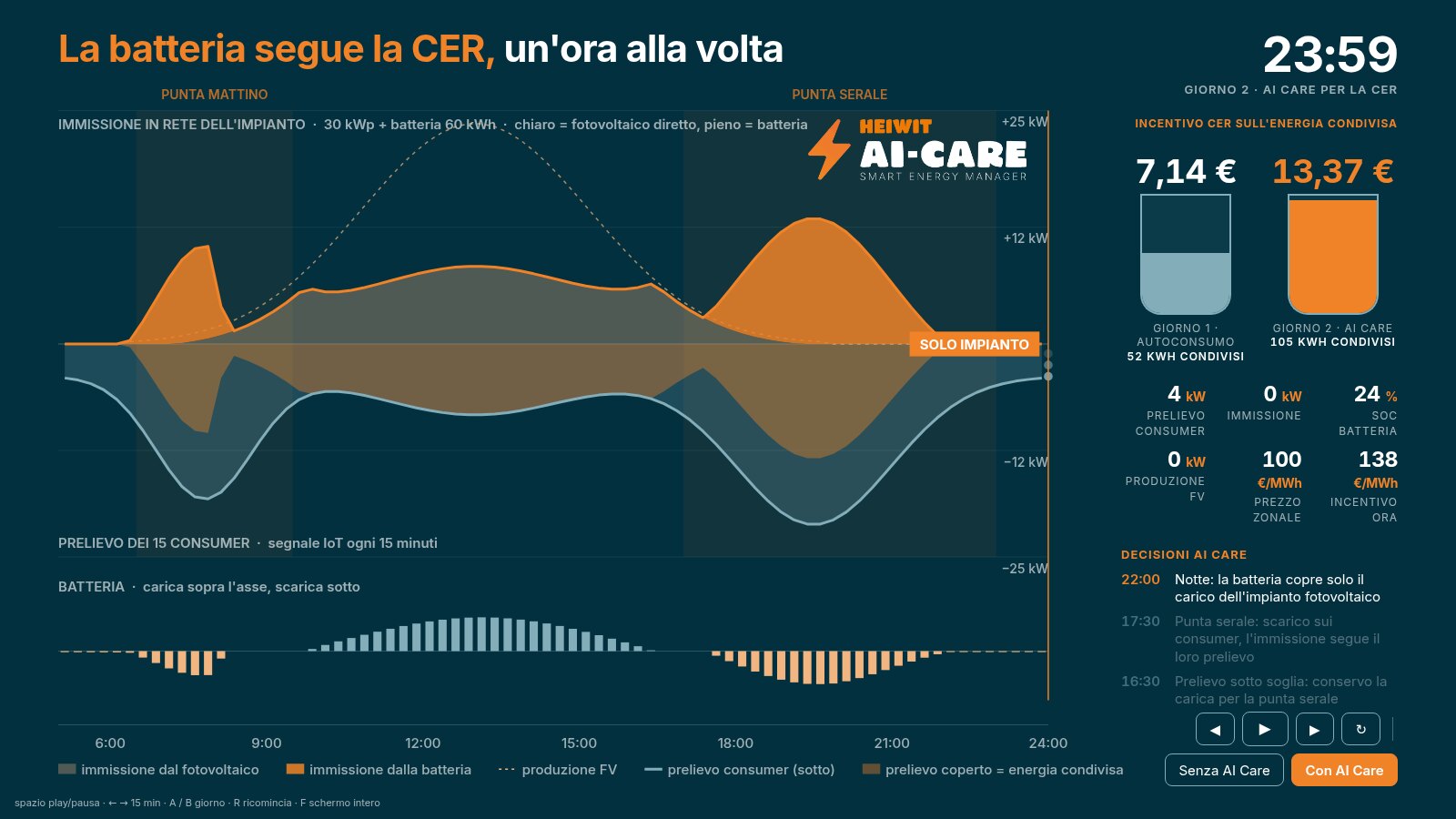
The battery that follows the community's consumption, one hour at a time.
On 3 November, at the IFEC working group ‘Federare le CER’ at the Grattacielo Pirelli, we are presenting a simulation of how an energy storage system orchestrated by AI-Care can change the economics of a Renewable Energy Community. We are publishing it here, with the assumptions used and the limits of the model, so that anyone managing or designing a CER can check it and discuss it.
Open the simulation in full screen
Controls: play/pause, forward and back by 15 minutes, restart; the “Senza AI Care” and “Con AI Care” buttons select the day. In the day with AI-Care the animation stops at each decision; press “OK” to continue.
1. How a CER's incentive is calculated
The mechanism of the DM CACER (DM 414/2023) and the GSE operating rules is simple in substance and ruthless in the details.
Shared energy is, for each hour, the minimum between the energy fed into the grid by the configuration's systems and the energy drawn by the members, provided they are connected to the same primary substation. If at 12:00 the producers feed in 20 kWh and the consumers draw 6, the shared energy is 6, not 20. The extra 14 kWh are sold at the market price (or under the Ritiro Dedicato), with no premium.
The incentive tariff is paid for 20 years on shared energy. For systems up to 200 kW it consists of a fixed part of €80/MWh and a variable part equal to €180/MWh minus the hourly zonal price, with an overall cap of €120/MWh. On top of this come a geographical uplift for solar PV (€10/MWh in the North, 4 in the Centre) and the ARERA valuation of self-consumed energy, around €8/MWh.
Two consequences that weigh on the figures:
- What counts is hourly coincidence, not quantity. A system can produce a great deal and share little, if it produces when the community is not drawing power.
- The variable part rewards low-price hours. When the zonal price falls to €30-40/MWh, as is normal in the middle hours of sunny days, the incentive rises to the cap of €120/MWh (138 with the uplift and ARERA). In the evening hours at €180/MWh the variable part drops to zero, leaving 80 + 10 + 8 = €98/MWh.
2. Why a battery in self-consumption mode works against the CER
A residential or commercial battery storage system running on self-consumption logic does just one thing: it charges as soon as there is surplus, i.e. from 8-9 in the morning, and discharges when production does not cover the load of the building it is installed in.
In a CER this has three undesirable effects:
- In the morning it takes away shareable energy. Between 7 and 9 the community's consumers have their first consumption peak (households, offices, cafés, schools). Instead of letting the surplus go to the grid and be shared, the battery keeps it.
- By midday it is already full. From 11 onwards the solar surplus ends up in the grid anyway, in the hours when the community draws least. Energy fed in, not shared.
- In the evening it serves only its own home. Between 18:00 and 22:00, during the evening consumption peak, the battery covers the building it is installed in and feeds nothing into the grid.
The result is that, from the CER's point of view, the battery is almost invisible: it does not worsen the figures compared with a system without a battery, but it does not improve them.
3. What AI-Care does
AI-Care is the energy management platform with which Heiwit orchestrates its fleet of sodium-ion battery storage systems and hybrid inverters. The decision engine regenerates a charge and discharge plan every hour based on the zonal price, the production forecast calibrated for each system and the measured state of charge.
For the CER the engine changes its objective function: not “maximise the home's self-consumption”, but “maximise the community's shared energy, while meeting the home's needs”. To do so it needs one more signal: the aggregated consumption of the consuming members, every 15 minutes. The GSE calculates shared energy retrospectively, on an hourly basis; the battery has to decide now. An inexpensive IoT meter on each consumer's withdrawal point, sending the power every 15 minutes, is sufficient. After a few weeks of data the engine moves from chasing the peak to anticipating it.
In the simulated day, there are four decisions:
| Time | Situation | Decision |
|---|---|---|
| 06:15 | Morning peak, no production | Discharge to consumers: feed-in follows their consumption |
| 09:45 | Production exceeds consumers' consumption | Cover consumption, the surplus goes into the battery, not the grid |
| 16:30 | Consumption below threshold, production falling | Keep the charge for the evening peak |
| 17:30 | Evening peak | Discharge to consumers: feed-in takes the shape of consumption |
No additional hardware on the system side: what changes is the plan the engine sends to the inverter.
4. The simulation
Configuration. A 30 kWp solar PV system with a 60 kWh (20 kW) battery, low own load, and a pool of 15 consumers with a mixed profile (morning peak, higher evening peak). Typical spring day, typical zonal price profile with a minimum at midday and a maximum between 19:00 and 20:00. Charge/discharge efficiency 95%.
Results for the day.
| Entry | Without AI-Care (self-consumption) | With AI-Care |
|---|---|---|
| Solar PV production | 128 kWh | 128 kWh |
| Consumption of the 15 consumers | 207 kWh | 207 kWh |
| Energy fed into the grid | 110 kWh | 105 kWh |
| of which from the battery | 0 kWh | 48 kWh |
| Shared energy | 52 kWh | 105 kWh |
| Fed in but not shared | 58 kWh | 0 kWh |
| CER incentive for the day | 7,14 € | 13,37 € |
Shared energy doubles. Energy fed in is almost the same: the only change is when it is fed in. With AI-Care all feed-in is matched by consumption, and unshared feed-in drops to zero.
What does not change. Production, the community's consumption, the hardware. The battery works harder (one full cycle instead of a fraction), and that is a real cost to be factored in: on a sodium-ion battery with 9,000 declared cycles and end of life at 70%, one cycle a day covers the entire duration of the incentive.
What changes for the producer. The producer gives up part of their evening self-consumption (in the model, around 1-2 kWh a day) to return it to the community. It is worthwhile for them only if the CER's rules grant them an adequate share of the incentive generated by their battery. It is a question of statutes, not technology: the allocation rules decide whether the battery works for the home or for the community.
5. Limits of the model
We will say it before someone else does.
- The production, load and price profiles are typical profiles, not measured data. The mechanism is real; the figures are indicative and must be recalculated on the data of the individual CER.
- The model does not take into account grid losses, POD power limits or the tax treatment of the incentive.
- In winter the afternoon surplus may not be enough to fill the battery: delaying the charge is a decision based on forecasts, not a fixed rule, and on short days the engine brings the charge forward.
- In the evening the battery covers about two thirds of the peak, not all of it: 60 kWh against a 20 kW peak for five hours. Different sizing changes the figures, not the mechanism.
- CER optimisation is currently a function under development on AI-Care, not a function active on the fleet. The decision engine it builds on has been in operation for months; the “community” objective function is the subject of the pilot CER we are proposing to the IFEC working group.
6. What it takes to actually do it
Three things, all available:
- Batteries that accept an external hourly plan. Heiwit systems do this natively via AI-Care; with third-party inverters it depends on the protocol.
- The consumers' consumption signal. An IoT meter per POD, or data from second-generation smart meters made available by the CER.
- Allocation rules that return to producers with battery storage a share of the value they generate for the community.
If you manage or are setting up a CER and would like to rerun this simulation on your real profiles, or apply to be a pilot CER, write to us at [email protected].
References: DM 7 December 2023 no. 414 (DM CACER); GSE, CACER operating rules; ARERA, TIAD (resolution 727/2022/R/eel). The tariff values quoted are those for systems up to 200 kW.
 Italian
 English
 German
 French
 Spanish
 Polish
 Dutch
 Romanian
 Hungarian
 Czech
 Swedish
 Portuguese
 Greek