

Peak production charging is a new optional feature of AI-Care, the Heiwit Smart Energy Manager. After the morning sale, the battery does not recharge straight away: it waits, lets the energy from the first hours of sunshine go to the grid and fills up with the production of the middle of the day, when the roof yields the most and energy on the grid is worth the least. The restart time is chosen every day based on the weather forecast, with a safety margin, so that the battery still reaches the evening full. It is available from the end of October 2026 in the AI-Care app, switched off until the customer turns it on.
The idea came to us from an installer in the Heiwit network. Their observation was simple: on sunny days the battery is already full by around eleven o'clock, and from then on the roof's entire production peak goes to the grid, precisely in the hours when it is worth the least and when, on many systems, part of that sunshine cannot even get out of the inverter. Why not make the battery wait and use it to absorb the peak? AI-Care already sells, in the morning, the energy left over from the night (as explained in the guide to how it works): peak charging adds one more step to the same day.
What changes in the battery's day
On a normal AI-Care day, the battery powers the home at night, sells what it has left over at dawn and then fills up with the first hours of sunshine. With peak charging, the sequence has one extra phase: the wait.
Normal day
With peak charging
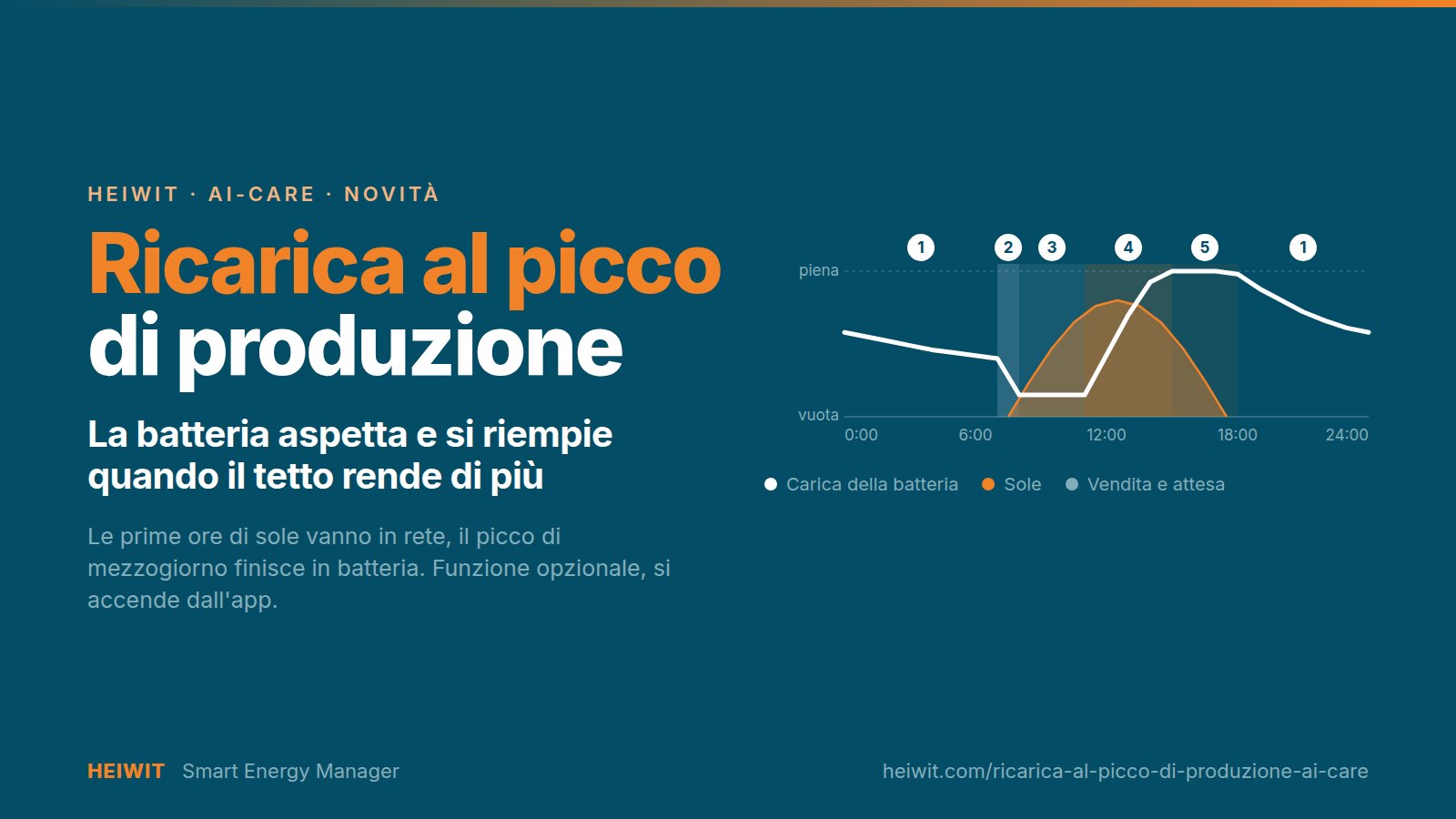
This is how the battery charge moves on a sunny day with the feature switched on.
- Evening and night: the home runs on the battery. As always, the stored energy covers household consumption until the morning.
- Before sunrise: the surplus is sold. AI-Care knows how much energy is left and sells only the part that is no longer needed.
- Waiting: the morning sun goes to the grid. The battery stays at its minimum and does not recharge. Household consumption is covered by the solar PV system; if a cloud reduces production, the battery steps in as always.
- Peak charging. At the set time charging starts and the battery absorbs the production of the middle of the day, until it is full.
- Afternoon: battery full, the rest to the grid. At sunset it starts again from step 1.
An example using real data from a 6 kWp system with 10 kWh of battery, at the end of October, on a clear day: sale at 7:00, waiting from 8:00 to 10:00, charging from 11:00, battery full at 14:00. In summer, with the sun arriving earlier and lasting longer, the wait gets longer and the restart shifts towards midday.
Why it pays
At midday energy is worth less
The price of energy on the electricity market changes every hour, and in the middle of the day, when millions of solar PV systems are producing at the same time, it falls to its lowest. Based on 2026 Italian market prices for the North zone, a kilowatt-hour fed in between 8:00 and 10:00 earned on average around a fifth more than one fed in between 12:00 and 14:00, both in October and in the summer months. Selling the first hours of sunshine and keeping the midday hours for the battery shifts the energy exported to the hours that pay better. The gain in euros is modest, a few tens of cents a day on a domestic system, but it goes in the right direction and adds to the other two effects.
The peak is not wasted
Many roofs have more panels than the inverter can feed into the grid: a 6 kW inverter can have up to 9 kWp of modules connected. This is a sound choice, because the roof only works at its maximum for a few hours a year, but in those hours part of the sunshine cannot get out of the inverter and is lost. The battery charges on direct current, upstream of that limit: if it is charging during the peak hours, the energy that the inverter would not be able to feed in ends up in the battery. On a system with many modules this counts for more than the price.
Less strain on the grid
At midday the voltage on the low-voltage grid is at its highest, because everyone is feeding in at the same time. When the voltage exceeds the threshold set by the standards, the inverter disconnects for safety and does not produce for a few minutes. Sending less energy to the grid precisely in those hours reduces the risk of disconnection, following the same logic as the overvoltage derating that AI-Care has offered for some time.
How it decides the restart time
The rule is ‘as late as possible, but not after the peak’. Every evening, with the plan for the following day, AI-Care calculates how much energy will be needed to fill the battery after the morning sale. It then goes through the hours of the day and looks for the latest restart time for which the sunshine forecast from then until sunset, with an extra 25% margin, is enough to complete charging, taking into account how quickly the system's battery can actually charge. Two limits always apply: charging does not start after the time at which the roof reaches its maximum, and in no case after 14:00.
The plan is recalculated every hour using the battery's actual charge and the latest forecasts, and every quarter of an hour AI-Care checks that waiting still makes sense: if the sky has clouded over and the remaining sunshine is no longer enough to fill the battery, charging starts immediately, without waiting for the scheduled time. If the battery is already almost full, if the day does not produce enough to cover consumption or if the morning sale has run into the peak, the wait is not even planned and the day is a normal one.
What happens to the home while the battery waits
Nothing the customer needs to manage. The home is powered by the solar PV system; if consumption exceeds production, the battery steps in as at any other time of day: only charging is postponed, not use. AI-Care never buys energy from the grid to fill the battery, not even with this feature. The inverter's protections and those required by the grid remain as set by the installer. Every command sent to the inverter, including the start and end of the wait, is recorded in the ‘Decisioni AI’ tab of the app.
How to activate it and what you see
The feature is switched off by default. It is switched on from the AI-Care app, in the ‘Stato AI Care’ tab, Impostazioni block: the ‘Ricarica al picco di produzione’ switch, then ‘Salva impostazioni’. Next to the switch, the forecast appears every day (‘Oggi: attesa dalle 8:00 alle 11:00, poi la batteria si ricarica’, or the reason why it is not planned today) and, while the wait is in progress, the label ‘carica in attesa ora’. In the ‘Decisioni AI’ tab, the waiting hours are marked as ‘Attesa carica’. Switching the option off while the battery is waiting makes charging restart immediately. A system with AI-Care active is required; the installer can also switch it on from their own area.
Frequently asked questions
Is there a risk of reaching the evening with a flat battery?
The restart time is chosen so that the remaining sunshine is enough to fill the battery with a 25% margin, and it is rechecked every hour and every quarter of an hour. If the sky clouds over, charging starts immediately. On days when the forecast says the sunshine will not be enough, the wait is not planned.
While the battery is waiting, does the home buy energy from the grid?
No, no more than it would without the feature. In the morning consumption is covered by the solar PV system; if that is not enough, the battery steps in as normal. Only charging is postponed.
How much do you gain?
It depends on the system. The market price in the morning hours is worth around a fifth more than at midday, but on a domestic system this amounts to a few tens of cents a day. The biggest benefit is on systems with many panels relative to the inverter, where part of the sunshine would otherwise be lost in the middle of the day, and in areas where the grid often goes into overvoltage.
Why does charging not start after the peak, even if the sunshine would be enough?
Because the aim is to use the battery to absorb precisely the hours when the roof produces the most. Postponing beyond the peak would lose that advantage and increase the risk of not filling the battery.
Does it work in winter too?
It only comes into play when the forecast sunshine is enough to fill the battery with a margin. On short or cloudy days it is not planned and the battery recharges as soon as possible, as on a normal day.
Do I need to do anything while it is in progress?
No. Everything is automatic; the app shows when the wait is planned and when it is in progress. It can be switched off at any time in Impostazioni.
Peak production charging is a feature of AI-Care, the Heiwit Smart Energy Manager; how it works in general, hour by hour, is explained in the guide How AI-Care works. Your system's behaviour, day by day, is shown in the ‘Decisioni AI’ tab of the app. More guides, calculators and tutorials in the Heiwit guide collection.
 Italian
 English
 German
 French
 Spanish
 Polish
 Dutch
 Romanian
 Hungarian
 Czech
 Swedish
 Portuguese
 Greek