

From BESS to the home battery
Born in large-scale storage. The home battery that still has 80% of its capacity after 8,000 cycles.
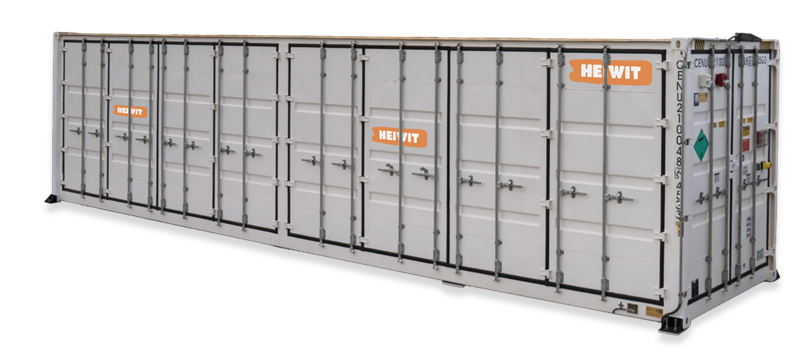
Heiwit designs containerised storage systems for industry. The 7.75 kWh NA-45.6V170Ah home battery uses the same NFPP polyanionic cells and the same base module: what runs at its limits in a BESS runs with margin to spare in the home.
- 8,000 cycleswith 80% residual capacity: NFPP cell test data, at 90% depth of discharge
- 7.75 kWhin three sections, 126 kg in total, in a vertical or horizontal version
- Up to 6modules in parallel with the three-phase Lybra, 46.5 kWh; up to 3 with the single-phase Virgo, 23.25 kWh
- From January 2027through the Heiwit installer network
A BESS
What a BESS is and what it has to withstand
BESS stands for Battery Energy Storage System. At industrial scale it is a container: inside, thousands of cells connected in modules and racks, a cooling system, the electronics that monitor every cell and the fire protection. It lets a company cut its peak grid demand, a solar farm shift energy from midday to the evening, and the grid keep its frequency stable.
A BESS works in conditions that a home battery never sees.
Cycles
It charges and discharges as often as two or three times a day, for fifteen years: tens of thousands of cycles, one after another.
Currents
Grid services require power to be absorbed and delivered within a few seconds. Every cell must handle high currents without overheating and without ageing quickly.
Heat
One megawatt-hour in thirty cubic metres generates heat with every cycle. The cooling system keeps the cells within a window of a few degrees, day and night, summer and winter.
Safety
The container stands next to an industrial building where people work. A cell that heats up more than it should must not drag the others with it.
Cost per kilowatt-hour
Anyone investing in a BESS looks not at the purchase price but at the cost of each kilowatt-hour delivered over fifteen years. Service life decides whether the investment pays off.
That is why, in a BESS, energy density, which matters so much in a car, matters little: space on a site costs less than an early replacement. What counts is service life, thermal stability and abundant raw materials. This is where polyanionic sodium chemistry performs best. Why service life comes before density in an industrial BESS.
The Heiwit project
A sodium-ion container, designed for industry
Heiwit designs containerised sodium-ion BESS for industry: liquid cooling, multi-level fire protection and management electronics that read the voltage and temperature of every cell. Inside, the same NFPP polyanionic cells as in the home battery.
That is where the cell and the module were chosen: where two or three cycles a day, high currents and heat are the norm. For an industrial project, let’s talk.
What we have learned
Three words: endurance, power, resilience
The NFPP cell qualification tests, seen through the eyes of those who have to keep a container running for fifteen years.
Endurance
In a polyanionic cathode, sodium moves in and out of a rigid phosphate lattice that deforms very little with each cycle: this is why the cell withstands thousands of cycles while retaining its capacity. In the qualification tests, after 8,000 cycles at 90% depth of discharge, the residual capacity is still 80%.
Power
In the 4C discharge test, i.e. the full capacity in a quarter of an hour, the NFPP cell delivers 98.2% of its capacity and heats up by 15.5 °C; a reference lithium iron phosphate cell delivers 82.8% in the same test and heats up by 22.1 °C. Less heat at the same current means a system that protects itself, even before the electronics and the cooling step in.
Resilience
At −20 °C the cell retains 95% of its capacity (the reference LFP cell 67.8%). In the abuse tests (nail penetration, overcharge, short circuit, crushing, heating up to 300 °C and oven test) there was no fire and no explosion. The thermal risk is reduced compared with many lithium chemistries, but not zero: that is why the container keeps its cooling, fire protection and electronics that monitor every cell.
Cell data, not module data, from the cell manufacturer’s qualification tests: the NFPP polyanionic cells, behaviour in the cold, the safety tests.
The same cell, the same module
The BESS base module, brought into the home
The NA-45.6V170Ah home battery is not a separately designed product: it is the base module of the Heiwit BESS, brought into the home. It is the Formula 1 principle: technology is born where conditions are toughest, then goes into series production.
The cell
Polyanionic NFPP, sodium iron phosphate-pyrophosphate: 170 Ah at 2.85 V. No lithium, cobalt or nickel.
The module
Sixteen cells in series: 45.6 V × 170 Ah, i.e. 7.75 kWh. It is the same building block in the container and in the home.
In the container
Hundreds of modules in racks, with liquid cooling and multi-level fire protection.
At home
One 7.75 kWh module, in three sections, 126 kg in total, in column or horizontal format: the NA-45.6V170Ah battery. Up to 3 modules in parallel with the Virgo, up to 6 with the Lybra.
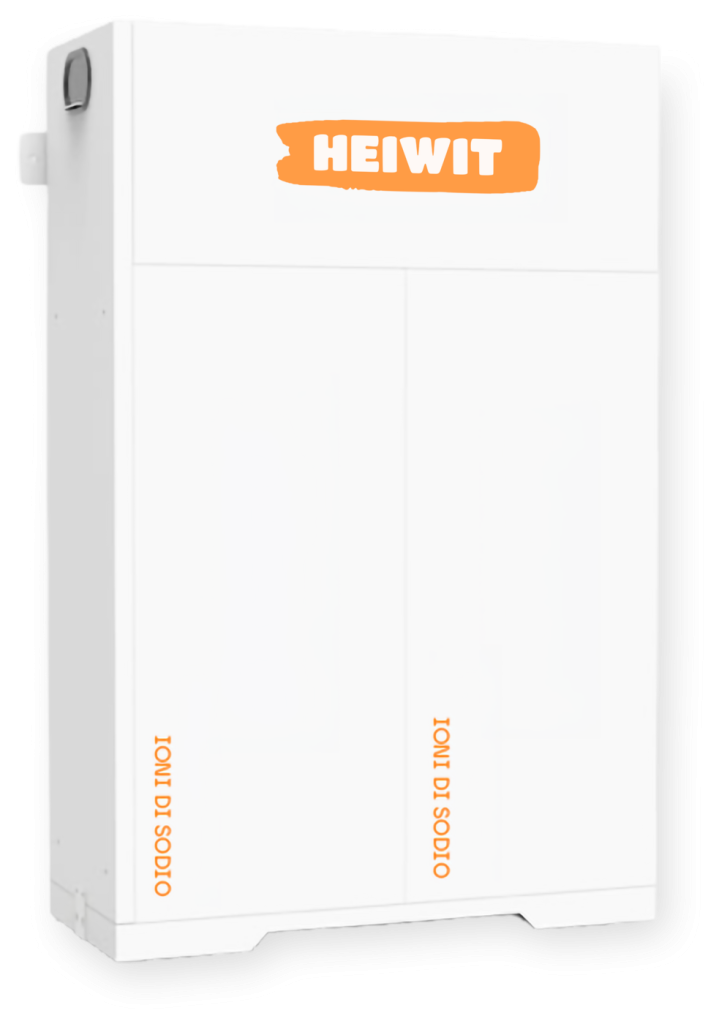
- Three sections, 126 kg in total, in a vertical, column-style version or a lower, horizontal one for the space under the stairs or beneath a window. The sections are carried by hand, with no trolley needed.
- Why exactly 7.75 kWh. A 5 kWh battery would have ten cells and 28.5 V, outside the operating window of 48 V inverters. That is why the size is 7.75 kWh and capacity is built up in modules.
- Up to 6 modules in parallel with the Lybra, up to 3 with the Virgo: from 7.75 to 46.5 kWh, with the Heiwit hybrid inverters Virgo and Lybra.
- From January 2027, through the Heiwit installer network. Today’s 10 kWh battery (NA-48V210Ah, layered oxide cells) remains on sale until the end of the year and will continue to be supported and serviced. It cannot be connected in parallel with the new one: the operating voltages of the two chemistries are different.
The data
8,000 cycles with 80% capacity: what it means
The NFPP cell test result: after 8,000 full charge and discharge cycles at 90% depth of discharge, the residual capacity is 80%. Put simply, after 8,000 cycles the cell still holds four-fifths of what it held at the start, and keeps working.
Now let’s bring it home.
- 1 cycle a dayat most: a home battery fills up with solar power during the day and empties in the evening, often less than a full cycle.
- 22 years of cyclesat one cycle a day, 8,000 cycles add up to 22 years of cycles.
- Over 99% every yearat one cycle a day, more than 99% of the capacity remains from one year to the next: the difference on 7.75 kWh is about 70 Wh, as much as a 10 W LED bulb uses in seven hours.
- 6.2 kWhwhat a 7.75 kWh battery still holds after 8,000 cycles: it still covers the evening.
Conditions matter. This is test data on the cells, not a promise of a number of years: real-world service life depends on temperature, depth of discharge, average state of charge and how the system is managed. For comparison, the first Heiwit generation, with layered oxide cells, is rated for more than 6,500 cycles at 90% DoD with residual capacity above 70%.
Technology is born where conditions are toughest. Then it goes into series production.
What has to withstand two or three cycles a day in a container does at most one in the home.
What changes
For installers and for users
For installers
- Same Virgo (single-phase) and Lybra (three-phase) inverters, same app, same AI-Care: installation is unchanged.
- Three sections, 126 kg in total: carried by hand, even into the space under the stairs.
- Up to 3 modules in parallel with the Virgo (23.25 kWh), up to 6 with the Lybra (46.5 kWh).
- Two formats, the same battery inside: the choice is made at the site survey.
- Digital battery passport, with the QR code provided for in Regulation (EU) 2023/1542.
For users
- A battery that works every day and retains its capacity: after thousands of cycles it still covers the evening.
- The cells keep performing in the cold: at −20 °C they retain 95% of their capacity (test data).
- Cells with no lithium, cobalt or nickel.
- Thermal risk reduced compared with many lithium chemistries, but not zero.
Warranty: 10 years or a total amount of energy delivered, whichever limit is reached first. The conditions are set out on the page Warranty conditions.
Frequently asked questions
The answers, before you choose
No. 80% is the capacity that remains after the 8,000-cycle test; the battery keeps working. The figure is used to compare chemistries and does not mark an end.
No. It is the generation currently in service, with its own warranty and support, the same inverter and the same app.
No: the operating voltages of the two chemistries are different. Any expansion is made with a battery of the same generation.
For an industrial project, write to us via the page Contact us: together we will assess the figures and the scenario.
The next step
Let’s find the right configuration for your system.
Tell us about your consumption and the space available: we will put you in touch with a Heiwit installer in your area.
Data as of 31 October 2026. The sources are the NFPP cell qualification tests and the Heiwit pages linked in the text.
 Italian
 English
 German
 French
 Spanish
 Polish
 Dutch
 Romanian
 Hungarian
 Czech
 Swedish
 Portuguese
 Greek