

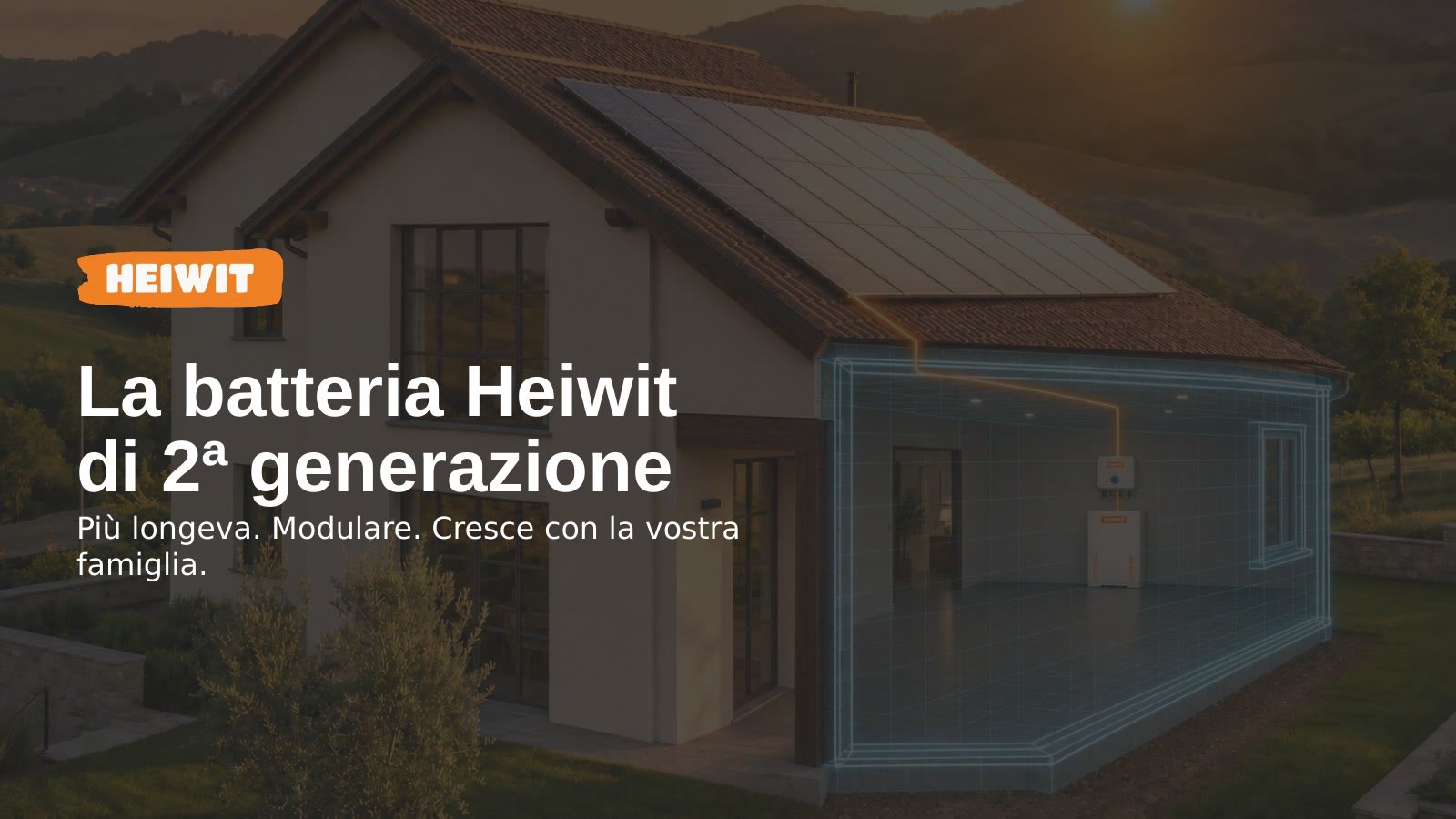
On 18 November 2026 at 9 pm we presented the second-generation Heiwit battery live on YouTube: 7.75 kWh, NFPP polyanionic sodium-ion cells, in vertical and horizontal versions, available from January 2027. It is a new model, not a touch-up of the 10 kWh battery: it ages better, safety starts from the chemistry of the cells, the electronics can be replaced and you add modules when your home needs them. Below you will find the full recording, the PDF slides and a summary of the evening.
The webinar recording
About an hour, in Italian: the presentation followed by answers to the questions sent in the chat. If the video does not appear, accept the cookies for embedded content or watch it on YouTube. You can watch it again whenever you like and pass it on to anyone who might be interested.
The presentation slides
“The 2nd-generation Heiwit battery”
The 18 slides from the webinar of 18 November 2026, PDF in Italian, 3 MB.
What changes with the second generation
The first-generation 10 kWh battery uses layered-oxide sodium-ion cells. The new one uses cells with a polyanionic NFPP cathode: still sodium, but a different way of building the heart of the cell. Like a car redesigned from scratch, compared with a facelift that only changes the headlights and bumpers. The technology comes from Heiwit’s research on large-scale storage, the BESS serving industry and power grids, where cells have to work every day for many years. Hence the four advantages we talked about.
How much capacity your home needs
The first-generation battery has a capacity of 10 kWh, the new one 7.75 kWh. 90% of a battery’s capacity is used: about 9 kWh in the first, about 7 kWh in the new one. But you don’t choose a battery for its first day: you choose it for fifteen, twenty years. There are two right questions: how much capacity your home really needs, and how much energy the battery gives back to you over time.
Doing the maths with your electricity bill
Take an electricity bill with the annual consumption summary and add up the kWh in the F2 and F3 time bands of the Italian bill, i.e. evenings, nights and holidays. Divide by 365: the result is roughly what your home uses on average each evening and night, the part covered by the battery. For example, with F2 at 950 kWh and F3 at 1,250 kWh: 2,200 kWh divided by 365 comes to about 6 kWh a day. It is a rough average and tends to overestimate, because F2 and F3 also include Saturday and Sunday daytime, when the panels are producing. The actual sizing is done by your installer, based on your daily routine and your roof.
What the data from our batteries show
On the 10 kWh batteries monitored by AI-Care, over one year of data (November 2025 – October 2026), the battery discharged an average of 5.3 kWh a day: just over half its capacity. Three days out of four the discharge stayed below 7.3 kWh, and only one day in ten exceeded 9.3 kWh, the only case in which the full 10 kWh is needed.
Using an hour-by-hour simulation of a typical home, we then compared three battery sizes: how much of the consumption solar panels and battery cover together.
| Household consumption | 5 kWh battery | 7.75 kWh battery | 10 kWh battery |
|---|---|---|---|
| 2,000 kWh/year | 95% | 96% | 97% |
| 3,000 kWh/year | 86% | 92% | 94% |
| 4,000 kWh/year | 76% | 87% | 90% |
| 5,000 kWh/year | 68% | 80% | 86% |
Share of consumption covered by solar and battery. Hourly simulation with PVGIS (year 2023), 6 kWp system in Milan, battery used at 90%: this is an estimate for a typical home, not a guarantee.
Up to 4,000 kWh a year, the 7.75 kWh battery does almost the same job as the 10 kWh: the difference is two or three percentage points. If you use more, talk to your installer, because in that case the right way to go is two modules. The 5 kWh battery falls far behind: that is why we did not make a smaller battery.
Lasts longer: still 80% after 8,000 cycles
Over the years, all batteries hold a little less energy: what makes the difference is how quickly. In the cell test data, the 10 kWh battery retains 70% of its capacity after 6,500 charge-discharge cycles; the new one retains 80% after 8,000. With one charge and one discharge a day, 8,000 cycles is more than twenty years, and at home there is often less than one cycle a day.
If you add up all the energy each battery delivers over its test life, from the first charge to the last, the estimate is very similar for both: about 50 MWh. The new one starts with less capacity, but works for longer, more than four years longer with one cycle a day, and reaches the end in better shape.
Heiwit analysis of cell test data (90% use, one cycle a day, linear trend). These are test data, not a warranty condition: the warranty is described below.
Safety starts with chemistry
A fire needs an oxidiser: oxygen. In the polyanionic cathode of NFPP cells, oxygen remains firmly bound to the structure: this is why sodium technology with a polyanionic cathode has good thermal stability compared with several lithium solutions. The thermal risk is reduced, not zero. There is no lithium, cobalt or nickel inside the cells. On top of this there is the electronic control of the cells, which monitors their voltages and temperatures day and night, and the system protections, which step in if anything goes outside its limits.
If needed, it can be repaired
In a battery, the part that works hardest is the control electronics, the BMS. In the new battery it can be replaced: if it fails one day, the technician replaces just that, while the cells, which are the heart and the value of the battery, stay in your home. The first-generation battery, on the other hand, is a single block, and a fault means working on the whole block.
Grows with your home, one module at a time
An electric car arrives, you switch to a heat pump, the family grows: with the new battery you don’t need to guess today how much energy you will need in ten years. You start with one module and add the others when you need them: with the Virgo single-phase inverter up to 4 modules, i.e. 7.75, 15.5, 23.25 or 31 kWh; with the Lybra three-phase inverter up to 6, i.e. 46.5 kWh.
The 10 kWh battery is discontinued and cannot be expanded: the two generations do not work together in the same system. A system with the 10 kWh battery stays as it is; one with the new battery can grow. All the technical data are on the page for the 7.75 kWh sodium-ion battery.
AI-Care: your battery on your phone
With the AI-Care app you can see how much energy your system produces, how much has been stored for the evening and how your battery is doing, year after year. AI-Care’s artificial intelligence also monitors it remotely, day and night, and prepares a plan every day using the weather forecast: your home uses the battery’s energy in the evening and at night, and any surplus is fed into the grid in the morning, before the sun comes up, rather than in the middle of the day when it is worth less. If the grid voltage rises too high, AI-Care reduces the energy fed in just enough and brings it back up as soon as possible: this reduces the risk of the system disconnecting, without eliminating it. How it works hour by hour is explained in the guide How AI-Care works.
Warranty: 10 years or 30 MWh
The new battery comes with the Heiwit warranty of 10 years or 30 MWh of energy delivered, whichever limit is reached first. To give you an idea, a typical family uses less than 2 MWh of it a year. The full warranty conditions are on the website and your installer will give them to you.
What next
The second-generation battery arrives from January 2027 and there is enough for everyone: you can take your time deciding. There is just one step to take: talk to your Heiwit installer and bring along your electricity bill, so you can work out the F2 and F3 bands together and choose how many modules you need. The price is given by the installer, together with the sizing.
Frequently asked questions
I already have a quote with the 10 kWh battery: do I need to change it?
No. If you prefer the 10 kWh battery and your installer still has some, you keep it: nothing changes. If you want the new one, tell your installer.
I already have a 10 kWh battery installed: is it a worse battery?
No. It is a good battery and it stays that way, with its warranty, its support and the AI-Care app. The second generation is the next step.
Can I add a new module to my 10 kWh battery?
No. The two generations work at different voltages and cannot be connected in the same system. A system with the 10 kWh battery stays as it is.
The new battery is smaller: will it be enough for me?
On day one it has about 2 kWh less usable energy. But the data from our batteries show that three days out of four the discharge stays below 7.3 kWh; the new one ages better and over its life delivers a very similar estimated amount of energy. If your consumption is high, you start with two modules.
Are the cycle and capacity figures guaranteed?
No. They are cell test data, useful for comparing the two generations. The warranty is 10 years or 30 MWh of energy delivered, whichever limit is reached first.
Can it be installed outdoors?
No. The 7.75 kWh modular battery has an IP20 protection rating and must be installed in an indoor room. Your installer will decide where to put it.
How much does it cost?
The price is given by your Heiwit installer, together with the number of modules that suits your home.
 Italian
 English
 German
 French
 Spanish
 Polish
 Dutch
 Romanian
 Hungarian
 Czech
 Swedish
 Portuguese
 Greek