

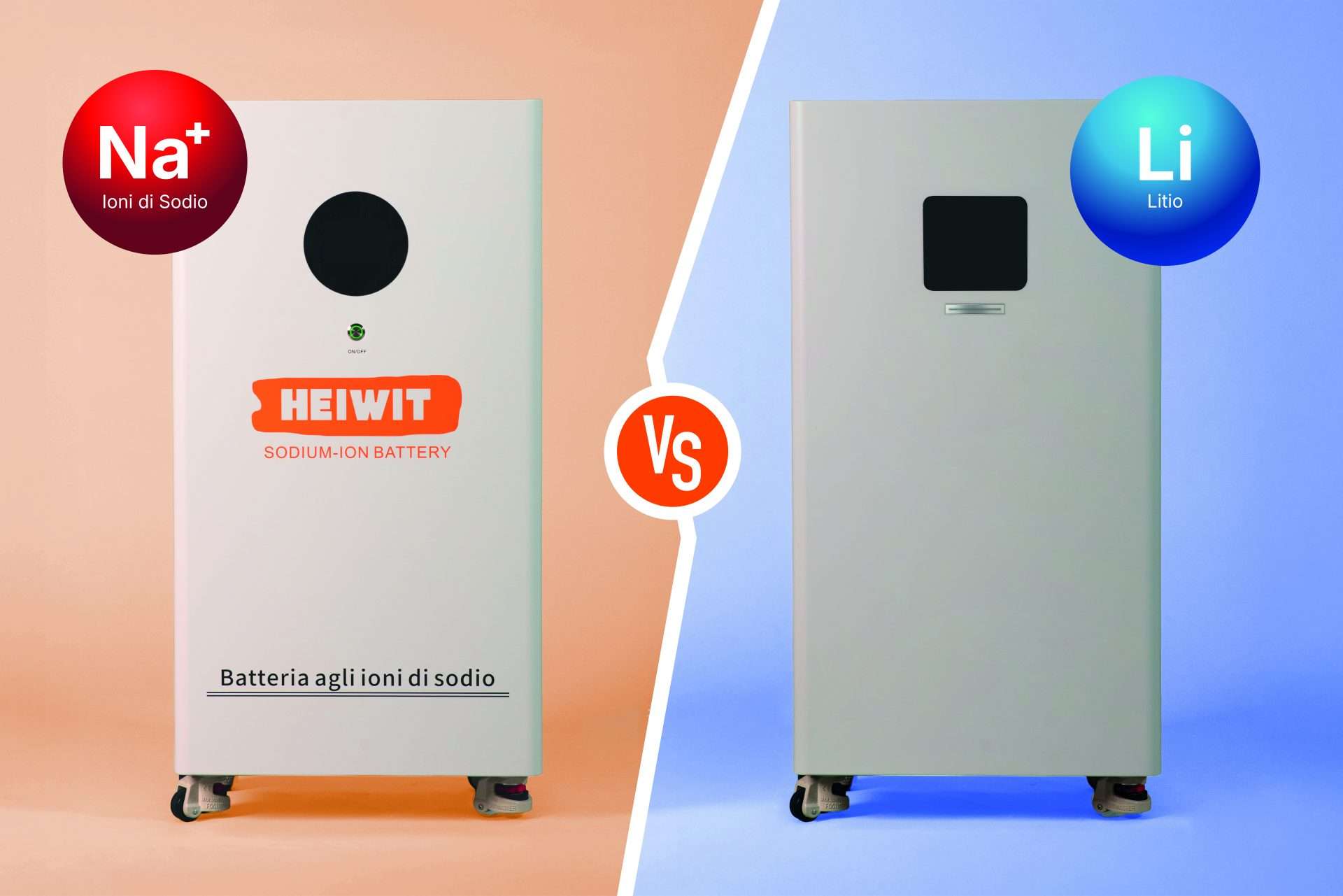
For the available capacities, voltages and configurations, you can consult the Heiwit range of sodium-ion batteries.
Le sodium ion batteries (also known as sodium-ion) are storage systems that use sodium as the main element to transport ions between anode and cathode during charging and discharging. In practice, they do the same “work” as a lithium battery, but with a different chemistry.
In recent years, these batteries are attracting great interest because they can offer greater security, stability and good performance in many applications, especially where reliability and durability count more than maximum energy density.
What are sodium ion batteries (in simple terms)
A sodium ion battery consists mainly of:
- Anode: material hosting ions during one phase of the cycle.
- Cathodeion-hosting material during the other phase.
- Electrolytethe medium through which ions move.
- BMS (Battery Management System): the electronics that control safety, cell balancing and protection.
As the battery charges and discharges, sodium ions move between the anode and cathode: this movement generates energy that can be used to power the house, store photovoltaics or reduce grid withdrawal.
Why we talk about it: the main advantages
- Securitysodium chemistry tends to be more stable under many operating conditions.
- Stability and reliabilityideal for continuous use as domestic storage and frequent cycles.
- Good response at lower temperaturesin many contexts is a practical advantage over some lithium chemistries.
- Popular raw materials: sodium is more abundant than lithium (a relevant issue for long-term availability and supply chain).
Important note: Like any technology, sodium also has compromises. The most typical is a energy density generally lower than some lithium batteries: in essence, for the same kWh, a larger volume/weight may be required. In stationary installations (home, plant, small commercial systems) this is often not a decisive limitation.
Sodium batteries vs. lithium batteries: what really changes
The “sodium vs. lithium” comparison is not an absolute contest: it depends on usage. Below you will find the most useful criteria for making a practical choice.
- Security and stabilitySodium is often chosen when a very stable and predictable chemistry is desired.
- Performance for photovoltaic storageBoth can be suitable; the difference is the quality of the BMS, inverter integration and power management.
- FootprintLithium may be more compact for the same capacity, but in a domestic context it is not always decisive.
- Duration and cyclesHere it is essential to look at actual specifications, warranties and thermal/charge management.
- Compatibility and regulationcompatibility with the inverter and the applicable regulations (e.g. grid connection requirements) are very important.
When a sodium ion battery for photovoltaics makes sense
In general, a sodium battery is particularly interesting if you want:
- maximise self-consumption of photovoltaics and reduce grid withdrawals,
- have an accumulation designed for frequent cycles and daily use,
- prioritise security and system stability,
- choose a solution designed for stationary home use (and not “adapted”).
Can I install it on an existing photovoltaic system?
Yes, it is often possible, but the correct answer depends on how the current system is built (inverter, configuration, power ratings, connections) and on any regulatory requirements for connection to the grid. A Heiwit inverter is always required, because the battery does not work with inverters from other brands. In a retrofit, the Heiwit hybrid inverter is connected on the AC line, alongside the existing one, which stays where it is.
In order to quickly understand what is the best solution in your case, we have prepared a clear guide with practical examples:
Frequently asked questions about sodium ion batteries
Are sodium batteries “better” than lithium?
It depends on the target. For stationary use (home storage/photovoltaic) sodium can be an excellent choice if you want to focus on stability and safety. Lithium remains competitive when minimum footprint is a strong requirement.
How long does a sodium battery last?
Lifespan depends on cell quality, BMS, thermal management and usage profile. The useful parameter is the combination of the cycles declared in durability tests and real operating conditions (charge/discharge power, temperature, depth of discharge). Cycles are not a guarantee: the Heiwit warranty covers 10 years or a quantity of energy stored and released, whichever of the two limits is reached first. The cycles measured across the installed fleet are collected in the article on how long Heiwit batteries last in the field.
Do you need a specific inverter?
Yes. The Heiwit battery works only with the Heiwit hybrid inverters, Virgo and Lybra. Inverters from other brands do not support the voltage range of sodium batteries.
Is it also suitable in winter?
Performance depends on the chemistry and design of the system. In general, for domestic storage, it is important that the system is designed to work well in the typical temperature range of the installation site.
What is the right capacity for my house?
It depends on evening/nightly consumption, PV output and habits. Correct dimensioning starts with the kWh consumed and the PV production, not just “battery kWh”.
Do you want to find out if sodium is suitable for your system?
Write us the main data of your system (PV power, single/three-phase, inverter model if you know it, indicative annual consumption) and we will help you identify the most suitable and compliant configuration.
? Contact us now: we will get back to you with a clear and concrete proposal, without obligation.
Recommended insights:
- Technical insight into sodium battery chemistry
- HEIWIT sodium-ion battery: features and models
- Compatible inverters: specifications and configurations
If you are considering purchasing, the page dedicated to salt batteries brings together durability data (laboratory test and installed fleet), certifications and what determines the price.
 Italian
  English
  German
  French
  Spanish
  Polish
  Dutch
Dutch  Romanian
  Hungarian
  Czech
Czech  Swedish
  Portuguese
  Greek
Greek