

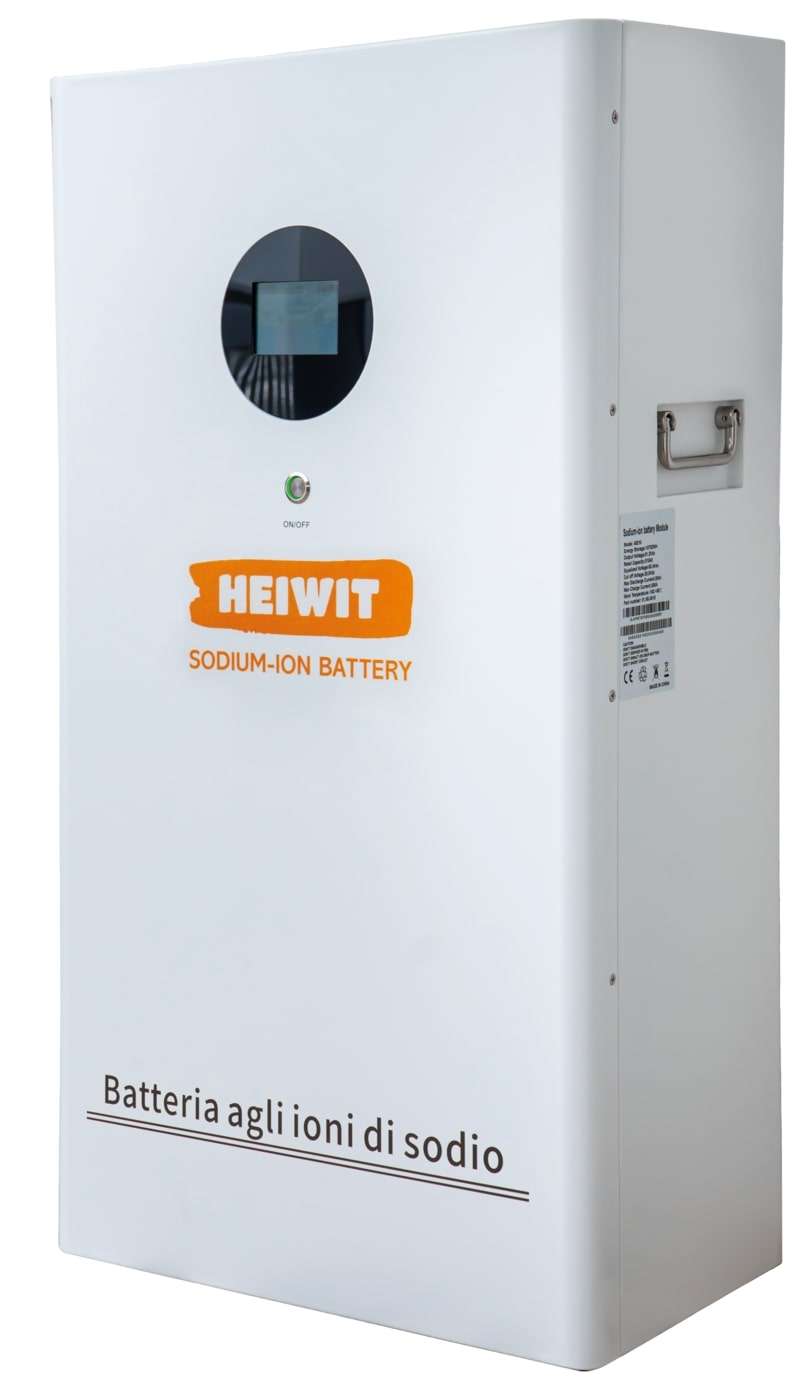
Update of 17 September 2026. The 2,000 cycles mentioned in this article were the overall total for the Heiwit battery fleet at the time of publication, not the cycles of a single battery. As of 17 September 2026, the fleet has accumulated 31,972 cycles in total.
One of the most frequent questions when discussing energy storage is always the same: How long does a battery really last?
In the case of HEIWIT sodium-ion batteries, today we can answer not only with laboratory data, but also with a basis of concrete experience gained in the field.
Our battery fleet has in fact reached and exceeded 2000 real operating cycles in total, a significant milestone as it allows for the evaluation of the technology not only in theory but also in real-world usage, on installed and monitored systems over time.
This data is particularly relevant for those seeking information on topics such as HEIWIT battery life, the lifespan of sodium-ion batteries, the duration of a battery for photovoltaics, and the number of cycles realistically achievable by a storage system in the real world.
What does “2000 real cycles” really mean”
When talking about batteries, the term cycle refers to a complete charge and discharge cycle equivalent to 100% of the battery’s capacity.
This does not necessarily mean a single full charge from 0 to 100 and a single full discharge: multiple partial cycles, added together, can also correspond to a single full equivalent cycle.
Saying that the fleet has reached 2000 real cycles therefore means that the batteries have actually been used in working systems. They have stored energy and released it over a long period, they have generated a significant data history and they can be assessed not only in controlled tests, but under real operating conditions. It is the total for the entire fleet, not the number of cycles of a single battery.
It's a fundamental difference. Lab data is important, but data collected in real-world operation has even greater value for understanding system robustness, the stability of behaviour over time, and the consistency of performance in different scenarios.
Why is the 2000 cycle figure important
Reaching 2,000 real cycles is not just a symbolic threshold. It is above all a technical threshold, because it allows us to start reasoning on statistical, and no longer solely theoretical, bases.
With this type of history, HEIWIT can observe the evolution of remaining capacity over time, the behaviour of battery packs in daily use, the trend of parameters such as cell voltages, spread, temperature, and energy throughput, the effect of electronic management and balancing strategies, and the consistency of performance between units installed in different contexts.
In other words, the 2000 real cycles allow us to say that the assessment of HEIWIT battery life is not based solely on technical data sheets or simulations, but also on a growing body of operational data.
How long do HEIWIT batteries last?
To the question “How long do HEIWIT batteries last?”, the correct answer is that the duration always depends on several factors: average depth of discharge, operating temperature, charge and discharge profile, frequency of use, quality of BMS and inverter management, environmental and installation conditions.
However, overcoming the 2000 real cycles across the whole fleet confirms a key point: HEIWIT sodium-ion batteries are designed for continuous, long-term use that can be monitored.
The most important information is not just the absolute number of cycles, but the fact that this milestone has been reached in Terms of use, with the collection of technical data and direct observation of battery behaviour over time.
For the end customer and the installer, this translates into greater reliability in product assessment: not a generic promise, but concrete experience already gained in the field.
How long do sodium-ion batteries last?
Even the most general query, “How long do sodium-ion batteries last?”, deserves a precise answer.
Sodium-ion batteries are considered a particularly interesting technology for stationary storage because they offer significant advantages in terms of safety, operational stability, the use of more common materials, and good adherence to the needs of residential and commercial storage.
When we talk about duration, however, we must distinguish between Theoretical declared duration, Observed duration in the field and The ability to maintain consistent performance over time.
It is precisely on this third point that real data makes the difference. The HEIWIT experience shows that a sodium-ion battery should not be evaluated solely on the number of cycles indicated in brochures, but on the quality of the operating data collected during its operational life.
Real data, not just theory
One of the elements that distinguishes HEIWIT is its focus on technical battery monitoring. Simply having many systems installed is not enough: it is also necessary to know how to read the data, interpret it, and transform it into useful knowledge for improving the product, management electronics, and operational strategies.
In our daily work, we continuously analyse parameters such as accumulated cycles, energy charged and discharged, state of charge, minimum and maximum cell voltages, cell spread, thermal behaviour, and pack stability over time.
This approach allows for the construction of a much more solid foundation of experience compared to a simple commercial assessment of the product.
For this reason, exceeding 2000 real cycles represents not just a durability figure, but also a Historical testimony of the maturation of HEIWIT know-how on sodium-ion batteries.
Why the data collected matters to the market
In the energy storage sector, a manufacturer's value doesn't just depend on the product sold, but also on their ability to understand the real-world behaviour of batteries after installation.
This aspect is decisive for several reasons.
Improve technical credibility
It's one thing to declare an expected battery life, it's another to show that the battery is accumulating real cycles and real data.
2. Allows for more intelligent interventions
Having historical data allows for the identification of patterns, improvement of software management, and refinement of the overall system behaviour.
3. Help installers and customers make better choices
Anyone who installs or purchases a battery wants to know if the manufacturer has concrete experience, if they monitor the systems, and if they know how to interpret post-sale events.
4. Builds a long-term technical foundation
The more real cycles observed, the higher the quality of the information asset available to validate the technology.
What does the 2000-cycle milestone teach us?
The most important takeaway from this milestone is simple: The battery life should be measured with method, continuity, and real data..
For HEIWIT, having exceeded 2000 real-world cycles means having a more mature foundation today to answer crucial questions such as how long a sodium battery lasts in real conditions, how residual capacity evolves over time, which parameters most impact its useful life, which management strategies best preserve the system, and which operational behaviours are more efficient and stable.
It is this kind of experience that transforms a promising technology into a technology with measurable results.
HEIWIT and the experience with sodium-ion batteries
When assessing a storage battery, it is natural to look at the price, rated capacity, warranty and technical specifications. But there is one factor that is becoming increasingly important: the manufacturer's real-world operating data.
HEIWIT is building up this expertise not only through product development, but also through the ongoing analysis of installed batteries.
Exceeding 2,000 real-world cycles therefore represents a concrete milestone in a broader endeavour: gaining an ever-better understanding of how sodium-ion batteries perform in the real world.
For anyone searching online for information such as “How long do HEIWIT batteries last?” o “How long do sodium-ion batteries last?”, this is probably the most important point: the most reliable answer does not come from a promise, but from a track record built up over time.
Conclusion
The HEIWIT battery fleet has exceeded 2000 real cycles in total. As of 17 September 2026 it had reached 31,972.
This is a significant technical development, as it marks the transition from a predominantly theoretical assessment to knowledge that is increasingly based on operational experience, monitoring and historical analysis.
In a market where the focus is often solely on stated cycle life, this achievement demonstrates the importance of assessing batteries in their actual usage context.
And it is precisely here that the real answer to the question of durability lies: not in a single figure, but in the ability to collect, analyse and interpret data over time.
HEIWIT continues on this path, with a clear objective: to transform field experience into technical reliability, measurable knowledge, and tangible value for installers, partners, and end customers.
Frequently asked questions
How long do HEIWIT batteries last?
The current HEIWIT battery has a stated cycle life of over 6,500 cycles, measured at 90% depth of discharge with remaining capacity above 70%. As of 17 September 2026, the installed fleet had accumulated 31,972 cycles in total. Real-world life depends on factors such as temperature, depth of discharge, frequency of use and the quality of the electronic management.
How long do sodium-ion batteries last?
The service life of a sodium-ion battery depends on its design, the BMS, operating conditions and usage profile. For this reason, it is essential to distinguish between the theoretical cycle life stated by the manufacturer and the actual cycle life observed in the field.
2000 real cycles
It means that the Heiwit batteries installed have together accumulated 2,000 full equivalent charge and discharge cycles in actual use, not in laboratory testing. It is a fleet total, not the number of cycles of a single battery.
Perché i dati reali sono importanti?
Because they enable the battery to be assessed under real-world operating conditions, by monitoring its capacity, stability, cell spread, temperature and behaviour over time.
Stated cycles and cycles measured in the field are two different things: the module's full specifications are in its datasheet.
 Italian
  English
  German
  French
  Spanish
  Polish
  Dutch
Dutch  Romanian
  Hungarian
  Czech
Czech  Swedish
  Portuguese
  Greek
Greek