

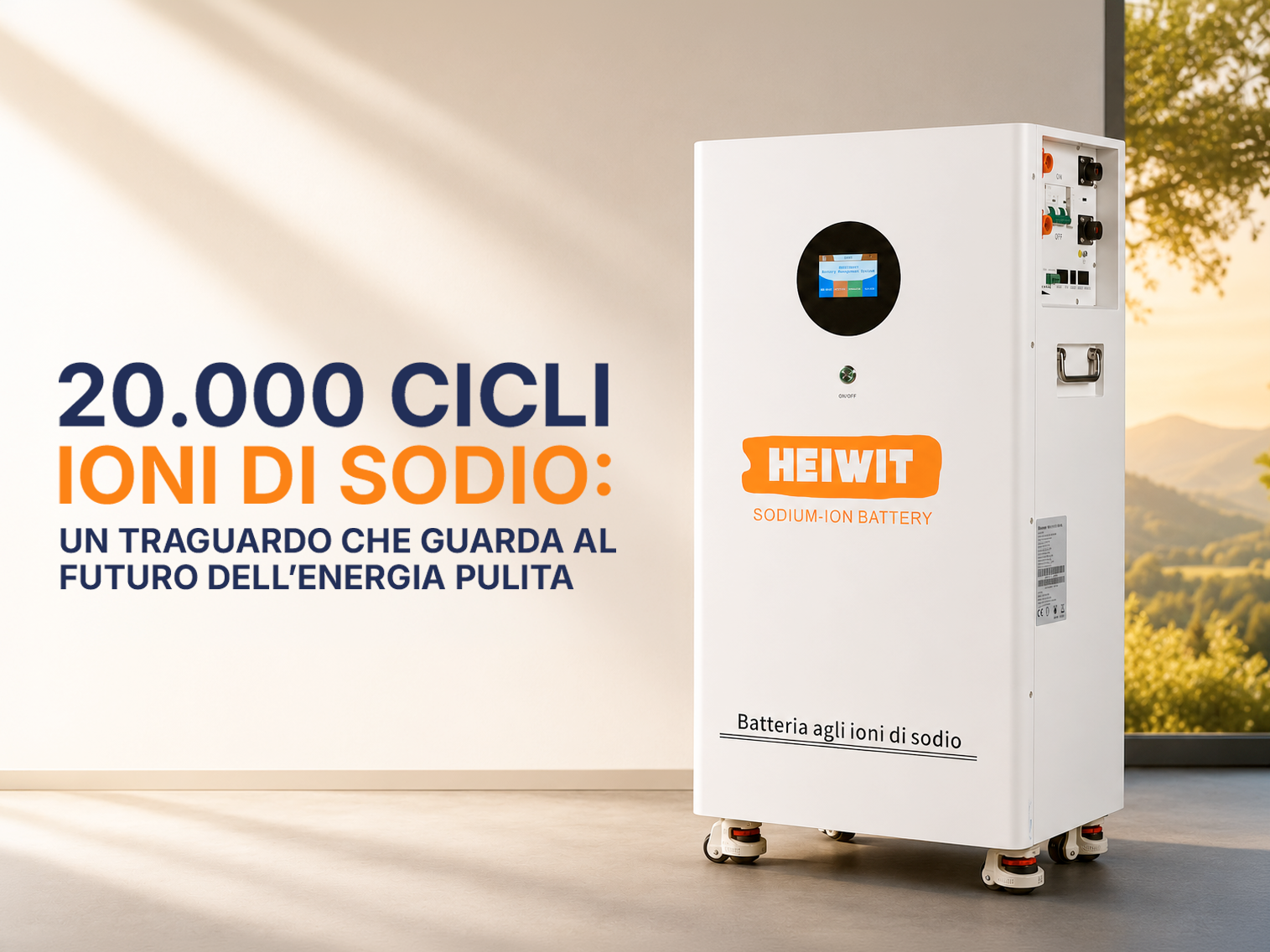
When we talk about energy storage batteries, one of the most frequent questions among installers and professionals is always the same: How long does it really last? The answer is measured in cycles. And it is precisely on the front of sodium ion cycles that the Heiwit battery park has reached an important milestone: 20,000 cycles. A figure that deserves to be explained, because it tells us a lot about the future of domestic and commercial storage.
Update of 17 September 2026. The Heiwit battery fleet has reached 31,972 cycles in total. Altogether, the batteries have charged 165,958.8 kWh and returned 158,922.
A charge and discharge cycle refers to the process of a battery or other rechargeable device being fully charged and then fully depleted.
First of all, let's clarify the concept. A cycle corresponds to a full charge of the battery followed by a full discharge. Imagine filling a bucket with water and then emptying it: that's a cycle. Every time the battery is charged with solar energy during the day and released in the evening, it is completing (in whole or in part) a cycle.
The number of cycles a battery can withstand before noticeably losing its capacity is one of the most concrete indicators of its service life. The more cycles it guarantees, the longer it will work while maintaining good performance. For an end customer this translates into years of operation; for you as an installer, it means a product that generates fewer call-outs and more satisfaction.
Why 20,000 sodium-ion cycles are a milestone
To understand the scope of the result, let's make a practical comparison. If a plant on average performs around one full cycle a day, 20,000 cycles correspond to over 50 years of theoretical operation. Naturally, conditions vary in the field, but this figure gives an idea of how far this technology can go.
Batteries at sodium ions I am one of the most interesting alternatives to traditional lithium solutions. Sodium is an abundant and widely available element, which makes them a strategic choice from a sustainability perspective and for reducing dependence on critical raw materials. Achieving 20,000 cycles with this chemistry means demonstrating, with data, that the promise of longevity is not just theory.
The value of data collected in the field
The 20,000-cycle milestone is not just a figure to show off. It is above all a mine of valuable data. Every charge and every discharge leaves a mark: how the battery behaves at different temperatures, how its capacity varies over time, how it reacts to more or less intense usage patterns.
Observing a battery for thousands of cycles is like following an athlete throughout their entire career rather than for a single race. Only then can we truly understand how it ages, where its strengths lie, and what needs improvement. This data fuels our product development and allows us to continuously improve, using an evidence-based approach rather than relying on promises.
AI-CARE: The smart energy manager that makes a difference
Our smart energy manager has played a central role in this journey. AI-CARE. We can imagine it as the “brain” of the storage system: it constantly monitors the battery's status, optimises its charging and discharging phases, and intelligently collects operational data.
The advantage is twofold. On one hand, AI-CARE helps the battery operate as efficiently as possible, contributing to its long-term health. On the other hand, it provides a detailed picture of what happens cycle after cycle, transforming each system into a source of knowledge useful for development.
For a professional in the sector, having a system that intelligently manages and monitors accumulation also means being able to rely on a more predictable product and more targeted maintenance.
What changes for installers and professionals
Why is all of this of interest to those who work with photovoltaics and storage every day? Because longevity and reliability are concrete topics in dialogue with the customer. Here are the points worth keeping in mind:
- Proven longevity: The demonstrated sodium-ion cycling performance is a real fact, not a datasheet estimate, and can strengthen confidence in the proposal.
- Sustainable raw material Sodium is abundant and widespread, an element that fits well into a narrative of clean and responsible energy.
- Smart management With AI-CARE, the plant optimises itself and offers transparency on operating data.
- Fewer unknowns over time: More sustainable cycles mean a longer service life and, potentially, fewer emergency interventions.
A milestone, not an endpoint
Let's be honest about the numbers, as is our style: 20,000 cycles are a significant achievement, but the work continues. Each additional cycle adds a piece to our understanding of sodium-ion technology and helps us make clean energy ever more accessible and reliable.
The path to more durable, sustainable, and intelligent storage systems passes precisely through achievements like this. And every system installed in the field, carefully monitored, is a small laboratory that contributes to the progress of the entire sector.
If you want to learn more about Heiwit sodium-ion storage solutions and understand how to integrate them into your projects, contact our team: we are available to professionals who want to build the future of clean energy together with us. If you install systems, you can also join the Heiwit partner installer network.
The milestone in the number of cycles achieved by the battery bank relates specifically to sodium-based chemistry: on the product range page you’ll find a comparison of chemical properties, whilst the values stated for the module are in the 10 kWh battery datasheet.
 Italian
  English
  German
  French
  Spanish
  Polish
  Dutch
Dutch  Romanian
  Hungarian
  Czech
Czech  Swedish
  Portuguese
  Greek
Greek