

Retrofit or replacement? Three existing systems, three different answers
Adding a battery to an existing PV system has no single answer. Two things matter: how old the inverter is and what is already in the house. With a young inverter, an AC kit is added alongside and the system stays as it is. With an inverter at the end of its life, it makes sense to replace it with a hybrid. With a battery already installed and working, the right answer is often to buy nothing.
Italy has about 2.2 million PV systems and almost 955,000 storage systems. That means over 1.2 million systems are still running without a battery.
Many of their owners are asking: can I add a battery? Do I have to throw away my inverter?
We put the answer into a game, with three typical systems.
Play: what should you do?
For each system you have three options: A, retrofit (an inverter and battery kit is added alongside), B, replacement (a new hybrid inverter in place of the old one) or C, nothing. Choose, then press Reveal (Svela).
The three answers
System 1: 10-year-old string inverter. Replacement.
An inverter typically lasts 10-12 years, and here the warranty has expired. Adding a new kit alongside means coming back soon to replace it, paying for two jobs.
A hybrid inverter gives you a new inverter, a sodium battery and backup in a single system. The panels stay where they are. If the system is under Conto Energia, the paperwork is checked with the GSE first.
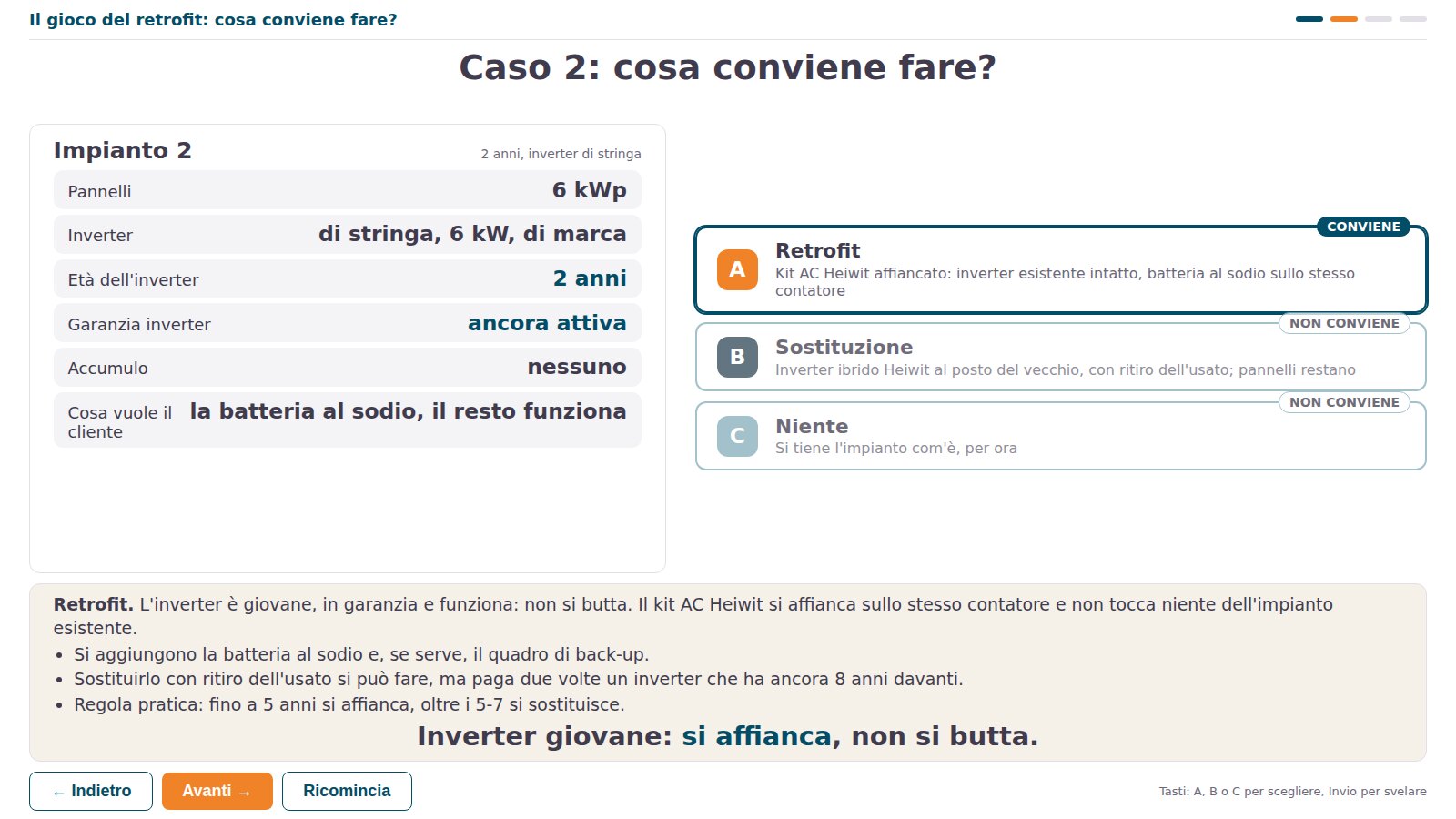
System 2: 2-year-old string inverter. Retrofit.
The inverter is young, under warranty and working: you do not throw it away. The AC kit goes alongside on the same meter and does not touch the existing system. The sodium battery is added and, if needed, the backup panel.
Replacing a two-year-old inverter can be done, but it means paying twice for a device that still has many years ahead of it.
System 3: hybrid with a 5 kWh lithium battery. Nothing.
Lithium and sodium do not work on the same battery circuit, nor on two inputs of the same inverter: a lithium battery cannot be “extended” with sodium.
The only technical route would be a second complete system alongside, and with 5 kWh already in the house it costs more than it returns. It is worth revisiting when the lithium battery reaches the end of its life, or if a heat pump and an electric car arrive in the house.
You do not always need to buy something. You always need the right answer.
The rule in brief
- Inverter up to about 5 years old: an AC kit is added alongside, the existing system stays untouched.
- Inverter over 5-7 years old: consider replacing it with a hybrid, which combines inverter, battery and backup.
- Battery already installed and working: usually it is best to wait.
Every system has its own history: the final choice is made by an installer after seeing the inverter, the electrical panel and the consumption.
Why think about it now
Net metering (scambio sul posto) has been closed to new systems since 2025: today the energy fed into the grid is worth the price of the hour in which it is fed in. And that price is higher when the sun is not shining.
In August 2026, according to Terna, energy cost an average of €194.7/MWh outside peak hours and €165.3/MWh during peak hours. That is exactly what a battery does: it stores the daytime sun and uses it in the evening.
Frequently asked questions
What is a retrofit with an AC kit?
It is the addition of a storage system, inverter and battery, alongside the existing PV system. The new system connects on the AC side of the house, on the same meter, without changing the panels and inverter already installed.
Can I add a sodium battery to a system with a lithium battery?
Not on the same inverter. The only option is a second, separate complete system alongside. With a small lithium battery that works, it usually does not pay off.
My system is under the Conto Energia scheme: can I add a battery?
In many cases yes, but any change to a subsidised system must first be checked with the GSE. An installer from the Heiwit network can handle the paperwork.
Who assesses my system?
An installer from the Heiwit network. You can find the nearest one in the installer directory.
Note on the data: PV systems in operation: 2,092,088 at the end of 2025 (Italia Solare analysis of Terna Gaudì data) plus 97,778 new systems from January to August 2026 (Terna, Rapporto mensile sul sistema elettrico, August 2026). Storage systems in operation: 954,881 (Terna, August 2026). The number of systems without a battery is a Heiwit estimate that assumes at most one storage system per PV system. Peak and off-peak prices: Terna on GME data, August 2026. Typical inverter lifetimes are indicative and vary by model and operating conditions.
For retrofits and new systems alike, the heart of the system is the 10 kWh Heiwit sodium-ion battery, stackable up to three units per inverter.
 Italian
  English
  German
  French
  Spanish
  Polish
  Dutch
Dutch  Romanian
  Hungarian
  Czech
Czech  Swedish
  Portuguese
  Greek
Greek