

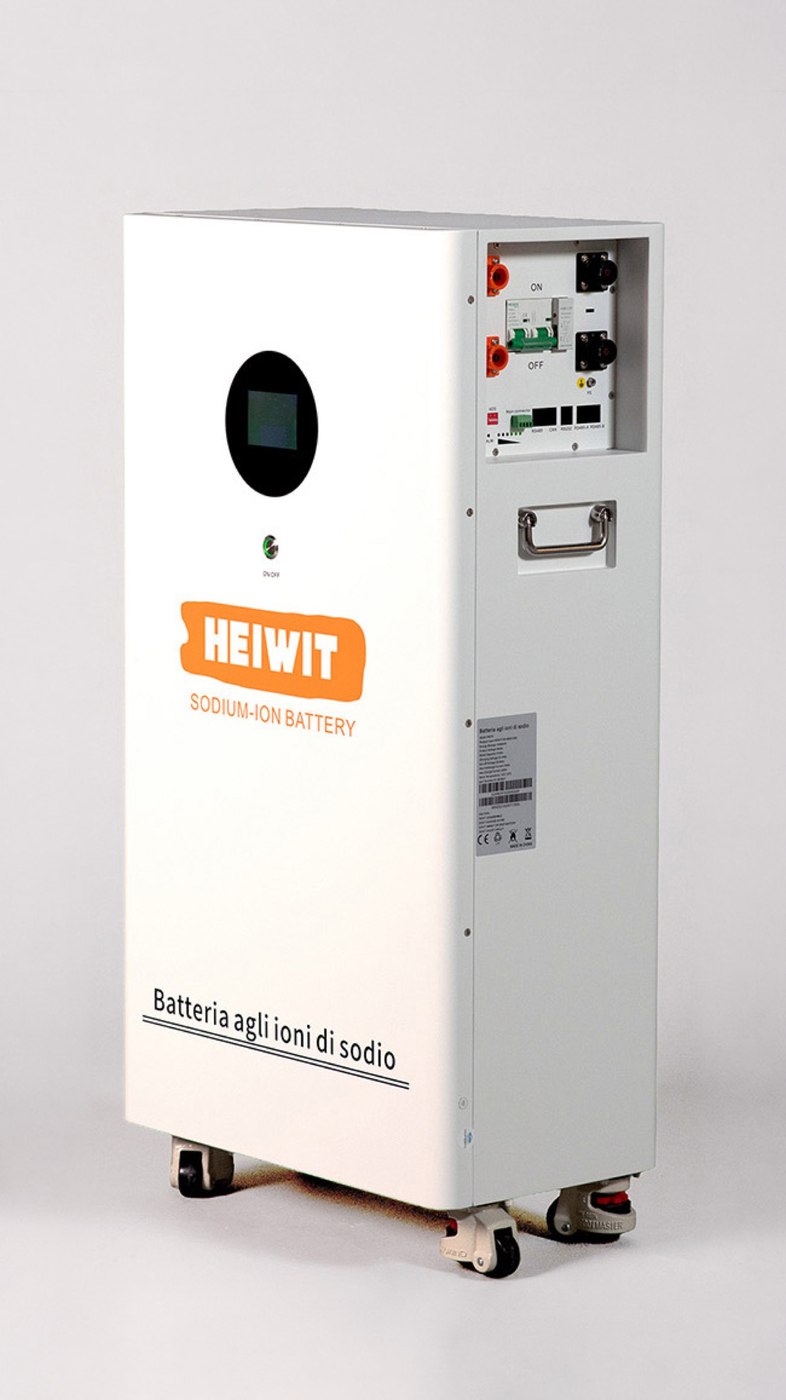
With the deployment of electric vehicles and storage systems (BESS) in increasingly “safety-critical” contexts (closed environments, buildings, infrastructure, large-scale logistics), the demand is no longer just how much energy we can store, but how a battery behaves when something goes wrong.
A recent scientific review proposes an “evidence-based” comparative analysis of safety between established (Li-ion) and emerging (sodium-ion and solid-state) technologies, showing a clear trend: moving from “engineered” safety (BMS, cooling, compartmentalisation) towards more 'engineered' safety. intrinsic, related to chemistry and materials. The comparison between lithium, sodium and solid-state batteries is also summarised in the article on why sodium can be safer than lithium.
Within this evolution, the sodium ion batteries (SIB) are gaining attention not only for cost and availability of raw materials, but above all for some measurable security advantages.
1) Increased “thermal margin” before runaway triggering
One of the most important indicators is the temperature T2, i.e. the threshold beyond which thermal runaway becomes irreversible. In various experimental comparisons, SIBs show higher trigger temperatures compared to many high-energy Li-ions: the review reports typical values in the range ~220-260/280 °C, against ~170-220 °C for NMC (all else being equal).
This means more margin to detect the anomaly and take action (thermal check, module insulation, emergency procedures).
Not only that: when the event occurs, the literature often describes a dynamic less “violent”, with less heat release and a slower progression (thus more time for mitigation and evacuation).
2) Slower propagation: more time to contain the accident
In real applications, the severity of a fault is often related to its ability to propagate from one cell to adjacent cells. For SIBs intermediate propagation rates (e.g. ~1.6-2.0 °C/min) and “neighbour trigger” times in the order of minutes (e.g. 8-12 min in some reports), being more manageable than high-energy Li-ion chemistries where propagation can be very fast.
For a systems integrator, this translates into a practical message: compartmentalisation, sensorisation and suppression strategies may have a wider window of effectiveness.
3) Venting gas: less hydrogen, less risk of explosiveness
Another dimension that is often underestimated is the gas composition released under failure conditions. The review shows that, while the formation of flammable gases (CO, hydrocarbons) remains possible, in SIBs the fraction of H₂ tends to be lower compared to some Li-ions (e.g.: ~30% against ~42% reported for LFP in consolidated data sets). Since hydrogen has a very wide flammability range and low ignition energy, reducing its presence may lower the explosive hazard of the mixture.
In addition, it is reported that SIB gases may show lower maximum explosion pressure and deflagration index than LFP and NMC, attributed to a higher CO₂ (non-flammable) and lower concentrations of highly reactive species.
4) Toxicity: a potentially better profile (and a road to “zero HF”)
In BESS in buildings, maritime contexts or confined spaces, safety is not only fire: it is also smoke toxicity. The review proposes a hierarchy in which, for scenarios where the accumulation of toxic gases is critical, SIBs are competitive and, with appropriate electrolytes, can become particularly interesting: they mention HF in the range of ~400-1000 ppm for SIB with NaPF₆ and the possibility of zero HF with formulations fluorine-free; In comparison, it is pointed out that LFP can generate very high levels of HF (order of 3000-8000 ppm).
The key point is not “one battery is always safer than another”, but that the dominant metric changes with the scenarioIn confined spaces, the toxicological profile can weigh as much as (or more than) T2 and propagation.
5) The real game changer for logistics and maintenance: 0-volt transport
Of all the advantages, there is one that is particularly operational: SIBs can be discharged and transported at 0 V with reduced risks. The rationale is in the materials: sodium does not alloy with aluminium to typical anode conditions, making it possible to use aluminium collectors also on the anode side and avoiding certain failure modes typical of copper in low SOC Li-ions (e.g. dissolution and restart problems). Result: less energy “stored” during transport and storage and reducing the risks of short, arc and thermal events in the supply chain.
For the supply chain this means potentially:
- procedures of warehouse and shipping more robust;
- easier management of end of line, assistance and EOL (from an operational security perspective);
- reduction of residual risk during handling and maintenance.
What follows: where SIBs make the most sense today
The review itself is very clear: the “rankings” of security are not universal and must be read by application. That said, the body of evidence (thermal margin, slower propagation, less explosive gases, improved toxicological profile and 0 V logistics) makes SIBs strong candidates especially for:
• stationary accumulation (BESS) where safety and total cost count more than maximum energy density;
- installations in which logistics and storage are a risk factor (supply chain, construction sites, remote sites);
- contexts where a compromise between performance and operational robustness.
To summarise: sodium ion batteries are not “magically invulnerable”, but show measurable security benefits and, above all, a unique operational advantage (0 V) that can become decisive in many industrial applications.
The wider thermal margin and the intrinsic safety described by the review do not remain theory: they are the criteria by which we select cells and electronics for our range of sodium-ion storage systems.
 Italian
  English
  German
  French
  Spanish
  Polish
  Dutch
Dutch  Romanian
  Hungarian
  Czech
Czech  Swedish
  Portuguese
  Greek
Greek