

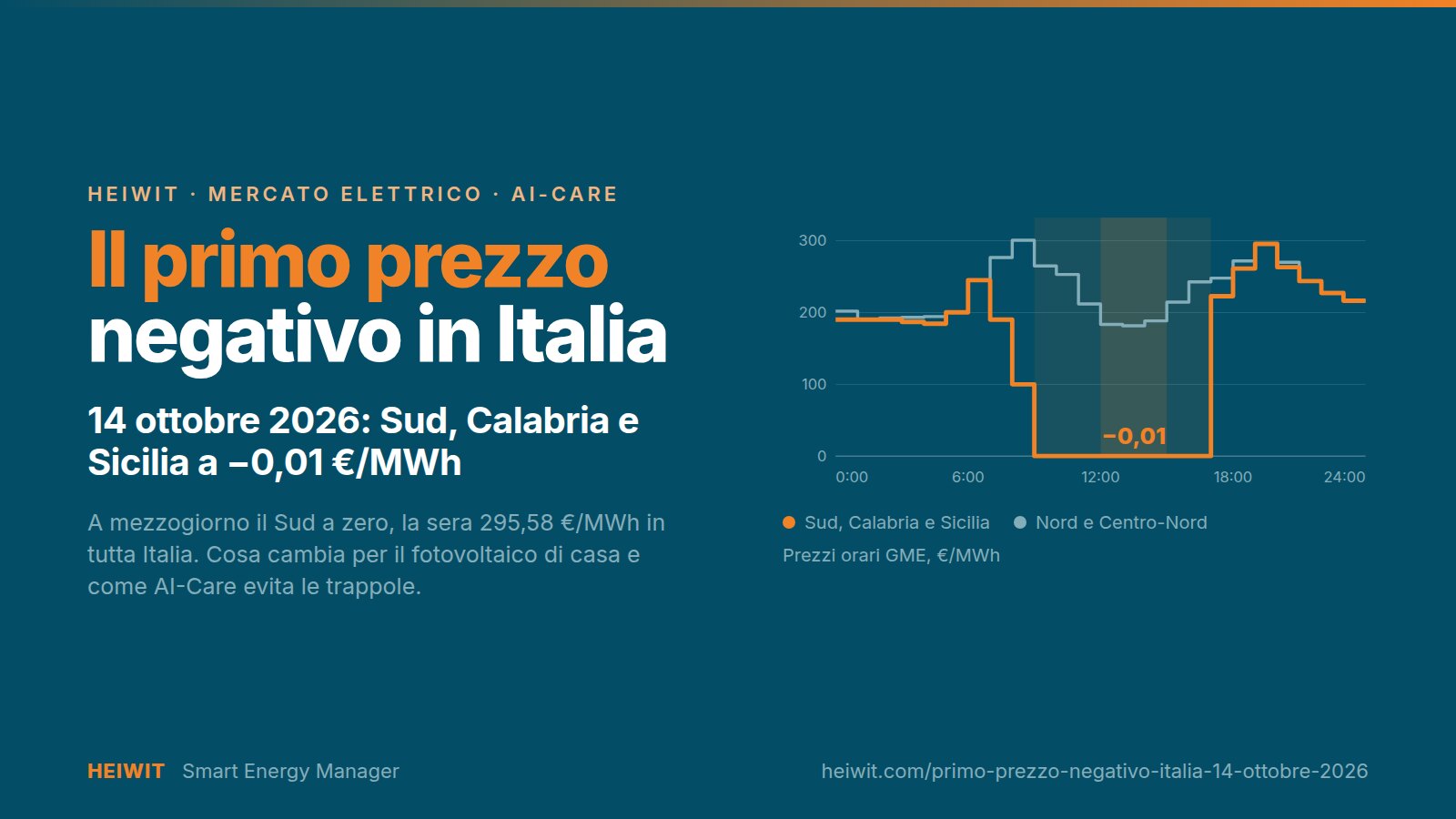
On 14 October 2026 the Italian electricity market recorded a negative hourly zonal price for the first time. In the day-ahead market the South, Calabria and Sicily zones closed at −0.01 €/MWh from 12:00 to 15:00, and at zero from 9:00 to 12:00 and from 15:00 to 17:00, while in the same hours the North was paying over 180 €/MWh. In the evening the price climbed back to 295.58 €/MWh across Italy. The minus sign is worth a thousandth of a cent per kWh, but the signal for solar owners is clear: in the South, on certain days, energy fed into the grid in the sunny hours is not paid for, while energy bought in the evening costs as much as ever. A battery managed by AI-Care keeps the day’s energy for the evening and sells only the surplus, before the sun comes up.
What happened on 14 October
Every day the energy market operator (GME) sets, in the day-ahead market (MGP), the price of electricity for the following day, hour by hour and zone by zone. Italy is divided into seven market zones: North, Centre-North, Centre-South, South, Calabria, Sicily and Sardinia. As long as the lines connecting them have spare capacity, the price is the same everywhere; when a line fills up, the zone with surplus energy is cut off and its price falls.
The auction closed on 13 October for the following day produced this result. In the South, Calabria and Sicily zones the price fell to 100 €/MWh between 8:00 and 9:00, to zero from 9:00, to −0.01 €/MWh from 12:00 to 15:00, then returned to zero until 17:00. In the same central hours the North and Centre-North stood between 181 and 188 €/MWh, the Centre-South and Sardinia between 28 and 58 €/MWh. From 17:00 the price rose everywhere and between 19:00 and 20:00 Italy became a single zone again, at 295.58 €/MWh.
All hourly prices on 14 October 2026 (€/MWh)
| Time | South, Calabria, Sicily | Centre-South, Sardinia | North, Centre-North | Pun |
|---|---|---|---|---|
| 0–1 | 190,10 | 202,00 | 202,00 | 200,35 |
| 1–2 | 190,10 | 190,80 | 190,80 | 190,70 |
| 2–3 | 190,10 | 192,25 | 192,25 | 191,96 |
| 3–4 | 186,97 | 193,22 | 193,22 | 192,38 |
| 4–5 | 184,37 | 194,44 | 194,44 | 193,09 |
| 5–6 | 200,25 | 200,25 | 200,25 | 200,25 |
| 6–7 | 245,00 | 245,00 | 245,00 | 245,00 |
| 7–8 | 190,10 | 276,64 | 276,64 | 265,55 |
| 8–9 | 100,00 | 287,07 | 300,82 | 273,08 |
| 9–10 | 0,00 | 220,67 | 265,00 | 223,27 |
| 10–11 | 0,00 | 200,00 | 253,08 | 211,01 |
| 11–12 | 0,00 | 59,49 | 212,08 | 154,42 |
| 12–13 | −0.01 | 47,21 | 183,33 | 130,60 |
| 13–14 | −0.01 | 27,83 | 181,50 | 126,43 |
| 14–15 | −0.01 | 58,43 | 188,40 | 138,10 |
| 15–16 | 0,00 | 85,75 | 214,49 | 161,41 |
| 16–17 | 0,00 | 171,00 | 242,79 | 197,45 |
| 17–18 | 222,76 | 240,20* | 248,02 | 243,01 |
| 18–19 | 261,30 | 271,85 | 271,85 | 270,43 |
| 19–20 | 295,58 | 295,58 | 295,58 | 295,58 |
| 20–21 | 263,13 | 270,01 | 270,01 | 269,04 |
| 21–22 | 243,77 | 243,77 | 243,77 | 243,77 |
| 22–23 | 227,15 | 227,15 | 227,15 | 227,15 |
| 23–24 | 216,40 | 216,40 | 216,40 | 216,40 |
* Sardinia 234.97 €/MWh between 17:00 and 18:00. Source: GME, day-ahead market results, hourly prices.
Two clarifications for anyone comparing sources. The GME numbers the hours from 1 to 24: the “hours 13, 14 and 15” cited in the first reports are the slots from 12:00 to 15:00. In addition, since 1 October 2025 the European day-ahead market also works in quarter-hours, and the GME publishes prices both per quarter-hour and per hour. According to the analysis by Andrea Giuseppe Ragno, there were 13 consecutive quarter-hours at −0.01 €/MWh, from 12:00 to 15:15, and the price stayed at or below zero from 8:30 to 16:45.
It is a first for the Italian day-ahead market. On the intraday markets, where producers adjust their schedules close to delivery, negative prices had already been seen in Sicily on dozens of days since 2025, and that day the third intraday auction reached almost −60 €/MWh.
As a level, −0.01 €/MWh is symbolic: the market stopped at the first step below zero. The minimum price of the European day-ahead market has been −600 €/MWh since 28 May 2026, when it was lowered from −500 after the negative records of late April and early May. On 1 May 2026 France and Austria had reached about −499 €/MWh.
Why the South
In the South three conditions came together. The figures below come from Ragno’s analysis of public data from Terna and the GME.
- Lots of wind. The South zone produced 59.5 GWh from wind, about three and a half times the August daily average; Sicily 25.2 GWh, about five times. In the central hours solar alone in the three zones reached about 4.6 GW.
- Low demand. At midday the South, Calabria and Sicily were consuming about 4.5 GW: solar alone covered almost all of it. Over the whole day Sicily consumed 40.5 GWh, about two thirds of an average August day.
- Congested lines. The link between the South and Centre-South was limited to 2,400 MW between 10:00 and 15:00, against 4,100–5,600 MW in the central hours in September; the one between Centre-South and Centre-North was full, at 2,000 MW, from 11:00 to 16:00. The surplus energy could not flow north, where the North was meanwhile importing from abroad.
According to the same analysis, there was little storage that could have absorbed that energy: in the South a few tens of MW of batteries, while the Sicilian pumped-storage plants, 885 MW, bought about 1 GWh in the day-ahead market against the roughly 7.5 GWh they could have taken in the zero- or negative-price hours. Part of the production was simply curtailed: between 11:00 and 15:00, Ragno estimates, between 2.1 and 2.6 GW of wind and solar in the South offered at or below zero found no buyer. As Valerio Covicchio, country manager at Whes, explained to pv magazine, negative-price bids have existed for some time, in Europe and in Italy: some plants would rather pay than shut down. What was new on 14 October is that demand fell far enough to meet them.
Zero prices, on the other hand, are nothing new in the South. In the GME hourly prices for January–October 2026, the hours with a zero or negative price were as follows:
| Market zone | Hours at zero or negative price, Jan–Oct 2026 |
|---|---|
| Sicily | 177 |
| Calabria | 175 |
| South | 174 |
| Sardinia | 95 |
| Centre-South | 73 |
| North and Centre-North | 14 |
Heiwit analysis of GME hourly zonal prices. In the South almost half of these hours (85) fell in May.
What changes for people with solar at home
Those who sell the energy they do not consume to the GSE, under the dedicated withdrawal scheme (ritiro dedicato), can be paid at the hourly zonal price, i.e. the price in their own zone in the hour the energy enters the grid. On 14 October, for a system in Apulia, Basilicata, Molise, Calabria or Sicily paid this way, the energy fed in between 9:00 and 17:00 earned nothing. Whether or not the minus sign is applied to the three hours at −0.01 €/MWh makes a difference of fractions of a thousandth of a cent: what counts is the zero. Those entitled to guaranteed minimum prices who have opted for them receive 4.75 cents per kWh for renewables in 2026, up to 1.5 million kWh a year, and at year end a balancing payment if zonal prices would have paid more.
On the purchasing side the price is different. Index-linked (variable) tariffs follow the PUN, which is the same for the whole of Italy: on 14 October it never fell below 126.43 €/MWh, between 13:00 and 14:00, and between 19:00 and 20:00 it stood at 295.58 €/MWh, before transmission, system charges and taxes. This is the trap: anyone in Sicily who that day fed their midday energy into the grid and bought energy back in the evening gave it away for free and paid it back at the highest price of the day.
What Heiwit batteries in the South did that day
We looked at the hourly data, measured by the inverters, of a sample of Heiwit systems with batteries in the South, Calabria and Sicily zones.
Just over a third of production was set aside when the market was not paying for it and returned to the home in the hours when energy costs the most: 57% of the energy discharged by the batteries came out from 17:00 onwards, in hours when the PUN averaged 254 €/MWh, weighted by the energy discharged. The rest of production went partly to household consumption and 44% to the grid, and 97.5% of that share went out in hours at zero or negative price: a full battery cannot do more.
The zero-price traps and how AI-Care avoids them
AI-Care is Heiwit’s Smart Energy Manager: every day it prepares an hour-by-hour plan for the battery, sends it to the inverter and corrects it as the day goes on (how AI-Care works, hour by hour). A day like 14 October lines up five traps.
1. Doing the sums with the wrong price
The PUN is the price you buy at, not the price you sell at. Between 13:00 and 14:00 on 14 October the PUN was 126.43 €/MWh and Sicily −0.01: a calculation based on the PUN would have given every kWh fed in in Sicily a value of over 12 cents that nobody paid. AI-Care values each hour’s sales at the zonal price of the zone where the system is located, derived from its position, and purchases at the PUN. The app’s plans and savings estimates therefore start from the real prices in your zone.
2. Giving energy away at midday and buying it back in the evening
This is the most expensive trap, and avoiding it is exactly what the battery is for. With AI-Care, from sunset to morning the home uses the battery’s energy and AI-Care does not sell it in the evening: it keeps it for consumption until dawn. The only exception is Holiday mode, when the home is empty: on those days AI-Care sells the energy that is not needed in the hours with the highest forecast price, evening included. On 14 October, in the South, the best-paid hour was between 19:00 and 20:00.
3. Selling when the market does not pay
If in the morning the battery holds more energy than needed until the sun arrives, AI-Care sells the surplus before solar production starts, and straight afterwards the sun recharges the battery for the evening. As a rule the hours before sunrise are paid more than the central ones: on 14 October, in the South, the price was 245 €/MWh between 6:00 and 7:00 and 190.10 €/MWh between 7:00 and 8:00, against zero in the central hours. On systems with AI-Care active, from 22 October to 2 November 2026 the energy fed into the grid before 10:00 was worth an average of 268 €/MWh, and the energy fed in between 10:00 and 17:00 199 €/MWh (hourly zonal price of each system, energy-weighted average).
There is a limit worth stating. The time of sale is tied to the arrival of the sun, not chased on the price list: it is right afterwards that the battery can recharge. On days when zero arrives early, such as 14 October in the South from 9:00, or 27 and 29 October in Sardinia with negative prices already between 9:00 and 11:00, the part of the sale that spills over into the first hours of sunshine is paid little or nothing.
4. Filling the battery too early
On sunny days the battery often fills up by mid-morning, and from then on all the production of the central hours goes to the grid at the lowest price. The peak-production charging, an optional AI-Care feature switched off by default, makes the battery wait after the morning sale and fills it during the central hours, choosing each day from the weather forecast when to restart so that it is still full by the evening. It is useful where the price drops only in the central hours, as in the North on 14 October (300.82 €/MWh between 8:00 and 9:00, 181.50 €/MWh between 13:00 and 14:00), and on systems with many panels relative to the inverter. On a day like that in the South, with zero from 9:00 to 17:00, shifting the charge does not change the revenue: all that matters is that the battery is full by the evening.
5. Thinking negative prices pay consumers
For a household the negative price does not reach the bill: anyone buying on an index-linked tariff pays the PUN, which on 14 October did not fall below 126.43 €/MWh, plus transmission, system charges and taxes. In any case, AI-Care does not charge the battery from the grid: it only decides how to use the energy produced by your roof.
Update of 3 November: what happened next
14 October did not remain an isolated case. On Saturday 24 October it was Sardinia’s turn, for the first time: −0.10 €/MWh between 16:00 and 17:00. On 27 October Sardinia fell to −2.03 €/MWh between 9:00 and 10:00 and to −0.75 €/MWh between 10:00 and 11:00 and between 14:00 and 15:00; on 29 October to −1.06 and −1.00 €/MWh between 9:00 and 11:00.
The interview published by pv magazine on 22 October recalls that in 2026, up to 16 October, the PUN had been at zero for 14 hours (10 over the weekend of 1–3 May, 3 on 24 May, 1 on 5 July), and Covicchio expects the next zero PUNs in spring; over the same period installed solar capacity in Italy rose from 41.1 GW in September 2025 to 48.3 GW in September 2026. Until grids and storage grow in step with solar, days like 14 October may recur in the South and on the islands.
Frequently asked questions
What is a negative zonal price?
It is the price for one hour, in one market zone, that closes below zero: whoever feeds energy into the grid in that hour pays instead of being paid. It happens when a zone has more energy than can be consumed or exported and some producers would rather pay than shut down. In Italy it happened for the first time on 14 October 2026, at −0.01 €/MWh, in the South, Calabria and Sicily zones.
Do negative prices lower household electricity bills?
No. Index-linked (variable) tariffs follow the PUN, which is a national price and on 14 October did not fall below 126.43 €/MWh; on top of that come transmission, system charges and taxes.
Do people on the dedicated withdrawal scheme lose out?
Those paid at the hourly zonal price earn nothing in those hours: the negative value is so small as to be negligible. Those who opted for guaranteed minimum prices receive 4.75 cents per kWh (2026 value, up to 1.5 million kWh a year) and, at year end, a balancing payment if zonal prices would have paid more. Either way, energy fed in at midday is worth far less than the energy bought back in the evening.
Will it happen again?
It already has: in Sardinia on 24, 27 and 29 October 2026. Zero-price hours are already frequent in the South and on the islands: from January to October 2026 there were 177 in Sicily, 175 in Calabria and 174 in the South zone.
Does AI-Care buy energy from the grid when it is cheap?
No. AI-Care does not charge the battery from the grid: it decides when the home uses the battery, when the battery recharges from the sun and how much energy to sell in the morning. In any case, a negative zonal price does not reach people who buy energy on a household tariff.
What is the best thing to do with a solar system in the South?
Use as much energy as possible at home during the sunny hours, for example for the washing machine, dishwasher and hot water, and use a battery to shift daytime production to the evening. On 14 October, on Heiwit systems in the South, 57% of the energy returned by the batteries was discharged after 17:00, when the PUN averaged 254 €/MWh.
Sources
- GME, day-ahead market results, zonal prices and PUN Index GME, hourly prices from 1 January to 31 October 2026.
- GME, SDAC 15-Minute Market Time Unit (MTU) Go-Live Date, 13 May 2025.
- ARERA, Dedicated withdrawal (ritiro dedicato) and guaranteed minimum prices.
- GSE, Dedicated withdrawal (ritiro dedicato), economic rules of the service.
- Sergio Matalucci, Prezzi elettrici negativi in Italia: un evento storico che apre nuovi scenari per gli accumuli?, pv magazine Italia, 22 October 2026.
- Sergio Matalucci, Italy’s negative prices highlight battery storage opportunity, ESS News, 23 October 2026.
- Andrea Giuseppe Ragno, Italy’s first negative prices, 22 October 2026.
- Alfredo Spalla, MGP, anche la Sardegna vede i prezzi negativi per la prima volta, Montel News, 23 October 2026.
- Prezzi negativi, il floor sulle borse UE scende a −600 €/MWh, Staffetta Quotidiana, 7 May 2026.
- Heiwit, analysis of hourly data from a sample of battery systems monitored by AI-Care: South, Calabria and Sicily zones on 14 October 2026; systems with AI-Care active from 22 October to 2 November 2026.
AI-Care is the Heiwit Smart Energy Manager; how it works hour by hour is explained in the guide How AI-Care works. More guides, calculators and tutorials in the Heiwit guide collection.
 Italian
 English
 German
 French
 Spanish
 Polish
 Dutch
 Romanian
 Hungarian
 Czech
 Swedish
 Portuguese
 Greek