

A photovoltaic quote shouldn't start from a generic estimate. It should start from the client's real consumption, their roof, their energy habits, and a simulation built on data. This is the logic behind AI-Care's Intelligent Quoter.
The commercial path of a photovoltaic system is often more complex than it appears. The client asks for a price, but before discussing price, one needs to understand how much energy they consume, when they consume it, how much usable roof space they have, what technical constraints exist, what size system makes sense to install, and what storage can truly improve self-consumption. If this phase is handled superficially, the risk is proposing a system that is not very consistent with their real needs.
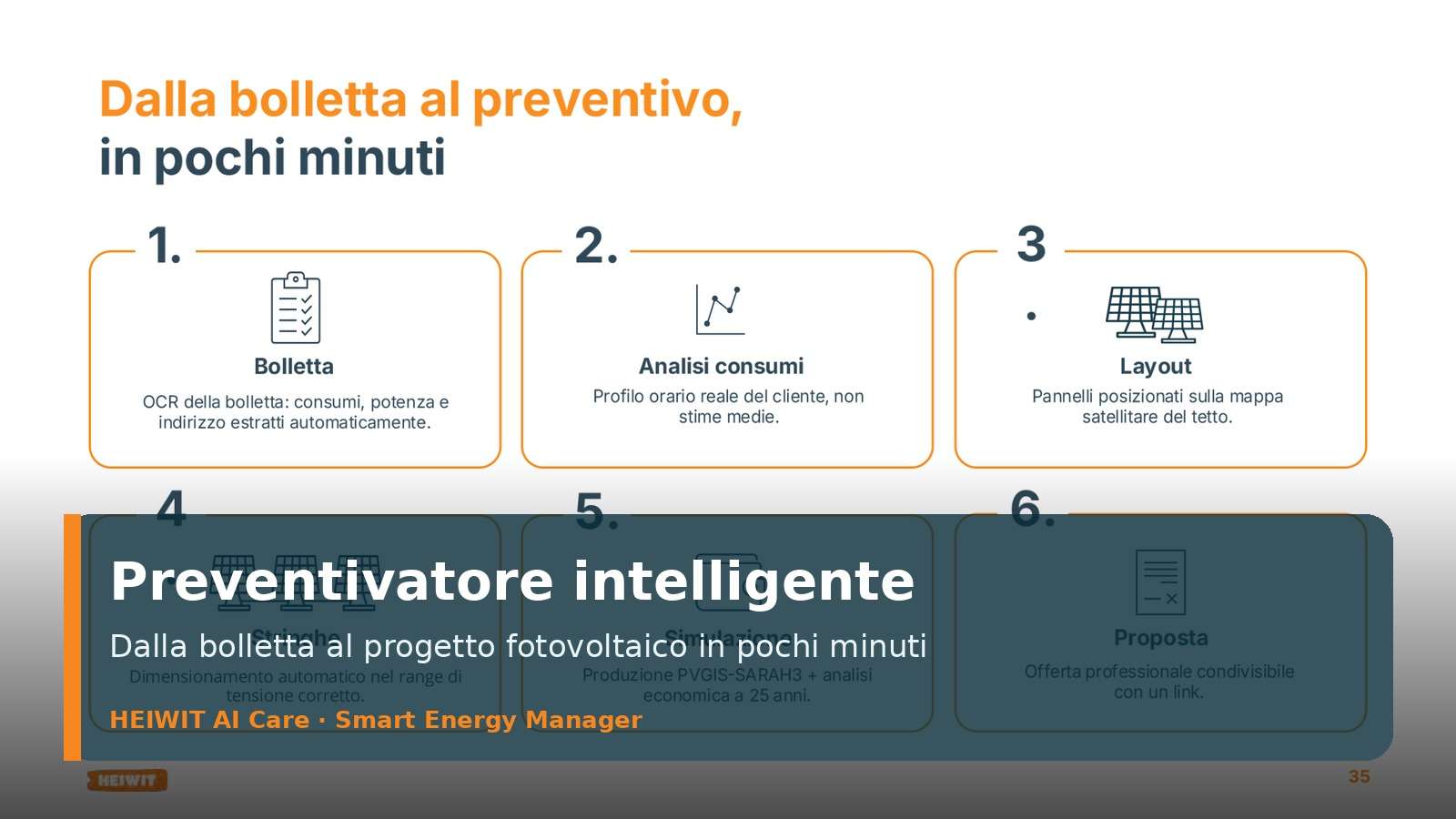
AI-Care introduces a guided workflow that starts with the bill and ends with a shareable proposal. The objective is to speed up the installer's work and, at the same time, provide more robust advice to the final customer.
From the bill to actual consumption
The first step is the analysis of the bill. The system uses OCR to automatically extract information such as consumption, power, and address. This reduces manual work and limits transcription errors. But the real value is not just reading the data: it is transforming it into an energy profile useful for sizing.
Many quotes are built on average annual consumption. This is an important figure, but it’s not enough. Two families can consume the same kWh in a year and have completely different needs: one concentrates consumption in the evening, the other works from home and consumes during the day; one has a heat pump, the other doesn't; one charges an electric car, the other uses the house very little during the summer months. An intelligent estimator must get as close as possible to real-world usage.
Hourly profile, not generic estimates
AI-Care works to build an hourly profile of the customer. This allows for a more accurate assessment of how much energy can be self-consumed, how much can be stored, and how much could be fed into the grid. It is a fundamental step for correctly sizing the battery and photovoltaic system.
The risk of an overly superficial estimate is twofold: proposing an under-dimensioned system, which does not cover enough needs, or an over-dimensioned one, which produces a lot of unused energy. In both cases, the client may not achieve the expected result. Starting from real data, on the other hand, helps to build a more defensible and professional proposal.
Rooftop layout for client
The estimator doesn't just stop at the bill. It also incorporates the panel layout onto the satellite map of the roof. This makes the proposal more concrete, as the client sees not just numbers, but a visual representation of the system. For an installer, this is a significant advantage: the proposal becomes clearer, more understandable, and easier to discuss.
The layout also helps to reason about available spaces, orientation, potential shading, and string configuration. Every roof is different, and every system must comply with precise technical limits. Automating part of this analysis does not mean eliminating the professional's work, but rather giving them a faster tool to arrive at an initial coherent configuration.
Automatic sizing in the correct range
One of the most useful functions concerns string sizing and adherence to the correct voltage range. Those who design systems know how important it is not to simply “put panels on the roof”. Strings must be compatible with the inverter, voltage limits, and real operating conditions.
AI-Care supports automatic sizing, helping to reduce errors and inconsistencies in the preliminary phase. This is particularly important when working on many quotes: the installer can maintain a higher technical standard even when the volume of requests grows.
Economic simulation over 25 years
The estimator also integrates photovoltaic production simulation and economic analysis over time. Production is estimated using climate data, and the analysis can be projected over 25 years. This allows for consideration not only of the initial price but also of the system's long-term performance.
For the end customer, it is essential to understand why a specific system size and storage capacity have been proposed. A clear simulation helps to explain self-consumption, exported energy, expected savings, and the benefits of the battery. For Heiwit, this is a central point: the sodium-ion battery must be integrated into a coherent energy project, not added generically.
Deductible expenses and a praiseworthy proposal
The process may also include the calculation of applicable deductions, such as 50% for a main residence and 36% for a second home, where provided for by current legislation. The cost estimate must always be verified at the final quotation stage, but including it in the preliminary quote helps the client to understand the project more fully.
The final proposal can be shared via a link. This is a very important operational detail: no static PDFs that quickly become outdated, but a digital, updatable, and consultable proposal. The client can open it, review it, and share it; the installer can modify it and keep it consistent with the project's evolution.
A new entry point for AI-Care
The estimator is also the natural entry point into the platform. Every new system is created with structured data: customer consumption, planned configuration, layout, simulation, storage, and proposal. This means that, once installed, the system can enter AI-Care with an already organised database.
This continuity between sales, design, installation, and monitoring is one of the most important advantages. The quote is no longer a document separate from the rest of the system's lifecycle. It becomes the first step in intelligent management that continues after installation.
Conclusion
The AI-Care Smart Estimator was created to make photovoltaic proposals faster, more accurate, and professional. From the bill to the layout, from the simulation to the shareable link, every step is designed to help the installer and customer make better decisions.
The market is asking for solutions that are simple to understand but technically robust. Heiwit responds with an integrated approach: sodium-ion battery, intelligent monitoring, energy management, and guided quoting. Because the real value isn't just selling a system, but designing an energy system that continues to perform well over time.
Real data, layout, simulation, and a shareable proposal help the installer to work better and the customer to choose with greater awareness.
In the simulation that starts from the bill, the item that changes self-consumption the most is the storage size: here it helps to know the range of sodium-ion systems and, for the most common configurations, the 10 kWh module.
 Italian
  English
  German
  French
  Spanish
  Polish
  Dutch
Dutch  Romanian
  Hungarian
  Czech
Czech  Swedish
  Portuguese
  Greek
Greek