

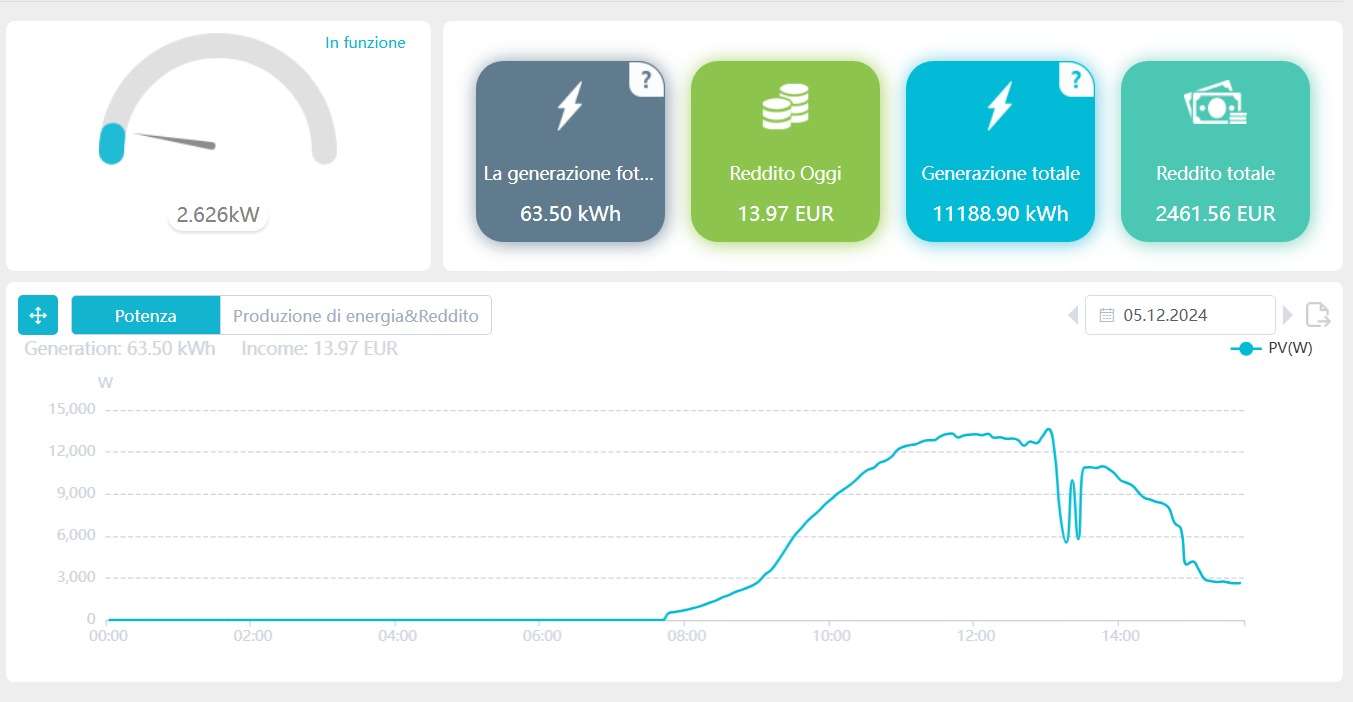
The graph of the daily production of one of our plants, dated 5 December 2024, shows an interesting case for analysing the opportunities and criticalities of photovoltaic energy management.
1. Initial phase: morning growth
Time: Around 08:00 hours.
Production: Gradual start, in line with the increase in solar irradiation.
This phase reflects the normal behaviour of an efficient photovoltaic system, which follows the solar cycle.
2. Peak phase: maximum production
Time: Around mid-day.
Production: Reaching the peak, with stable and optimal output.
During this phase, the plant works at maximum available capacity, taking advantage of the favourable atmospheric conditions.
3. Critical phase: production stoppage
Timetable: In the afternoon.
Production: A sharp drop in production.
Cause: Neither an atmospheric nor a technical problem, but the saturation of the power grid, which prevented further energy input.
Consequence: The inverter was forced to stop or reduce production, so the energy was not put to use and potential energy was wasted.
Problems and opportunities
The critical issues encountered
Saturated grid: The lack of capacity of the grid to absorb all the energy produced is a common limitation in some areas.
Economic loss: every hour of energy not fed into the grid is energy that was produced but not put to use.
Note: the euro values shown in the monitoring app screenshot are calculated by the app using a fixed tariff set manually and do not correspond to actual revenue.
Possible solutions
Short term:
Collaboration with the network operator to monitor and resolve frequent saturation events.
Medium- to long-term:
Storage systems: Integrating storage batteries, such as sodium ion batteries, allows excess energy to be stored and used later, reducing dependence on the grid.
Management optimisation: Adopt solutions that best balance production peaks and consumption.
Why storage systems are essential
This case clearly demonstrates how important it is to have an advanced storage system capable of
Maximising the value of the energy produced.
Reduce waste.
Increasing your energy independence.
Sodium-ion batteries are an effective solution, with cells free of lithium and cobalt. With these systems, we can optimise photovoltaic production and successfully meet the challenges of grid saturation.
Investing in intelligent energy management solutions is not only a strategic choice, but a necessity for a more efficient use of the energy produced.
The afternoon slump described here is precisely the time when energy should be conserved rather than wasted: to understand how, take a look how sodium-ion storage works and the 10 kWh HEIWIT-NA module.
 Italian
 English
 German
 French
 Spanish
 Polish
 Dutch
 Romanian
 Hungarian
 Czech
 Swedish
 Portuguese
 Greek