

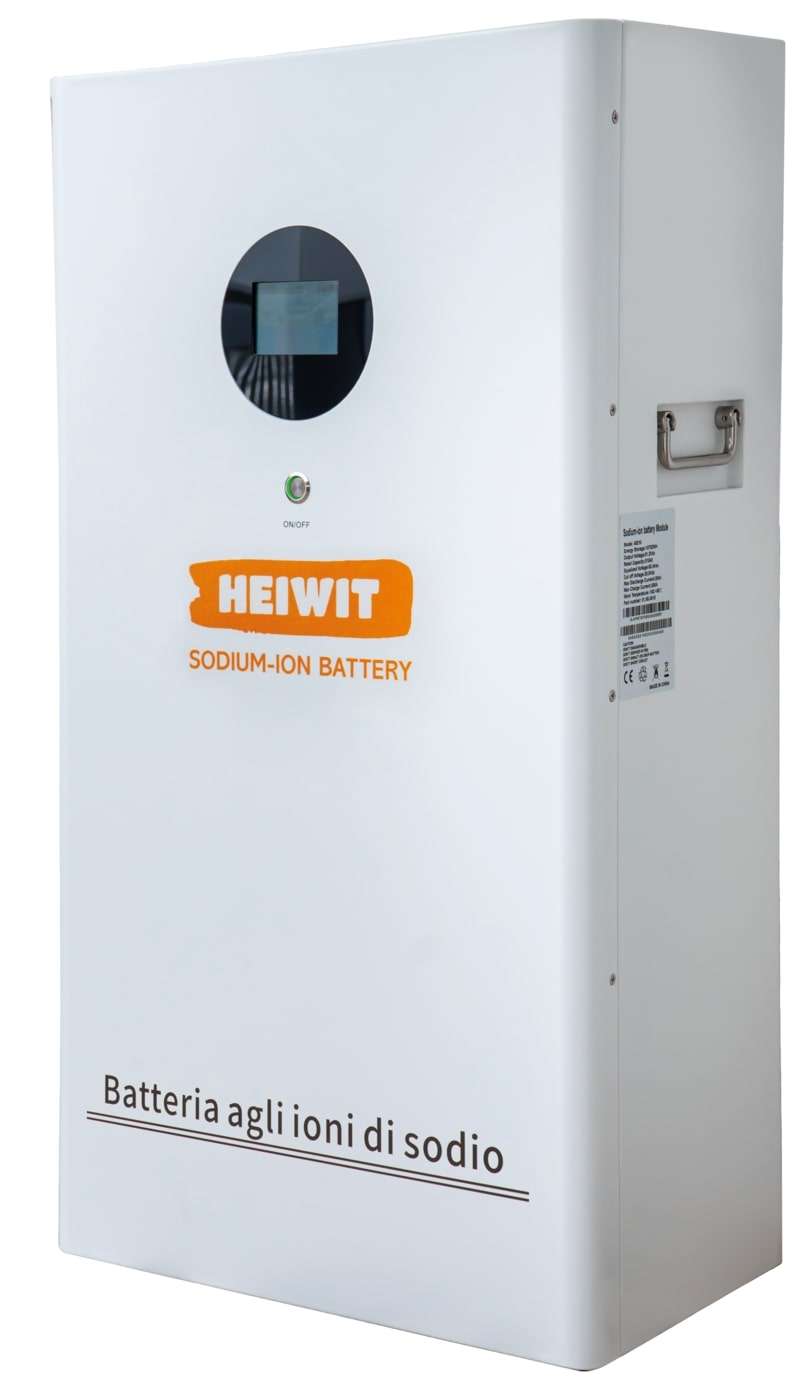
Sodium-ion self-discharge: only 6% lost over 539 days
When talking about battery storage, the focus is often solely on capacity, power, and price.
But there is one parameter that says a great deal about the real quality of a battery: the self-discharge.
And it's precisely here that our HEIWIT 10 kWh sodium-ion battery shows an extremely interesting figure.
Between 31 October 2024 and 23 April 2026, the battery lost only the 6%.
Means an average self-charge of just about 0.35% per month. Measurement taken on several batteries, at room temperature, at the latitude of Milan.
What is self-loading?
Self-discharge is the natural loss of energy that a battery undergoes over time, even when not in use.
In other words: a battery can lose some of its charge simply by remaining idle.
For this reason, a low self-discharge value is a very important indicator.
This means that the battery can retain energy better over time,
reducing waste and maintaining the available charge for longer.
Why is this data so relevant?
A total loss of 6% over 539 days is equivalent to approximately 0.011% per day,
or around 4.1% (annual equivalent).
The battery maintains its energy extremely stably over time.
This is a tangible benefit, particularly in all those cases where the storage system is not stressed in the same way every day:
second homes, systems for occasional use, backup systems, homes with variable consumption or periods of low usage.
What does it mean for someone using a battery at home?
- More energy conserved over time, instead of being wasted unnecessarily.
- Greater real efficiency when the battery remains charged for days or weeks.
- More reliable performance even when the system is not used continuously.
- Less invisible energy waste, which in the long run make the difference.
The value of self-discharge in sodium-ion batteries
In the debate about storage technologies, the cost per kWh is often discussed, but much less about how much a battery lasts.
to actually store the stored energy.
And yet, this is precisely one of the aspects that separates a “datasheet” battery from one that's viable in real life.
The observed data on our HEIWIT 10 kWh battery shows a extremely low self-discharge.
It is the type of result that translates into a simple but fundamental perception:
The energy stays where it needs to stay, that is, inside the battery, ready when needed.
A small piece of data, a huge meaning
Losing just 6% over a period of 539 days is not just an interesting figure.
It's a concrete indicator of stability, Design quality and The capacity to store energy over time.
In a sector where every percentage point counts, being able to talk about approximately 0.35% per month: average self-discharge observed
means being able to show a real, measurable and immediately understandable technical feature.
HEIWIT 10 kWh: energy that remains available, over time.
Why a big battery isn't just one that accumulates energy. It's one that truly conserves it.
Figure calculated over the period between 31/10/2024 and 23/04/2026, equal to 539 days, on several batteries, at room temperature and at the latitude of Milan.
The total observed loss of 6% corresponds to an average self-discharge rate of approximately 0.34–0.35% per month.
Such low self-discharge stems from the design of the module: data, datasheet and manual are in the 10 kWh sodium-ion battery data sheet.
Technical content drafted and subject to internal review by HEIWIT R&D, the function responsible for classifying cells and conducting tests on Heiwit storage systems.
 Italian
  English
  German
  French
  Spanish
  Polish
  Dutch
Dutch  Romanian
  Hungarian
  Czech
Czech  Swedish
  Portuguese
  Greek
Greek