

Observational study · Residential accumulation
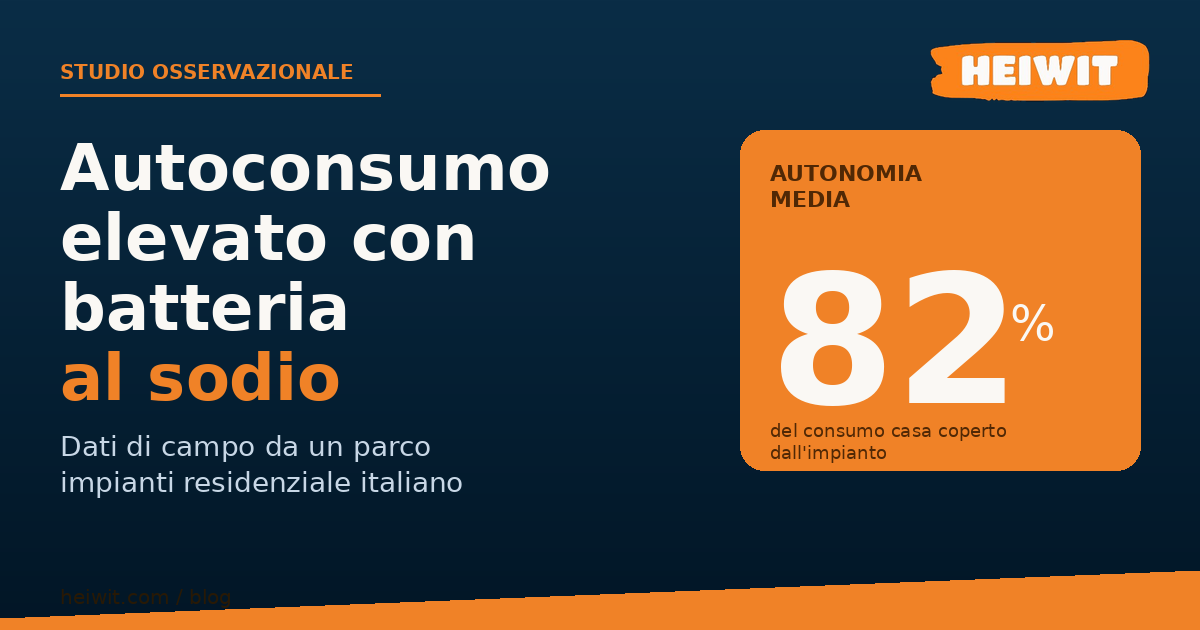
High self-consumption with sodium-ion batteries: data from an Italian plant park
Analysis of the distribution of energy autonomy across a park of facilities
residential photovoltaic systems equipped with sodium-ion (Na-ion) storage.
Median higher than 80%, contribution from the flat discharge curve and
Considerations on the thermal behaviour of technology.
Foreword
The integration of an electrochemical storage system in a photovoltaic plant
domestic aims to transfer PV production over time into
Surge in consumption hours not directly covered by generation
solar. The most representative metric for this transfer is
the’energy autonomy in English self-sufficiency ratio),
defined as the fraction of household consumption covered by the system, calculated as:
autonomy (%) = (total consumption − grid draw) / total consumption × 100
In literature, Italian residential autonomy values with sized storage
They are typically in the range of 60% to 80%
(see RSE studies 2022; Quoilin and others., 2016). This note presents
the results of an internal monitoring survey on a sample of residential installations
with Heiwit sodium battery, showing a concentrated distribution on
higher values and discussing the technological factors that make it possible.
Methodology
The data comes from the Heiwit monitoring platform, which acquires
with minute-by-minute cadence the electrical quantities of connected systems.
For the present study, the following were aggregated, hour by hour
Cumulative sizes of internal inverter counters on a movable window
in 60 days
- energy produced by the photovoltaic generator;
- power fed to the grid (output);
- energy drawn from the grid (input);
- Energy transferred during battery charge and discharge.
Installations lacking a complete time series have been excluded.
over the period (installations less than 30 days old or with interruptions
communication channels exceeding 15% of the time). The following were also segregated
installations operating in “Zero Export” mode, whose PV production can
result in underestimation due to the curtailment set by the inverter
Awaiting network connection authorisation: for these systems
the autonomy is still calculable, but with the awareness that it is
from a conservative estimate compared to the definitive operating regime.
All of the sample's units are equipped with sodium-ion storage.
Heiwit (16S configuration, ~48V nominal) with proprietary BMS and
continuous monitoring of key battery health parameters
(State of Health, cycling, cell temperature).
Results
Distribution of energy autonomy
The average energy autonomy of the sample was equal to
82%, with a range observed from 23% to 98%. The distribution
it is markedly skewed towards high values, with the vast majority of
systems ranging from 80% to 95%.
| Range of autonomy | Park quota | Reading |
|---|---|---|
| ≥ 95% | approximately 12% | Near total independence from the grid |
| 80%–94% | approximately 56% | Optimised residential typical profile |
| 60%–79% | approximately 24% | Good level, room for improvement (e.g. accumulation capacity) |
| 40%–59% | approximately 3% | Profiles with heavy evening consumption compared to PV production |
| < 40% | approximately 5% | Recent or undersized systems for consumption |
The data that emerges most clearly is the concentration of over
68% in the park above the 80% of autonomy, one level
generally associated in literature with accumulated configurations
oversized or with very regular consumption profiles. The finding
a heterogeneous operational sample (different loads, different exposures,
varying seasonality) reaches these levels with sizings
standard warrants a closer look at the mechanisms that make it possible.
Discharge curve and depth used
Sodium-ion batteries based on layered or polyanionic cathodes
(NFPP) present a discharge voltage curve
essentially flat in a wide state of charge range
(SoC) — typically between 5% and 95% — unlike lithium iron
phosphate (LFP), which also has a wide plateau but closes the useful window
a few percentage points earlier at the two extremes. In practice, this means
that the power delivered by the sodium battery remains nominal up to
very low charge states, without the BMS imposing derating or shutdowns
Discharge pre-checks.
Operationally, this translates to a usable depth of discharge (DoD)
actually exploited a few percentage points higher compared to
a lithium battery of the same nominal capacity. On a daily series
typical residential load, these additional points shift the
Transition from the “controlled discharge” regime to the “supplementary network” regime”
for 30–50 minutes, directly contributing to improved independence
registered.
Thermal behaviour
A second characteristic of sodium chemistry observed in the data is
monitoring is the performance stability as a function of temperature
exercise. Whereas for lithium chemistries the power available in
drops noticeably below +5 °C and when charging
typically limited below 0 °C, on the sample's Na-ion packs
the rated discharge power remained constant even on the datasets
acquired in northern Italian installations during the winter months, with
room ambient temperatures measured in the range −5 °C / +35 °C.
This flatness thermal has significant practical effect
on autonomy: in the early hours of the morning, when consumption is
Typically concentrated (hot water, cooking, electric heating
(auxiliary) and PV production is still minimal, the battery is capable
to deliver the power required by the load even if the technical room
it is not air-conditioned, avoiding the transit of a withdrawal quota from
net that with other chemicals would be inevitable.
Discussion
The main factor explaining the high autonomy observed in the sample
analysed, it is the combination of three typical elements of sodium technology:
- Extended SoC utility windowthe flat voltage curve
allows operation in discharge down to very low states without derating,
increasing the effectively utilised DoD in daily cycling. - Temperature independence: the rated power
it is also available for use in non-air-conditioned environments,
eliminating the typical derating of lithium chemistries in cold months
and coping with the morning peak demand. - Dynamic response of the packs and the BMS: latency
during the transition from charge to discharge (and vice versa) is less than a second
on the monitored systems, a condition that minimises the proportion of consumption
covered by the grid during the transition.
In addition to these intrinsic factors, there is a systemic factor: the
the ability to discharge the battery to very low charge levels without
accelerated effects on calendar and cyclic degradation. The evidence
experimental results published on NFPP cathodes and Prussian-type cathodes
White (see Hwang and others., Chem. Soc. Rev. 2017;
Tapia-Ruiz and others., J. Phys. Energy (2021) indicate a
a wide chemical stress window, consistent with the fact that, in our
According to the data, plants that have been in operation for more than 12 months show no deviations
SoH classifications compared with more recent ones.
Limitations of the study
The results presented here are indicative of the residential housing stock
Italian and should not be generalised to different consumer profiles (commercial,
light industrial, off-grid). The 60-day observation window
covers a limited seasonality; a 12-month analysis will consolidate the
estimate of the median range and will allow for a separate assessment of
summer and winter terms, during which we expect a decline
metric check during the cold months (due to reduced solar radiation,
(not due to technological limitations of the battery).
It is also observed that a not insignificant portion of the analysed park
It is under the “Zero Export” regime pending connection authorisation
definitive, a condition in which the inverter limits PV production. For
These systems' range metric is an underestimate compared to the
normal operating conditions: further relocation is expected
of the distribution towards higher values once the process is complete
Authoritative.
Conclusions
The field analysis confirms that, on an Italian residential park
heterogeneous, equipped with a Heiwit sodium-ion battery, it is
possible to achieve average levels of energy autonomy
greater than 80%, with over a tenth of the park to
top of the scale (≥ 95%). The distinctive features of the
sodium technology — flat discharge curve, independence from
operating temperature, wide SoC useful window — contribute to
explain these values without resorting to over-sizing
of accumulation.
Over the next few months, we will be releasing an update with coverage of
a full solar year and a separate analysis of the distribution
of autonomy by time band and by season, including a
Quantitative comparison of the discharge curve between Na-ion and LFP measured
on same-sized batches in the laboratory.
The battery life observed in the systems also depends on the thermal behaviour of the chemical composition and on how the battery releases energy at the end of the discharge cycle: both aspects are explained in the an overview of sodium-ion technology.
 Italian
  English
  German
  French
  Spanish
  Polish
  Dutch
Dutch  Romanian
  Hungarian
  Czech
Czech  Swedish
  Portuguese
  Greek
Greek