
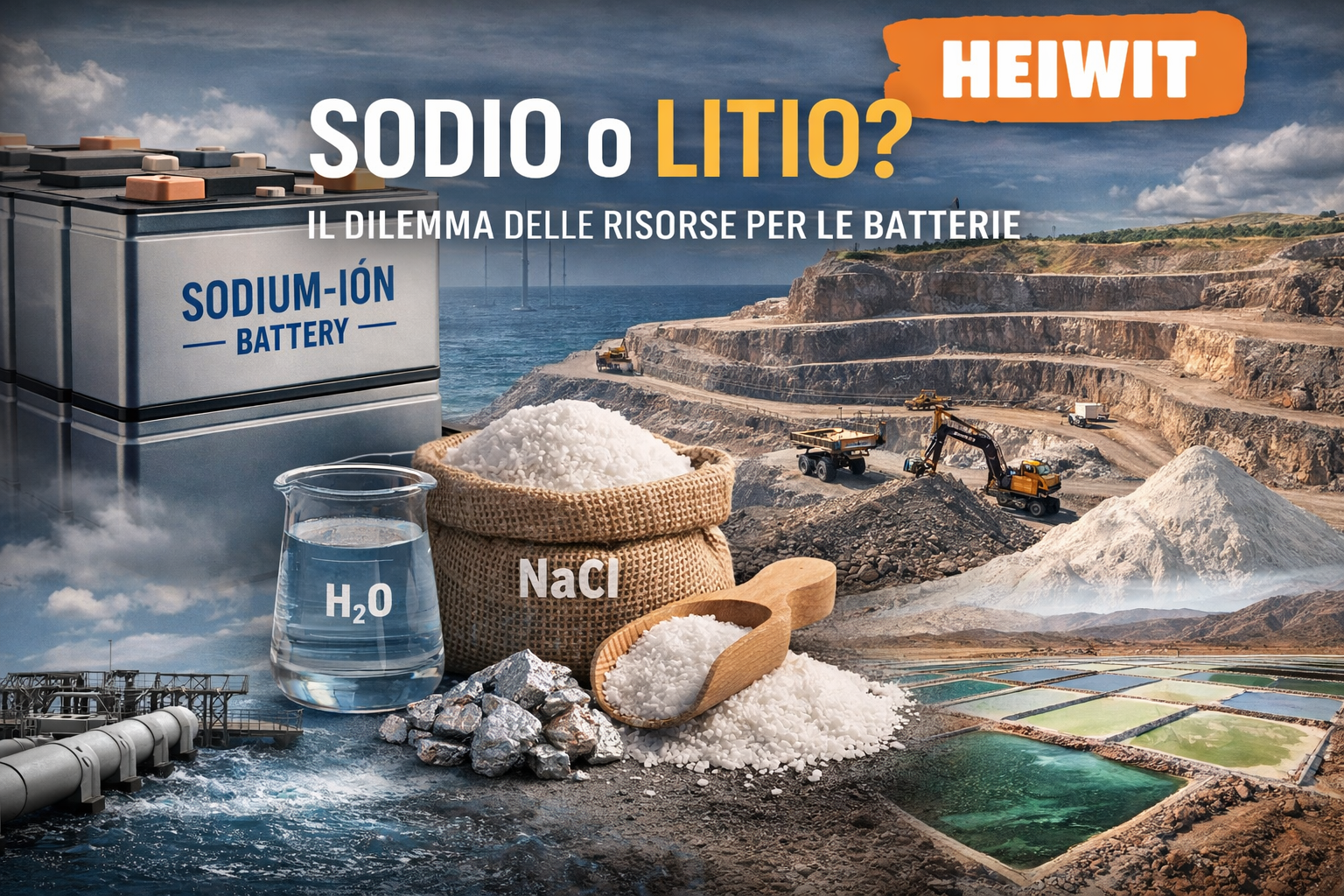
I sistemi di cui si parla sono quelli della Heiwit range of sodium-ion batteries.
How much raw material is really needed for sodium-ion batteries? The scientific calculation, explained simply
Spoiler: no, the sea would not be desalinated if all the batteries the world needs were sodium-ion. Vediamo perché.
Quando si parla di batterie al sodio, una delle obiezioni più diffuse è questa: “Se il sodio viene dal mare, allora per fare abbastanza batterie bisognerebbe desalinizzare gli oceani”. È un’immagine suggestiva, ma è sbagliata.
La realtà è molto diversa: il sodio è uno degli elementi più abbondanti, diffusi e accessibili sulla Terra. Si trova nel mare, certo, ma anche in enormi giacimenti di sale, in salamoie naturali e in una filiera industriale che già oggi movimenta quantità gigantesche di cloruro di sodio. Per questo, dal punto di vista della disponibilità della materia prima, il sodio parte da una base molto più sostenibile e scalabile del litio, especially for stationary storage.
In other words: la sfida delle batterie agli ioni di sodio non è trovare abbastanza sodio. La sfida è trasformare una materia prima abbondante ed economica in celle sempre più efficienti, durevoli, sicure e industrializzabili.
Short answer: anche in uno scenario globale molto spinto, la quantità di sodio necessaria per alimentare decine di TWh di storage sarebbe compatibile con una frazione della filiera mondiale del sale già esistente.
Conclusion: il sodio non richiederebbe di “svuotare il mare”, mentre il litio resta legato a una filiera molto più critica, concentrata e sensibile sotto il profilo estrattivo e geopolitico.
Perché questo tema è importante
La transizione energetica richiederà una quantità enorme di sistemi di accumulo. Con l’aumento di fotovoltaico ed eolico, il mondo avrà bisogno di batterie in grado di immagazzinare energia in modo sicuro, economico e scalabile.
Ed è qui che entra in gioco una domanda decisiva: Are raw materials really enough?
Per il litio, la questione è centrale. Per il sodio, invece, il quadro cambia radicalmente: parliamo di un elemento estremamente abbondante, già presente in enormi flussi industriali e distribuito in modo molto più ampio. Questo è uno dei motivi per cui il sodio rappresenta una delle strade più promettenti per una sostenibilità reale dello storage su larga scala.
How many batteries would the world need?
Non esiste un solo numero definitivo, perché il futuro dello storage sarà composto da più tecnologie: batterie, pompaggio idroelettrico, accumuli termici, idrogeno e altre soluzioni. Ma per fare un ragionamento scientifico serve uno scenario di riferimento.
We can use three simple levels:
- 1 TWh bulk accumulation: very large but still partial scenario
- 10 TWhhighly relevant global scenario
- 30 TWhA very ambitious global scenario for electrochemical storage
Per capire l’ordine di grandezza: 30 TWh significano 30 miliardi di kWh di capacità installata. È uno scenario volutamente estremo, utile proprio per testare la tesi più forte possibile: se davvero il mondo installasse decine di TWh di batterie al sodio, servirebbe una quantità irrealistica di materia prima?
La risposta, come vedremo, è no.
To calculate the amount of sodium needed for 1 kWh, we need to consider the energy content of sodium in a battery. This depends heavily on the type of sodium-ion battery technology being used. Here's a breakdown of the basic physics and how you'd approach the calculation: **1. Energy Density of Sodium:** The fundamental concept is energy density, usually expressed in Watt-hours per kilogram (Wh/kg) or Watt-hours per litre (Wh/L). For sodium-ion batteries, the theoretical specific energy of sodium itself is a component, but the overall battery performance is determined by the complete electrode materials and electrolyte. * **Theoretical Energy Density of Sodium Metal:** If we were simply considering the pure energy potential of sodium metal as an anode material, we could look up its theoretical specific capacity and combine it with the voltage. * *Theoretical Specific Capacity of Sodium (Na):* Approximately 1166 mAh/g. * *Nominal Voltage of Sodium Electrode (vs. SHE):* Approximately -2.71 V (this is a standard potential, actual battery voltage will be lower due to other components). However, directly using these values for a practical battery is an oversimplification. Practical sodium-ion batteries use sodium compounds in the electrodes, and the overall cell voltage is crucial. **2. Practical Sodium-Ion Battery Energy Density:** For practical calculations, you'd use the energy density of a *complete sodium-ion battery cell* that uses sodium. This value is determined experimentally or through advanced modelling of the specific battery chemistry (e.g., using sodium-nickel-manganese-cobalt oxide (NNMC) cathodes, layered oxides, polyanionic compounds, etc.). * **Typical Energy Densities:** Current state-of-the-art laboratory-scale sodium-ion batteries can achieve energy densities ranging from **70-160 Wh/kg** (and sometimes higher for advanced prototypes). Commercial cells are often lower. **3. Calculation Steps:** Let's assume we have a sodium-ion battery with a known energy density. * **Target Energy:** 1 kWh = 1000 Wh * **Known Value:** Energy Density (E_density) in Wh/kg * **Calculation:** To find the mass of *the battery* needed for 1 kWh, you would use: Mass of Battery = Target Energy (Wh) / Energy Density (Wh/kg) *Example:* If your sodium-ion battery has an energy density of **100 Wh/kg**: Mass of Battery = 1000 Wh / 100 Wh/kg = 10 kg **4. Relating to Sodium Mass:** The 10 kg calculated above is the mass of the *entire battery pack* (including cathode, anode, electrolyte, separator, casing, etc.). The actual mass of *sodium* within that battery pack will be a fraction of this total weight. * **Identifying the Sodium Component:** Sodium is typically used in the anode, and its contribution to the total mass depends on the specific electrode formulation. The cathode material also plays a significant role in the overall battery chemistry and mass. * **Estimating Sodium Mass (Approximation):** Without knowing the exact battery chemistry and electrode composition, it's impossible to give a precise figure for the sodium mass alone. However, you *could* estimate it if you knew the percentage by weight of sodium in the active anode material, and the percentage of the anode material in the total cell mass. * Let's say the anode material itself is 20% of the total battery mass. * And within that anode material, the active sodium-containing compound makes up a certain percentage. If we consider a simplified scenario where a significant portion of the anode is related to sodium. This becomes complex rapidly if you're looking at specific compounds like NaFePO4 or Na3V2(PO4)3. **In summary, for a basic physical calculation:** 1. **Determine the energy density (Wh/kg) of a practical sodium-ion battery you are considering.** This is the most crucial and variable factor, dependent on the specific technology. 2. **Divide the target energy (1000 Wh) by this energy density to get the total mass of the battery per kWh.** 3. **To find the mass of sodium *within* that battery, you would need detailed specifications of the battery's internal composition**, which is not a simple "physical constant" calculation but rather an engineering detail of the specific battery. **Therefore, the amount of *sodium* needed for 1 kWh is not a single, fixed number but depends entirely on the efficiency and engineering of the sodium-ion battery technology used.** You are effectively calculating the amount of *battery* needed, and then the sodium content is a fraction of that.
To answer, one must start from physics, not from impressions.
In a sodium-ion battery, each ion No+ carries one elementary electric charge. One mole of sodium corresponds to approximately 26.8 Ah of transferable electric charge.
Assuming an average cell voltage of approximately 3.0 V, una mole di sodio può trasferire circa:
26,8 Ah × 3,0 V = 80,4 Wh
Poiché una mole di sodio pesa circa 23 grams, the theoretical minimum of sodium to accumulate 1 kWh è:
1000 Wh / 80,4 Wh × 23 g ≈ 286 g di sodio
Per semplicità divulgativa e per non sottostimare, arrotondiamo a:
0.30 kg of sodium per kWh of battery
Questo valore non è uno slogan commerciale, ma un Order of magnitude physics. Nella pratica può variare in base alla chimica specifica, ai materiali attivi, al design della cella e alle riserve di sodio presenti nel sistema, ma il punto chiave non cambia: la quantità di sodio necessaria resta sorprendentemente contenuta rispetto all’enorme disponibilità naturale del materiale.
Real numbers translation: from 1 TWh to 30 TWh
| Capacità installata | Sodium required | Salt equivalent (NaCl) | Theoretical equivalent in seawater* |
|---|---|---|---|
| 1 TWh | 0.30 million tonnes | circa 760,000 tonnellate | circa 0,03 km³ |
| 10 TWh | 3.0 million tonnes | around 7.6 million tonnes | circa 0,28 km³ |
| 30 TWh | 9.0 million tonnes | around 22.9 million tonnes | circa 0,8 km³ |
*Questo dato indica quanta acqua marina conterrebbe, in teoria, quella quantità di sodio. Non significa che sarebbe necessario trattare quell’acqua con impianti di desalinizzazione.
Clear refutation: no, the sea would not be desalinated
Qui è fondamentale essere molto chiari.
Sodium batteries do not require desalination of seawater.
La desalinizzazione è un processo pensato per ottenere Freshwater from saltwater. The battery supply chain, on the other hand, needs Sodium salts as a chemical raw material. They are two profoundly different things.
Dire che il sodio “può venire dal mare” non significa che il mondo dovrebbe costruire enormi impianti per togliere sale dagli oceani al solo scopo di fare batterie. Il sodio industriale può provenire da:
- sales gem rock salt
- Greeting natural
- solar evaporation
- flussi chimici e industriali già esistenti
La rappresentazione corretta non è quindi “un mondo che prosciuga il mare”, ma una filiera che attinge a risorse saline vastissime, già oggi utilizzate dall’industria su scala globale.
What part of the salt supply chain would actually be needed?
Il cloruro di sodio, cioè il comune sale, contiene circa il 39,3% in terms of mass. This means that to obtain 1 tonne of sodium, you need approximately 2.54 tonnes of NaCl.
Applying this ratio to the scenario 30 TWh, it would take about 22.9 million tonnes of salt.
Sembra tanto? In assoluto sì. Ma su scala industriale globale è un numero pienamente compatibile con una grande filiera già esistente.
Il punto cruciale è proprio questo: anche in uno scenario mondiale molto spinto, il sodio necessario per le batterie rappresenta una quantità gestibile rispetto ai flussi globali del sale.
Questa è una delle ragioni per cui, dal punto di vista materiale, il sodio è strutturalmente più sostenibile del litio: non perché richiede “meno chimica”, ma perché si basa su una risorsa immensamente più diffusa, più accessibile e meno critica.
E dal mare quanto sodio si “prenderebbe” in teoria?
L’acqua marina contiene circa 35 grams of salts per kilogram e il sodio è uno dei suoi componenti principali. In media, si può stimare una concentrazione di circa 10.8 grams of sodium per kilogram of seawater.
This means that One cubic metre of seawater contains approximately 11 kg of sodium.
So, for the scenario 30 TWh, we would need equivalent content in approximately 0,8 km³ di acqua marina.
This number must also be interpreted correctly:
- è tiny relative to the scale of the oceans;
- non implica alcuna “desalinizzazione del pianeta”;
- serve solo a mostrare che la quantità di sodio in gioco è piccola rispetto alle risorse disponibili.
Il vero confronto da fare è con il litio
Quando si valuta la sostenibilità di una chimica per batterie, non conta solo la prestazione elettrochimica. Conta anche la base materiale: dove si trovano gli elementi, quanto sono diffusi, quanto è critica la filiera, quanto pesa l’estrazione, quanto è vulnerabile la catena di approvvigionamento.
Ed è qui che il sodio mostra uno dei suoi vantaggi più forti.
Per il litio, una stima comunemente utilizzata è di circa 160 grams of lithium metal per kWh. Applying this value to 30 TWh in storage, it would reach approximately:
4.8 million tonnes of lithium
Il punto non è dire che il litio non servirà più. Il punto è capire la differenza tra due mondi molto diversi:
- the sodium si appoggia a una base materiale vastissima, distribuita, economica e chimicamente già presente in filiere enormi;
- the lithium resta legato a una catena di approvvigionamento più delicata, più concentrata geograficamente, più esposta a tensioni industriali e geopolitiche.
In summary: il litio è più leggero e più energetico per unità di massa, ma il sodio è molto più abbondante e molto più naturale da scalare sul piano delle materie prime.
Perché questo conta davvero per la sostenibilità
Quando si parla di sostenibilità non bisogna fermarsi alla parola “green”. Bisogna chiedersi: questa tecnologia può essere prodotta in grandi volumi senza creare nuove dipendenze critiche?
Nel caso del sodio, la risposta è molto più incoraggiante rispetto al litio, soprattutto per applicazioni come:
- residential property
- Commercial and industrial storage
- photovoltaic systems
- Electrical grids and utility scale
Per queste applicazioni, la priorità non è solo avere la massima densità energetica possibile. È avere anche:
- raw materials available
- maggiore stabilità dei costi
- catene di fornitura più robuste
- greater security
- a truly scalable technology in the long term
Ed è qui che il sodio può rappresentare una forma di sostenibilità più concretanot theoretical, not just environmental in a narrative sense, but Industrial, material and systemic.
The scientific conclusion
If the world installed tens of TWh of sodium-ion batteries, We shouldn’t desalinate the sea e non ci troveremmo davanti a un problema di scarsità intrinseca della materia prima.
Dovremmo invece fare ciò che ogni grande tecnologia richiede:
- industrialise production
- Refine materials
- optimise cell chemistry
- Improve processes, electronics, BMS and system integration
Questo è il punto fondamentale: la sfida del sodio non è l’abbondanza della risorsa, ma la maturazione della tecnologia.
In summary: il sodio non è interessante perché “viene dal mare”, ma perché si basa su una materia prima straordinariamente abbondante, diffusa e già disponibile su scala industriale. Per questo, nel lungo periodo, rappresenta una delle basi più solide per uno storage davvero sostenibile.
Domanda finale: la vera sostenibilità dello storage passerà dal sodio?
Per alcune applicazioni ad altissima densità energetica il litio continuerà a essere centrale. Ma quando il tema è to store so much energy safely, accessibly, reproducibly and on a global scale, sodium has a very strong argument in its favour: la materia prima non è il problema.
Ed è proprio per questo che sempre più attenzione si sta spostando verso le batterie agli ioni di sodio: non come curiosità tecnologica, ma come candidata seria a rendere lo storage energetico più resiliente, più democratico e più sostenibile per il pianeta.
Contenuto tecnico redatto e sottoposto a revisione interna da HEIWIT R&D, la funzione che qualifica le celle e conduce le prove sui sistemi di accumulo Heiwit.
 Italian
  English
  German
  French
  Spanish
  Polish
  Dutch
Dutch  Romanian
  Hungarian
  Czech
Czech  Swedish
  Portuguese
  Greek
Greek