
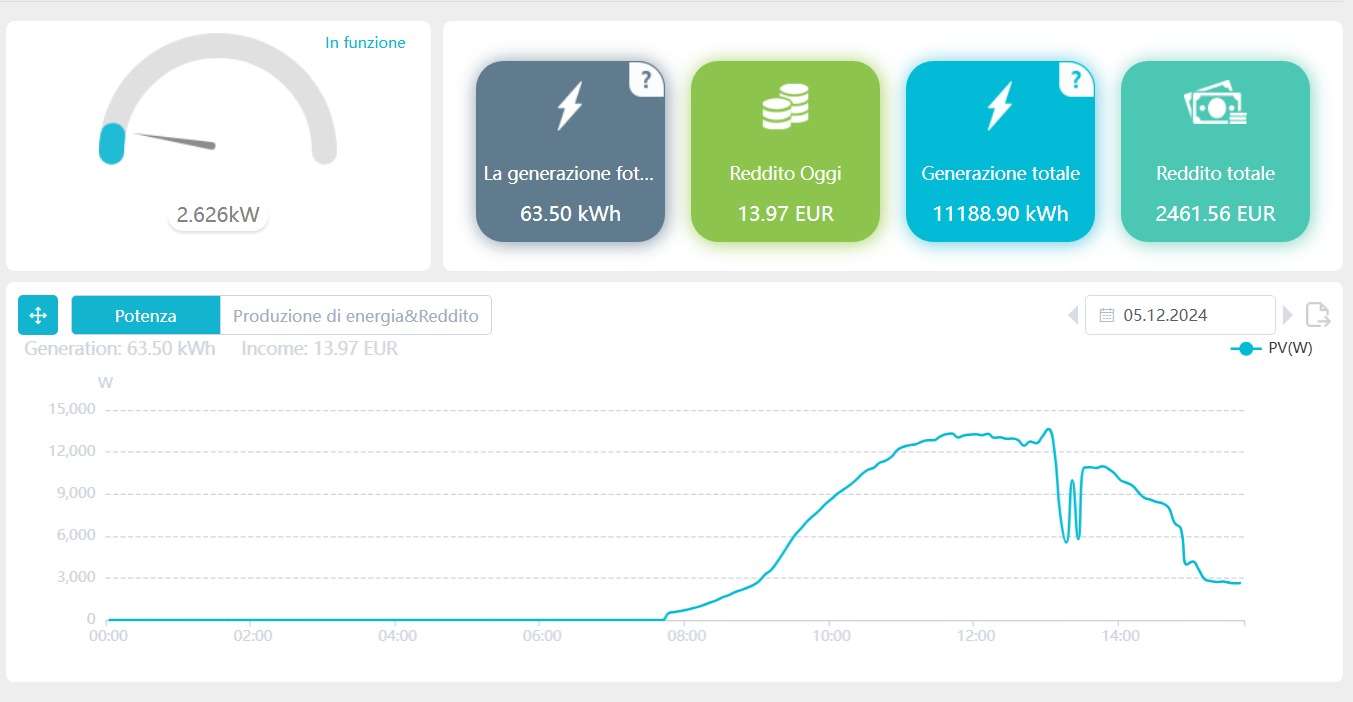
Il grafico della produzione giornaliera di uno dei nostri impianti, datato 5 dicembre 2024, evidenzia un caso interessante per analizzare le opportunità e le criticità legate alla gestione dell’energia fotovoltaica.
1. Initial phase: morning growth
Time: Around 08:00 hours.
Produzione: Avvio graduale, in linea con l’aumento dell’irraggiamento solare.
This phase reflects the normal behaviour of an efficient photovoltaic system, which follows the solar cycle.
2. Peak phase: maximum production
Orario: Verso metà giornata.
Produzione: Raggiungimento del picco, con un’erogazione stabile e ottimale.
Durante questa fase, l’impianto lavora alla massima capacità disponibile, sfruttando le condizioni atmosferiche favorevoli.
3. Critical phase: production stoppage
Timetable: In the afternoon.
Production: A sharp drop in production.
Causa: Non un problema atmosferico né tecnico, ma la saturazione della rete elettrica, che ha impedito l’immissione di ulteriore energia.
Conseguenza: L’inverter è stato costretto a interrompere o ridurre la produzione, portando a una perdita di fatturato e a uno spreco di energia potenziale.
Problematiche e opportunità
Le criticità riscontrate
Rete satura: La mancata capacità della rete di assorbire tutta l’energia prodotta è una limitazione comune in alcune aree.
Perdita economica: Ogni ora di energia non immessa equivale a un mancato guadagno per l’impianto e per i suoi utenti.
Possible solutions
Short term:
Collaboration with the network operator to monitor and resolve frequent saturation events.
Medium- to long-term:
Sistemi di accumulo: Integrare batterie di accumulo, come quelle agli ioni di sodio, permette di immagazzinare l’energia prodotta in eccesso e di utilizzarla successivamente, riducendo la dipendenza dalla rete.
Management optimisation: Adopt solutions that best balance production peaks and consumption.
Perché i sistemi di accumulo sono fondamentali
This case clearly demonstrates how important it is to have an advanced storage system capable of
Massimizzare il valore dell’energia prodotta.
Reduce waste.
Ensuring greater energy independence.
Le batterie agli ioni di sodio rappresentano una soluzione ideale, sia per la loro efficienza che per la sostenibilità ambientale. Grazie a questi sistemi, possiamo ottimizzare la produzione fotovoltaica e affrontare con successo le sfide legate alla saturazione della rete elettrica.
Investire in soluzioni intelligenti per la gestione dell’energia non è solo una scelta strategica, ma una necessità per un futuro più sostenibile e remunerativo.
Il calo pomeridiano descritto qui è esattamente il momento in cui l’energia andrebbe conservata invece che persa: per capire come, guarda come funziona l’accumulo agli ioni di sodio and the modulo HEIWIT-NA da 10 kWh.
 Italian
  English
  German
  French
  Spanish
  Polish
  Dutch
Dutch  Romanian
  Hungarian
  Czech
Czech  Swedish
  Portuguese
  Greek
Greek