
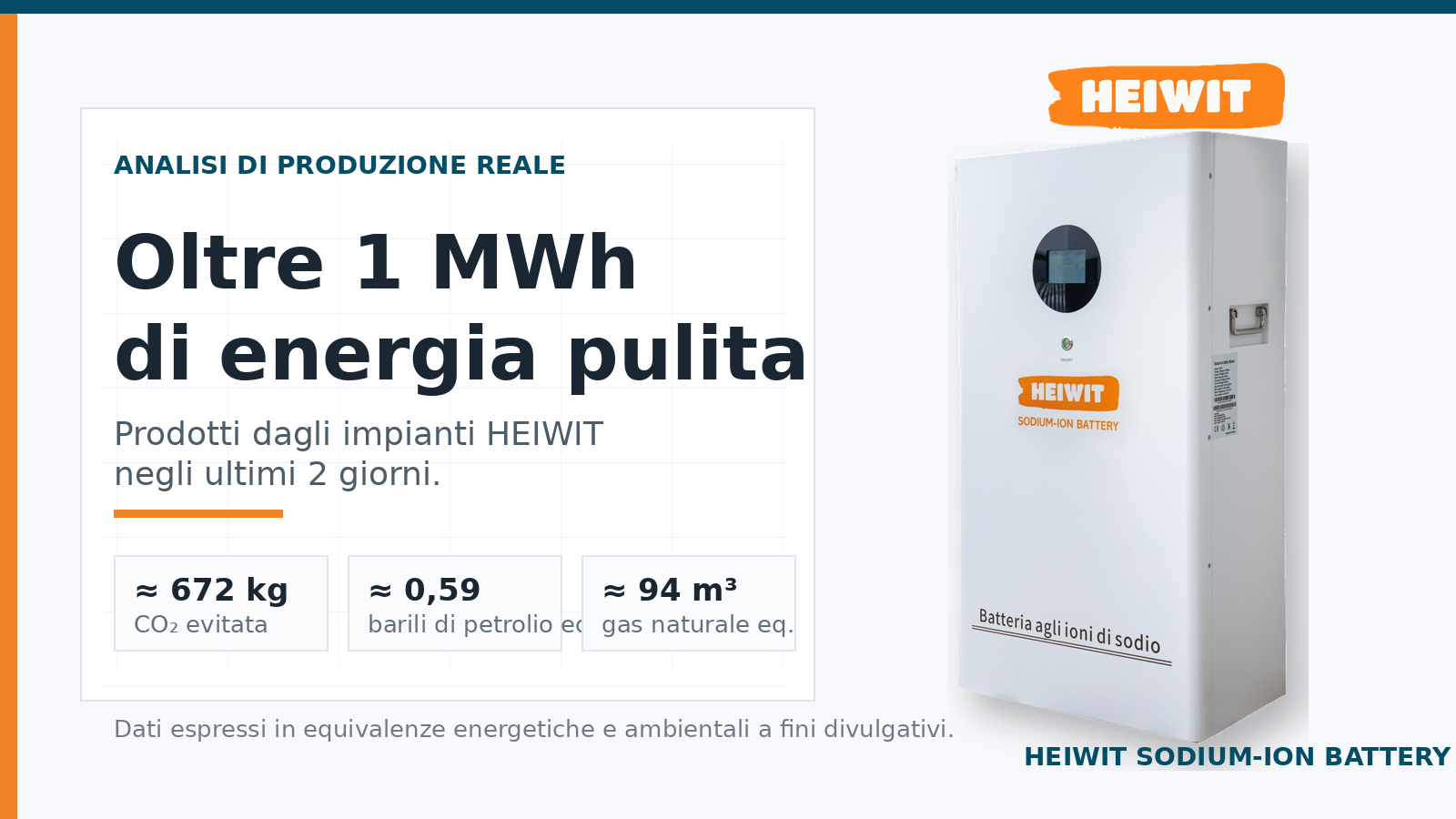
Over the last 2 days, the monitored HEIWIT plants have exceeded overall 1 MWh of clean energy produced.
Espresso in forma più immediata, significa oltre 1,000 kWh generati da impianti reali in un intervallo molto breve. Dal punto di vista tecnico, questo dato è interessante perché consente di ragionare non solo sulla potenza nominale installata, ma soprattutto sulla Effective energy production, cioè sull’energia realmente resa disponibile dagli impianti in condizioni operative reali.
Per chi si occupa di accumulo, fotovoltaico ed efficienza energetica, leggere correttamente questo numero è importante: 1 MWh non è solo una soglia simbolica, ma un valore che permette di quantificare in modo concreto l’impatto energetico e ambientale di una rete di impianti in esercizio.
To produce over 1 MWh in 2 days
A Megawatt-hour (MWh) corresponds to 1.000 kilowatt-hours (kWh) of energy.
Quando si dice che gli impianti HEIWIT hanno prodotto oltre 1 MWh in 2 giorni, si intende che il totale dell’energia elettrica generata nel periodo considerato ha superato i 1.000 kWh. È quindi un dato energetico reale, misurabile e leggibile anche in chiave impiantistica.
Questo tipo di indicatore è particolarmente utile perché:
- measure the actual yield of the plants in the field;
- allows production to be translated into understandable environmental equivalences;
- Help to assess the real contribution of renewable technologies compared to fossil fuels.;
- fornisce una base concreta per l’analisi tecnica delle performance nel tempo.
Environmental equivalence: how much CO2 is avoided with 1 MWh of clean energy
To estimate the environmental benefit of renewable production, a conversion factor between electricity and avoided emissions is used. Assuming an average factor of approximately 6,72 × 10⁻⁴ metric tonnes of CO2 per kWh, the production of 1,000 kWh matches approximately 0,672 tonnes of CO2 avoided, cioè circa 672 kg of CO2.
In altre parole, superare 1 MWh di produzione pulita in 2 giorni significa evitare l’immissione in atmosfera di una quantità di anidride carbonica già significativa, soprattutto considerando che si tratta di un periodo molto breve e di sola produzione reale osservata. Questo rende il dato particolarmente utile anche in chiave divulgativa per chi cerca informazioni su quanta CO2 fa risparmiare un impianto fotovoltaico o un sistema energetico con accumulo ben gestito. :contentReference[oaicite:0]{index=0}
Equivalent in barrels of oil
From an energy perspective, 1,000 kWh is approximately 3,412 million Btu. Taking into account that a barrel of oil equivalent contains approximately 5.8 million Btu, il risultato è un equivalente di circa 0.59 barrels of oil. :contentReference[oaicite:1]{index=1}
Questa equivalenza non significa che sia stato materialmente sostituito mezzo barile di petrolio in un singolo impianto, ma aiuta a rappresentare in modo comprensibile il contenuto energetico prodotto dalle fonti rinnovabili. È quindi una metrica utile per tradurre un dato elettrico in una grandezza energetica confrontabile con i combustibili tradizionali.
Equivalent in cubic metres of natural gas
Un altro confronto utile è quello con il gas naturale. Utilizzando il potere energetico tipico del gas naturale, pari a circa 1.036 Btu per cubic foot, you get an energy content of about 36,600 Btu per cubic metre. Consequently, 1 MWh matches approximately 93-94 m3 natural gas equivalents. :contentReference[oaicite:2]{index=2}
Anche in questo caso si tratta di un’equivalenza energetica, utile a spiegare in modo tecnico ma accessibile quanto sia rilevante una produzione rinnovabile apparentemente “piccola” se osservata solo come numero assoluto. In realtà, già 1 MWh in 2 giorni rappresenta una quantità di energia non trascurabile quando viene letta in rapporto ai combustibili fossili che avrebbe potuto sostituire.
Perché questo dato è tecnicamente interessante
From a scientific and engineering perspective, exceeding 1 MWh in 2 days should not be interpreted as a celebratory message, but as an operational figure that demonstrates three important aspects.
1. La produzione reale conta più della potenza nominale
Nel settore energia si tende spesso a comunicare soprattutto i kW installati. Tuttavia, ciò che conta davvero è l’energia effettivamente prodotta nel tempo. Parlare di MWh reali significa spostare l’attenzione dalla semplice dimensione dell’impianto alla sua resa concreta.
2. I dati sul campo hanno più valore delle sole simulazioni
Forecasting simulations are useful, but production data measured from real plants hold greater value when seeking to understand the actual behaviour of an energy technology. Observed production over two days, in fact, allows for the evaluation of performance within a real, rather than theoretical, operational context.
3. Environmental equivalences help to better understand the numbers
Dire “1 MWh” è corretto dal punto di vista tecnico, ma non sempre immediato per il pubblico generale. Tradurre questo valore in CO2 evitata, barili di petrolio equivalenti o metri cubi di gas naturale rende il dato più interpretabile anche in chiave divulgativa, senza rinunciare al rigore.
Perché Google apprezza contenuti divulgativi ma tecnici su energia e accumulo
Quando si scrive di fotovoltaico, batterie e produzione energetica, i contenuti più utili sono quelli che rispondono in modo chiaro a domande concrete come:
- How much energy does a photovoltaic system produce?;
- How much CO2 is saved with 1 MWh of clean energy?;
- How many cubic metres of gas does 1 MWh correspond to?;
- What is the environmental value of 1 MWh?;
- How to correctly read the actual production data of a plant.
Un articolo tecnico-divulgativo ben costruito è utile proprio perché unisce due livelli: da un lato il dato scientifico, dall’altro la sua interpretazione pratica. In questo modo il contenuto non appare promozionale, ma informativo, e diventa più rilevante sia per il lettore sia per i motori di ricerca.
A seemingly small piece of data, but very useful to analyse
A prima vista, 1 MWh potrebbe sembrare un numero modesto rispetto ai grandi volumi del settore utility scale. In realtà, quando il dato è letto nel contesto corretto, assume un valore importante: rappresenta energia reale già prodotta, già misurata e già traducibile in benefici ambientali tangibili.
Nel caso degli impianti HEIWIT, il superamento di questa soglia in soli 2 giorni offre quindi uno spunto tecnico interessante per osservare la capacità del sistema di generare energia pulita e di contribuire, in modo misurabile, alla riduzione dell’impronta emissiva associata ai consumi energetici tradizionali.
Conclusion
In the last 2 days, HEIWIT plants have produced over 1 MWh of clean energy, pari a più di 1,000 kWh of actual production.
Translated into technical and environmental equivalents, this value corresponds to approximately 672 kg of CO2 avoided, approximately 0.59 barrels of oil equivalent and around 94 m3 natural gas equivalents. :contentReference[oaicite:3]{index=3}
Si tratta di un dato semplice ma molto utile, perché aiuta a spiegare in modo chiaro come leggere la produzione reale degli impianti e come trasformare un numero energetico in un’informazione ambientale concreta, comprensibile e scientificamente fondata.
Frequently asked questions
How much CO2 is saved with 1 MWh of clean energy?
Utilizzando un fattore medio di circa 6,72 × 10⁻⁴ tonnellate metriche di CO2 per kWh, 1 MWh di energia pulita corrisponde a circa 0,672 tonnellate di CO2 evitate, cioè circa 672 kg. :contentReference[oaicite:4]{index=4}
Around 0.16 to 0.17 barrels of oil.
From an energy perspective, 1 MWh is equivalent to approximately 0.59 barrels of oil equivalent.
Approximately 96 cubic metres of natural gas correspond to 1 MWh.
1 MWh is approximately equivalent to 93-94 ₘ3 in natural gas equivalents, based on the average energy content of the gas.
Perché è meglio parlare di MWh reali invece che solo di kW installati?
Perché i kW indicano la potenza nominale dell’impianto, mentre i MWh misurano l’energia effettivamente prodotta nel tempo. È quindi il dato più utile per valutare la resa reale di un sistema energetico.
Un megawattora in due giorni è la produzione; quanto se ne usa davvero dipende da quanta se ne riesce a conservare. È il compito dei sistemi di accumulo agli ioni di sodio, a partire dal modulo da 10 kWh.
 Italian
  English
  German
  French
  Spanish
  Polish
  Dutch
Dutch  Romanian
  Hungarian
  Czech
Czech  Swedish
  Portuguese
  Greek
Greek