
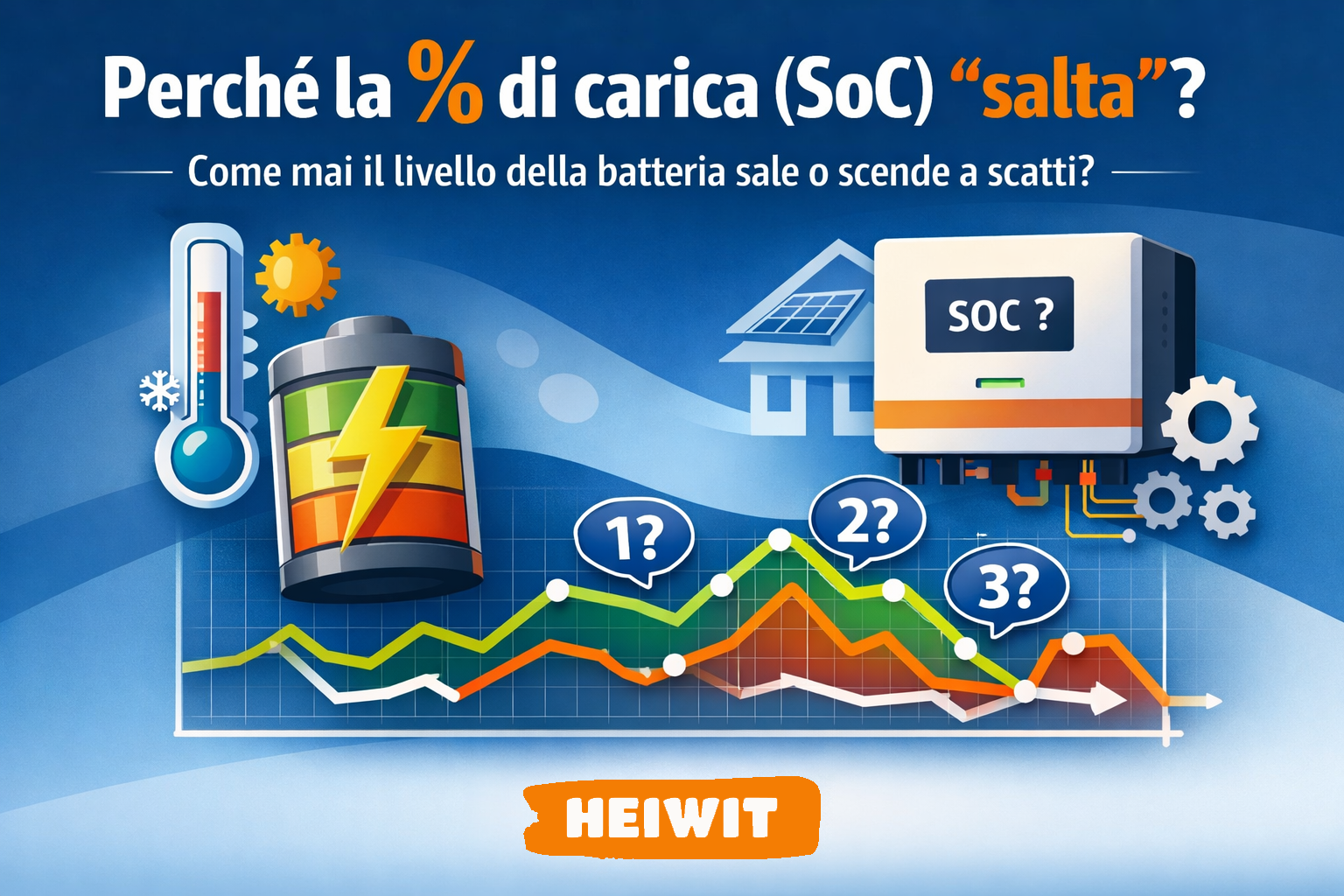
The behaviour described applies to the systems of Heiwit range of sodium-ion batteries.
Perché la percentuale di carica (SoC) a volte “salta”? (Succede anche al litio, soprattutto LFP)
Se hai una batteria domestica collegata al fotovoltaico, può capitare di vedere un comportamento che sorprende:
the percentage of charge (SoC, State of Charge) does not always rise or fall in a perfectly continuous manner.
A volte sembra fare piccoli “scatti” (ad esempio 52% → 47% oppure 18% → 23%).
Nella grande maggioranza dei casi questo non indica un guasto: è l’effetto naturale del fatto che il SoC è una
intelligent estimation, non una misura diretta. E questa stima può aggiornarsi quando cambiano le condizioni
(power demand, temperature, charge/discharge phase, rest periods), or when the system recalibrates.
1) Cos’è davvero il SoC? Una stima, non un “sensore”
Non esiste un sensore che “legge” la percentuale di carica come un galleggiante nel serbatoio.
The SoC is estimated by BMS (Battery Management System) using measures such as:
current, voltage e temperature, together with a mathematical model.
In many architectures, a combination of:
coulomb counting (counting how much charge goes in/out over time) and
corrections based on voltage at rest (OCV) and on the temperature.
Quando cambiano le condizioni o migliorano le informazioni disponibili, l’algoritmo può “riallineare” la stima,
e questo può apparire come un salto.
To be remembered: un salto di SoC spesso è un updating the estimate.
Non significa automaticamente che “energia è sparita”.
In alcune condizioni (freddo o richieste di potenza alte) può però cambiare anche quanta energia è immediately usable
senza scendere sotto soglie di tensione: quindi la sensazione di “autonomia” può variare.
2) Perché si nota di più all’inizio vita (o dopo reset/aggiornamenti)
Nei primi giorni/settimane di utilizzo — o dopo un reset, un aggiornamento firmware, o un cambio importante di parametri —
il sistema può attraversare una fase di calibration (often called self-learning).
In questa fase l’algoritmo affina i parametri con cui traduce segnali elettrici in percentuale.
Quando l’algoritmo trova nuovi “punti di riferimento” (per esempio condizioni vicine a fine carica o fine scarica,
o periodi di riposo utili per leggere l’OCV), può correggere la stima e far apparire uno scatto.
3) Escursione termica: perché caldo/freddo rende il SoC più “nervoso”
La temperatura influenza tutte le batterie perché cambia la loro risposta elettrochimica ed elettrica.
In generale, la temperatura può modificare:
- internal resistance and voltage drops under load;
- the relationship between voltage at rest (OCV) e SoC;
- the dynamics of tension recovery quando il carico cambia o la batteria si “rilassa”.
Risultato: a parità di energia realmente presente, la tensione misurata può cambiare in modo diverso a seconda della temperatura e della potenza istantanea.
Se l’algoritmo usa (anche) la tensione per correggere il SoC, può aggiornare la stima quando le condizioni cambiano bruscamente.
Practical example: in una notte fredda la tensione sotto carico può calare di più rispetto a una giornata mite.
Quando poi la batteria si scalda o il carico diminuisce, la tensione “rimbalza”: l’algoritmo può riallineare il SoC.
Questo effetto è noto nei sistemi di battery gauging, soprattutto con grandi variazioni di temperatura.
4) Succede anche al litio? Sì. E spesso è più evidente su LiFePO4 (LFP)
Questo fenomeno non è “tipico del sodio”: è comune a molte chimiche (litio incluso) perché dipende dal modo in cui si stima il SoC.
In particular, on batteries LiFePO4 (LFP) la stima del SoC è spesso più delicata perché la curva
OCV–SoC ha una zona centrale molto “piatta” (un plateau):
In that range, the voltage changes little even though the percentage of charge changes a lot.
Questo riduce l’“osservabilità” del SoC basata su tensione e rende più probabili correzioni non perfettamente lineari,
especially with noise, variable loads and low temperatures.
(Per approfondire tecnico: diversi lavori riportano che l’LFP ha un plateau OCV–SoC che rende la stima SoC più difficile, e che piccoli errori/rumori di tensione
possono amplificarsi in errori di SoC; inoltre l’isteresi tra carica e scarica va gestita con cura.)
5) Perché, in alcuni casi, il sodio può risultare più sensibile agli estremi (basso SoC / alto SoC)
Qui è importante essere precisi: non esiste “il sodio” come comportamento unico, perché dipende dalla specifica chimica (catodo/anodo),
dal progetto del pack e dall’algoritmo del BMS. Detto questo, alcune evidenze sperimentali su celle commerciali mostrano che
in certain sodium-ion technologies the dependence of resistance/impedance on temperature e SoC
può essere più marcata rispetto a celle LFP, e che in regioni di SoC più basse le perdite/inefficienze possono aumentare.
From a practical point of view, this means that close to the extremes (especially in low SoC and cold or high power):
- la tensione può essere più “sensibile” a cambi di carico (maggiore voltage sag);
- l’energia immediatamente utilizzabile può ridursi temporaneamente per ragioni di tensione/potenza;
- l’estimatore del SoC può fare correzioni più visibili perché i parametri elettrici cambiano più rapidamente.
In addition, as with many chemistries, areas close to the limits may include regions with different tension gradients and phenomena
legati a transizioni di fase o a plateaus/pendenze (a seconda dei materiali): questo può rendere la mappatura tensione↔SoC più “non lineare”
e quindi più soggetta a ricalcoli quando cambiano temperatura e carico.
6) Come leggere l’immagine che inserirai qui sotto (e capire se è “normale”)
Quando guardi un grafico o una schermata con il SoC, per interpretare correttamente eventuali “salti” controlla sempre anche:
- Battery temperature (se cambia molto, è normale che la stima si aggiorni);
- Charging/discharging power (sudden spikes change the voltage under load);
- Phases of rest (in riposo la tensione si stabilizza e l’OCV è più informativa);
- Areas close to end of charge/discharge (where many systems apply conservative logic and corrections).
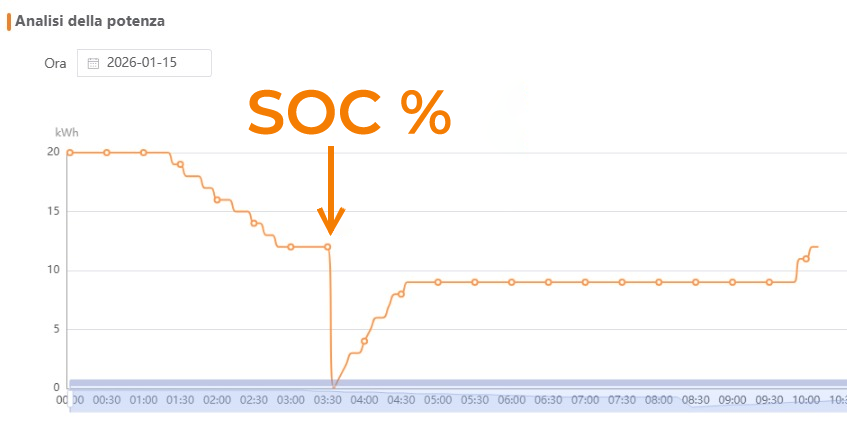
è spesso un ricalcolo della stima (non un guasto). Se invece gli scatti sono grandi, continui e senza cause visibili, conviene far verificare i log.
7) When to really worry
È sensato chiedere una verifica se noti:
- very wide and repeated shots (es. 20–30%) senza variazioni di temperatura o potenza;
- recurrent alarms or frequent sudden limitations;
- inconsistent behaviour between energy exchanged (kWh) and SoC variation over long periods.
In summary (super-clear version)
- Il SoC è una estimate based on models and sensors.
- All’inizio vita (calibrazione) e con escursione termica la stima può aggiornarsi → piccoli “salti”.
- It also happens to lithium: on LFP è spesso più evidente per via del plateau of tension.
- On some cells sodium-ion gli estremi possono risultare più sensibili perché resistenza/impedenza e perdite variano di più con SoC e temperatura.
Contenuto tecnico redatto e sottoposto a revisione interna da HEIWIT R&D, la funzione che qualifica le celle e conduce le prove sui sistemi di accumulo Heiwit.
 Italian
  English
  German
  French
  Spanish
  Polish
  Dutch
Dutch  Romanian
  Hungarian
  Czech
Czech  Swedish
  Portuguese
  Greek
Greek