
Studio osservazionale · Accumulo residenziale
High self-consumption with sodium-ion batteries: data from an Italian plant park
Analisi della distribuzione dell’autonomia energetica su un parco di impianti
residential photovoltaic systems equipped with sodium-ion (Na-ion) storage.
Mediana superiore all’80%, contributo della curva di scarica piatta e
Considerations on the thermal behaviour of technology.
Foreword
L’integrazione di un sistema di accumulo elettrochimico su impianto fotovoltaico
domestico ha l’obiettivo principale di trasferire nel tempo la produzione PV in
Surge in consumption hours not directly covered by generation
solare. La metrica più rappresentativa di questo trasferimento è
l’energy autonomy in English self-sufficiency ratio),
definita come la frazione del consumo casa coperta dall’impianto, calcolata come:
autonomia (%) = (consumo totale − prelievo da rete) / consumo totale × 100
In literature, Italian residential autonomy values with sized storage
correttamente sono tipicamente compresi tra il 60% e l’80%
(see RSE studies 2022; Quoilin and others., 2016). This note presents
the results of an internal monitoring survey on a sample of residential installations
with Heiwit sodium battery, showing a concentrated distribution on
valori più elevati e discutendo i fattori tecnologici che lo rendono possibile.
Methodology
The data comes from the Heiwit monitoring platform, which acquires
with minute-by-minute cadence the electrical quantities of connected systems.
For the present study, the following were aggregated, hour by hour
Cumulative sizes of internal inverter counters on a movable window
in 60 days
- energy produced by the photovoltaic generator;
- power fed to the grid (output);
- energy drawn from the grid (input);
- Energy transferred during battery charge and discharge.
Installations lacking a complete time series have been excluded.
over the period (installations less than 30 days old or with interruptions
communication channels exceeding 15% of the time). The following were also segregated
gli impianti operanti in modalità “Zero Export”, la cui produzione PV può
result in underestimation due to the curtailment imposto dall’inverter
in attesa dell’autorizzazione di connessione alla rete: per questi sistemi
l’autonomia è comunque calcolabile, ma con la consapevolezza che si tratta
from a conservative estimate compared to the definitive operating regime.
All of the sample's units are equipped with sodium-ion storage.
Heiwit (configurazione 16S, ~48 V nominali) con BMS proprietario e
continuous monitoring of key battery health parameters
(State of Health, cycling, cell temperature).
Results
Distribuzione dell’autonomia energetica
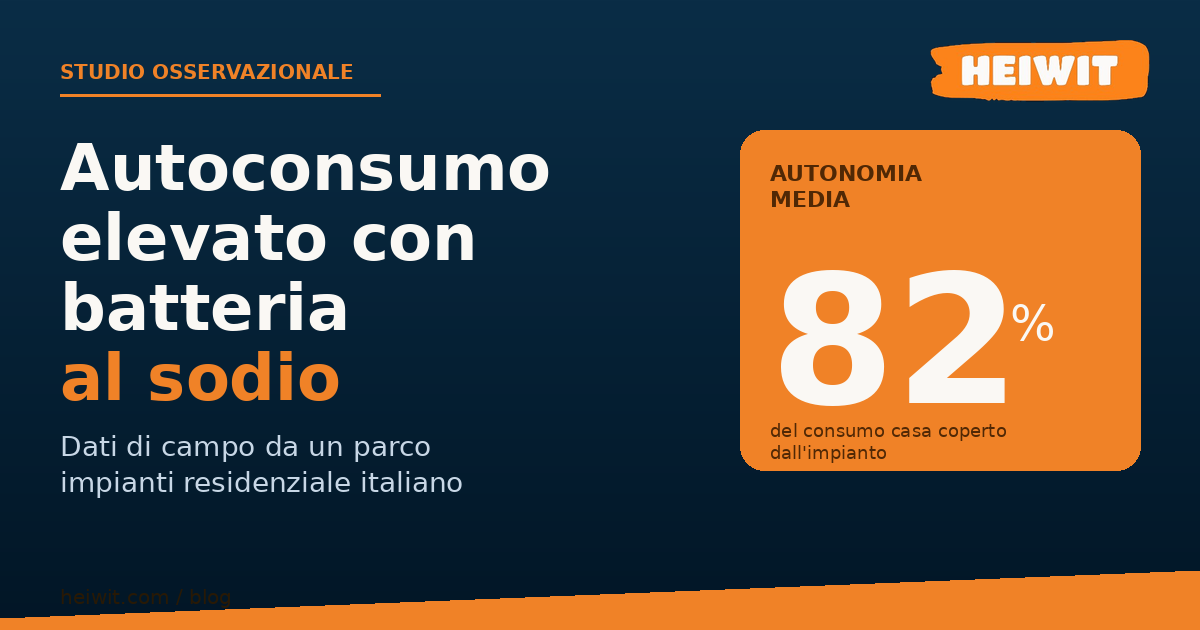
L’autonomia energetica media del campione è risultata pari al
82%, with a range observed from 23% to 98%. The distribution
è marcatamente sbilanciata verso valori alti, con la grande maggioranza degli
impianti compresa tra l’80% e il 95%.
| Range of autonomy | Park quota | Reading |
|---|---|---|
| ≥ 95% | approximately 12% | Near total independence from the grid |
| 80%–94% | approximately 56% | Optimised residential typical profile |
| 60%–79% | approximately 24% | Buon livello, margini di miglioramento (es. capacità accumulo) |
| 40%–59% | approximately 3% | Profiles with heavy evening consumption compared to PV production |
| < 40% | approximately 5% | Recent or undersized systems for consumption |
Il dato che emerge con maggiore evidenza è la concentrazione di oltre il
68% del parco al di sopra dell’80% of autonomy, one level
generally associated in literature with accumulated configurations
oversized or with very regular consumption profiles. The finding
a heterogeneous operational sample (different loads, different exposures,
stagionalità diverse) raggiunga questi livelli con dimensionamenti
standard warrants a closer look at the mechanisms that make it possible.
Curva di scarica e profondità utilizzata
Sodium-ion batteries based on layered or polyanionic cathodes
(NFPP) present a discharge voltage curve
essentially flat in a wide state of charge range
(SoC) — tipicamente tra il 5% e il 95% — diversamente dal litio ferro
phosphate (LFP), which also has a wide plateau but closes the useful window
a few percentage points earlier at the two extremes. In practice, this means
that the power delivered by the sodium battery remains nominal up to
very low charge states, without the BMS imposing derating or shutdowns
Discharge pre-checks.
Operativamente questo si traduce in una profondità di scarica utile (DoD)
actually exploited a few percentage points higher compared to
a una batteria al litio di pari capacità nominale. Su una serie giornaliera
typical residential load, these additional points shift the
passaggio dal regime “scarica controllata” al regime “rete suppletiva”
di 30–50 minuti, contribuendo direttamente al miglioramento dell’autonomia
registered.
Thermal behaviour
A second characteristic of sodium chemistry observed in the data is
monitoraggio è la stabilità delle prestazioni in funzione della temperatura
exercise. Whereas for lithium chemistries the power available in
scarica scende sensibilmente sotto i +5 °C e in carica viene
tipicamente limitata sotto 0 °C, sui pacchi Na-ion del campione la
potenza nominale di scarica si è mantenuta costante anche sui dataset
acquired in northern Italian installations during the winter months, with
temperature ambiente locali misurate nel range −5 °C / +35 °C.
This flatness thermal has significant practical effect
sull’autonomia: nelle prime ore del mattino, quando il consumo è
Typically concentrated (hot water, cooking, electric heating
ausiliario) e la produzione PV è ancora minima, la batteria è in grado
to deliver the power required by the load even if the technical room
non è climatizzato, evitando il transito di una quota di prelievo da
net that with other chemicals would be inevitable.
Discussion
Il fattore principale che spiega l’elevata autonomia osservata, nel campione
analizzato, è la combinazione di tre elementi tipici della tecnologia al sodio:
-
Extended SoC utility windowthe flat voltage curve
allows operation in discharge down to very low states without derating,
increasing the effectively utilised DoD in daily cycling. -
Temperature independence: the rated power
è disponibile anche in condizioni operative non climatizzate,
eliminating the typical derating of lithium chemistries in cold months
and coping with the morning peak demand. -
Dynamic response of the packs and the BMS: latency
nel passaggio da carica a scarica (e viceversa) è inferiore al secondo
on the monitored systems, a condition that minimises the proportion of consumption
covered by the grid during the transition.
In addition to these intrinsic factors, there is a systemic factor: the
possibilità di portare la batteria a stati di carica molto bassi senza
accelerated effects on calendar and cyclic degradation. The evidence
experimental results published on NFPP cathodes and Prussian-type cathodes
White (see Hwang and others., Chem. Soc. Rev. 2017;
Tapia-Ruiz and others., J. Phys. Energy (2021) indicate a
a wide chemical stress window, consistent with the fact that, in our
According to the data, plants that have been in operation for more than 12 months show no deviations
sistematiche di SoH rispetto a quelli più recenti.
Limitations of the study
The results presented here are indicative of the residential housing stock
Italian and should not be generalised to different consumer profiles (commercial,
light industrial, off-grid). The 60-day observation window
copre una stagionalità limitata; un’analisi su 12 mesi consoliderà la
stima dell’autonomia mediana e permetterà una valutazione separata per
summer and winter terms, during which we expect a decline
metric check during the cold months (due to reduced solar radiation,
(not due to technological limitations of the battery).
It is also observed that a not insignificant portion of the analysed park
è in regime “Zero Export” in attesa di autorizzazione di connessione
definitiva, condizione in cui l’inverter limita la produzione PV. Per
questi impianti la metrica di autonomia è una sottostima rispetto al
regime di esercizio nominale: ci si attende un’ulteriore traslazione
della distribuzione verso valori più elevati una volta completato l’iter
Authoritative.
Conclusions
L’analisi di campo conferma che, su un parco residenziale italiano
eterogeneo equipaggiato con accumulo agli ioni di sodio Heiwit, è
possible to achieve average levels of energy autonomy
superiori all’80%, with over a tenth of the park to
vertici della scala (≥ 95%). Le caratteristiche distintive della
tecnologia al sodio — curva di scarica piatta, indipendenza dalla
temperatura operativa, finestra utile di SoC ampia — concorrono a
explain these values without resorting to over-sizing
dell’accumulo.
Over the next few months, we will be releasing an update with coverage of
un anno solare completo e un’analisi separata della distribuzione
dell’autonomia per fascia oraria e per stagione, includendo un
Quantitative comparison of the discharge curve between Na-ion and LFP measured
on same-sized batches in the laboratory.
Le autonomie osservate sugli impianti dipendono anche dal comportamento termico della chimica e da come la batteria cede energia a fine scarica: entrambi gli aspetti sono spiegati nella panoramica sulla tecnologia agli ioni di sodio.
 Italian
  English
  German
  French
  Spanish
  Polish
  Dutch
Dutch  Romanian
  Hungarian
  Czech
Czech  Swedish
  Portuguese
  Greek
Greek