
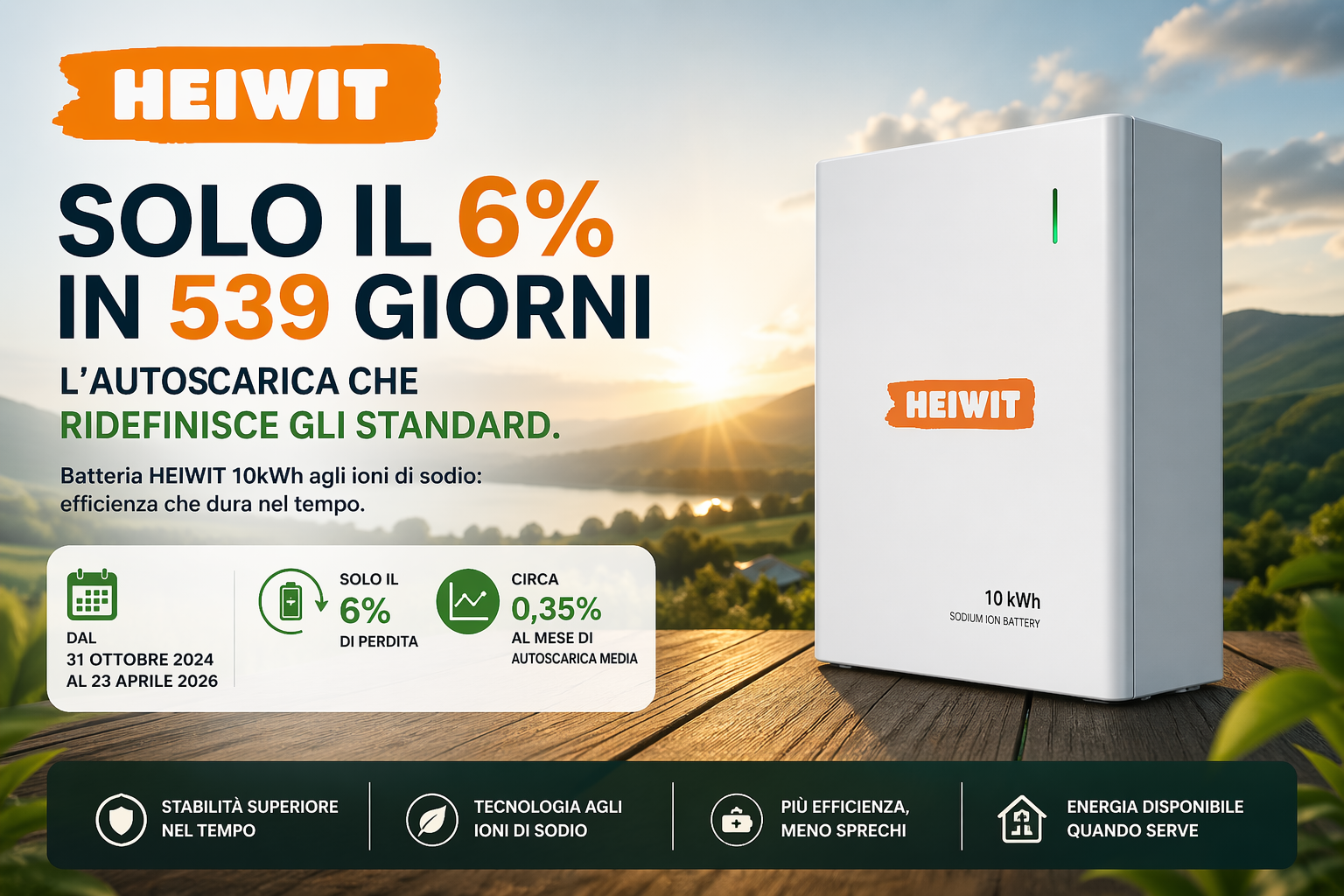
Sodium-ion self-discharge: only 6% lost over 539 days
Quando si parla di batterie di accumulo, spesso ci si concentra solo su capacità, potenza e prezzo.
Ma c’è un parametro che dice moltissimo sulla qualità reale di una batteria: l’autoscarica.
Ed è proprio qui che la nostra batteria HEIWIT da 10 kWh agli ioni di sodio mostra un dato estremamente interessante.
Between 31 October 2024 and 23 April 2026, the battery lost only the 6%.
Significa un’autoscarica media di appena approximately 0.35% per month.
Che cos’è l’autoscarica?
L’autoscarica è la naturale perdita di energia che una batteria subisce nel tempo anche quando non viene utilizzata.
In altre parole: una batteria può perdere parte della sua carica semplicemente restando ferma.
Per questo motivo un valore basso di autoscarica è un segnale molto importante.
This means that the battery can trattenere meglio l’energia nel tempo,
riducendo sprechi e mantenendo più a lungo la carica disponibile.
Perché questo dato è così rilevante?
A total loss of 6% over 539 days is equivalent to approximately 0.011% per day,
or around 4.11 TP3T (annual equivalent).
The battery maintains its energy extremely stably over time.
Questo è un vantaggio concreto soprattutto in tutti quei casi in cui il sistema di accumulo non viene stressato ogni giorno allo stesso modo:
second homes, systems for occasional use, backup systems, homes with variable consumption or periods of low usage.
What does it mean for someone using a battery at home?
- Più energia conservata nel tempo, instead of being wasted unnecessarily.
- Greater real efficiency when the battery remains charged for days or weeks.
- Prestazioni più affidabili even when the system is not used continuously.
- Less invisible energy waste, which in the long run make the difference.
Il valore dell’autoscarica nelle batterie agli ioni di sodio
In the debate about storage technologies, the cost per kWh is often discussed, but much less about how much a battery lasts.
conservare davvero l’energia immagazzinata.
Eppure è proprio questo uno degli aspetti che separa un accumulo “da scheda tecnica” da un accumulo valido nella vita reale.
The observed data on our HEIWIT 10 kWh battery shows a extremely low self-discharge.
È il tipo di risultato che si traduce in una percezione semplice ma fondamentale:
l’energia resta dove deve restare, cioè dentro la batteria, pronta quando serve.
A small piece of data, a huge meaning
Perdere solo il 6% in un intervallo di 539 giorni non è soltanto un numero interessante.
È un indicatore concreto di stabilità, qualità progettuale e capacità di conservare energia nel tempo.
In a sector where every percentage point counts, being able to talk about approximately 0.351 TP3T per month: average self-discharge observed
means being able to show a real, measurable and immediately understandable technical feature.
HEIWIT 10 kWh: energy that remains available, over time.
Perché una grande batteria non è solo quella che accumula energia. È quella che la conserva davvero.
Date calculated over the period between 31/10/2024 and 23/04/2026, amounting to 539 days.
The total observed loss of 6% corresponds to an average self-discharge rate of approximately 0.34–0.35% per month.
Un’autoscarica così contenuta si misura sul campo, ma nasce dal progetto del modulo: dati, datasheet e manuale sono nella scheda della batteria da 10 kWh agli ioni di sodio.
Contenuto tecnico redatto e sottoposto a revisione interna da HEIWIT R&D, la funzione che qualifica le celle e conduce le prove sui sistemi di accumulo Heiwit.
 Italian
  English
  German
  French
  Spanish
  Polish
  Dutch
Dutch  Romanian
  Hungarian
  Czech
Czech  Swedish
  Portuguese
  Greek
Greek