
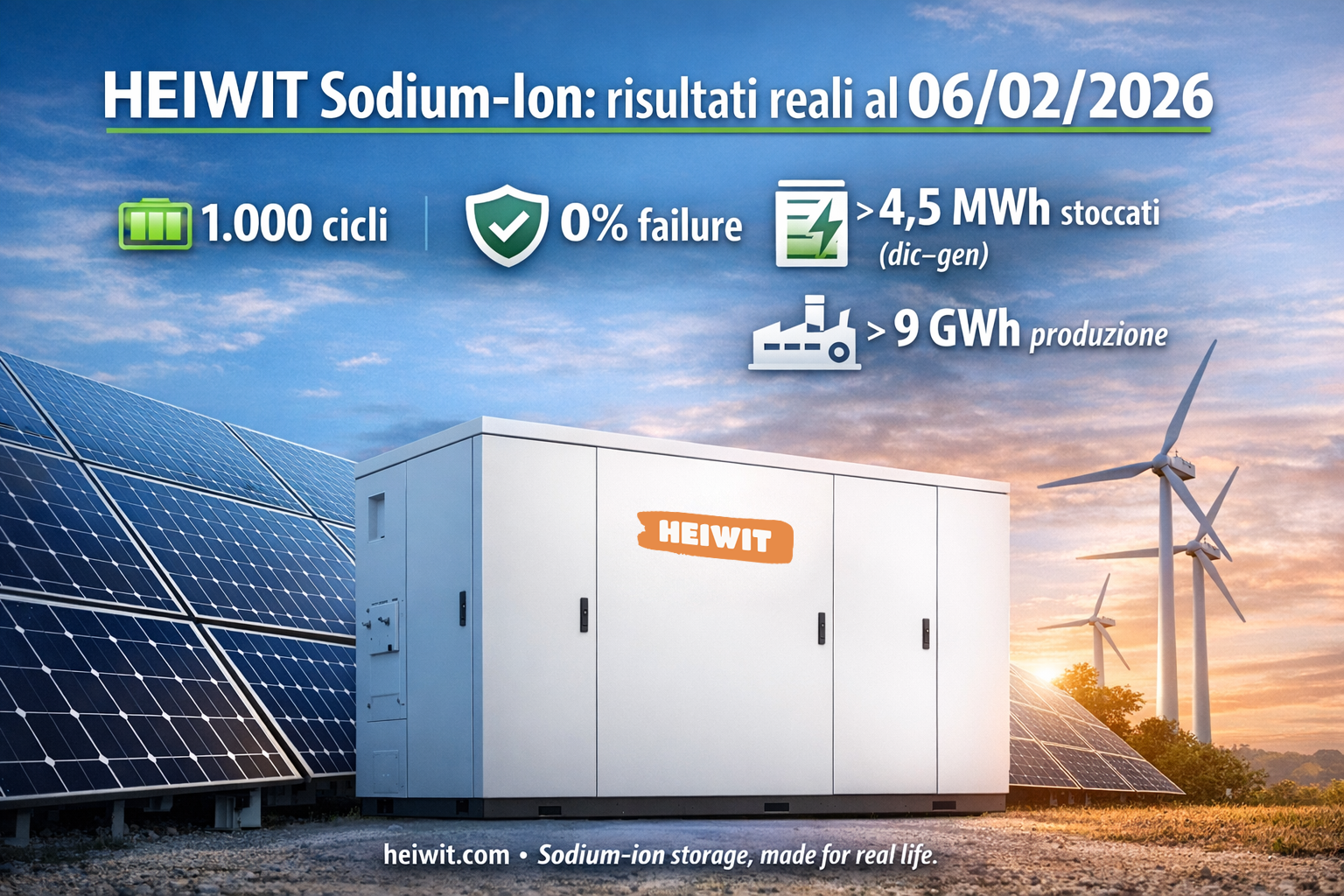
HEIWIT sodium ion batteries: field results to date (06/02/2026)
6 February 2026 marks a concrete milestone in the HEIWIT sodium-ion battery journey: the first systems have reached 1,000 life cycles maintaining performance absolutely in line with forecasts, and with a figure that, for those working in energy, is worth more than a thousand slogans: failure rate of 0% on the whole inverter + battery installed, to date. In parallel, the operational numbers show a net growth in real usage: more than 4.5 MWh of stored energy even during the most “difficult” months (December and January, with typically lower photovoltaic production), and a total aggregate production over 9 GWh on the monitored systems.
These are milestones that tell not only “how much” it works, but above all “how” a technology behaves when it leaves the laboratory and is confronted with daily variability: weather, domestic or industrial loads, irregular charging cycles, different installations, not always ideal thermal conditions. This is where a battery really proves its worth.
1,000 cycles: what it really means (and why it is a turning point)
In the language of accumulation, a cycle is not an abstract concept: it is energy coming in, energy going out, and electro-chemical stress repeating itself over time. Reaching 1,000 cycles means going through an important part of a system's operational life, with repeated charge/discharge phases and the natural “fatigue” that every battery accumulates.
The most important thing is not only to have reached the threshold, but to have done so with results in line with forecasts. This indicates consistency between design and reality: correct sizing, adequate thermal management, effective BMS logic, stable inverter-battery interaction, and - last but not least - an installation and commissioning chain that reduces human error, often responsible for many problems in the industry.
In other words: the 1,000 cycles are not “a brochure number”, but a technical checkpoint which confirms the goodness of the project and management in the field.
Reliability: 0% failure between inverter and battery installed
Say 0% of failure (inverter + battery) is a strong statement, because in the real world every complex system is exposed to possible failures: electronic components, cabling, communications, firmware, protections, installations in different environments. This is precisely why, when a company manages to maintain such a figure on a real installed base, the message is clear: the system is stable, procedures are robust and quality control is effective.
This result should be read concretely: “0% failure” means that, until 06/02/2026, no failures were recorded that would impair operation between inverter and battery on installed and monitored systems. It is an indicator of technical and operational maturity that has an immediate impact on three key aspects:
-
Continuity of service for the end user (stored energy is needed when needed, no surprises).
-
Reducing service costs (fewer interventions, less downtime, fewer replacements).
-
Confidence of installers (less “returns” in the yard, more reputation, more scalability).
Energy performance in winter: 4.5 MWh stored even in the “leanest” months”
December and January are a severe test bed for any storage solution combined with photovoltaics. Production drops, days are shorter, weather is often unfavourable and household loads may increase (electric heating, heat pumps, increased evening consumption). In this scenario, obtaining more than 4.5 MWh of stored energy is not just a “volume figure”, but proof that the accumulation is really used, even when the generation is less abundant.
In practice, it means that HEIWIT batteries are doing what they exist for: moving energy through time, reducing waste and increasing self-consumption whenever possible. And doing so in winter is particularly significant, as it highlights the system's ability to work with often more irregular cycles and tighter charging windows.
Total production over 9 GWh: the growth of the park and monitoring
The figure of over 9 GWh of total production (aggregated over the monitored systems) tells another story: the platform and ecosystem around the battery. When a technology grows, it is not enough that it “works”: you need measure, monitor, correct e standardise. A modern accumulator is not just chemistry, but a complete system: data, telemetry, diagnostics, performance analysis, prevention of abnormal events.
Aggregate production of this magnitude indicates that the systems are working steadily and that the installed base - and especially the quality of the data collected - is becoming an asset: more intelligent maintenance can be done, seasonal patterns can be identified, operating parameters can be optimised, and technical answers can be given that are increasingly based on real evidence.
Why sodium matters: reliability, operational safety and industrial sustainability
Sodium ion batteries are gaining attention because they respond to very real needs: more resilient supply chains, more available materials, and a technology path that aims to combine performance and robustness. In the context of a photovoltaic storage system (residential or commercial), what really matters is:
-
System stability over time (and the 1,000 cycles prove it).
-
Reliability of integration (0% failure inverter+battery to date).
-
Ability to work in real conditions (winter included, with energy actually stored).
The numbers released today are not “promises”: they are measured results. And this changes the conversation from “emerging technology” to “operational technology”.
What it means for users and installers: less risk, more predictability
For installers and users, predictability is the real currency. A battery must not surprise: it must behave in a consistent, replicable, manageable way. The HEIWIT results to date suggest a model that rewards:
-
Scalable installations, because the system proves to be stable.
-
Simpler assistance, because the blocking faults are not occurring.
-
Safer design, because you work on real data (cycles, energy, seasonal behaviour).
In a market where we often only talk about “nominal kWh”, these KPIs - real cycles, failure rate, energy stored in winter, aggregate production - are the ones that really count.
Next steps: from technical achievement to industrial growth
Achieving 1,000 cycles and maintaining such a clean reliability history is not an end point: it is the basis for acceleration. The next step is to turn technical quality into operational standard, consolidating procedures, expanding the installed base, and continuing to monitor and improve.
The most important fact today is that HEIWIT batteries are proving in the field what is expected of modern storage: consistency, reliability e real utility, even when the available energy is less abundant. And in the world of energy, when reality confirms predictions, that is where true confidence is born.
I dati raccolti sul campo riguardano i sistemi realmente in esercizio: per capire come sono costruiti e come si posizionano rispetto alle altre chimiche, parti dalla gamma degli accumuli agli ioni di sodio e dalla scheda del modulo da 10 kWh.
 Italian
  English
  German
  French
  Spanish
  Polish
  Dutch
Dutch  Romanian
  Hungarian
  Czech
Czech  Swedish
  Portuguese
  Greek
Greek