
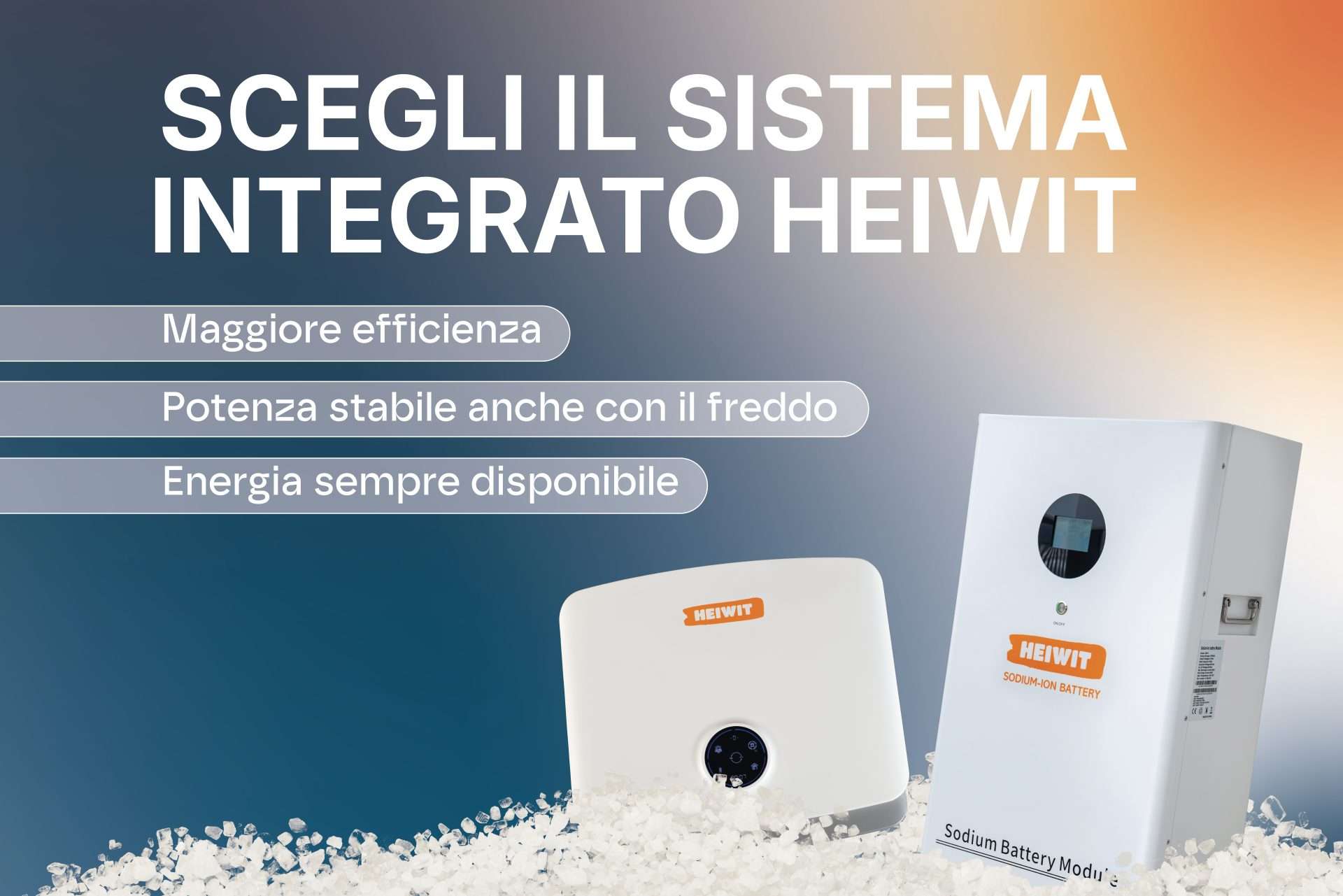
Why Heiwit sodium ion batteries only work best with our inverters
When it comes to residential storage, it is often taken for granted that “one battery is as good as another” and that it is enough to choose a “compatible” inverter to make everything work. In reality, with a new and different technology such as
the sodium, this simplification becomes the fastest way to achieve mediocre results:
Inaccurate SoC, protections that go off at the wrong times, reduced performance at the extremes of charge, limitations in winter, and energy management that does not really exploit the potential of storage.
In Heiwit we have chosen a precise path: Heiwit battery + Heiwit inverter. Not because “you can't” connect anything else, but because we want to ensure what really matters to us: security, performance, durability e an uncompromising user experience.
And with sodium, the difference between a system “turning on” and a system “working perfectly” is all in the integration.
In this article we explain, in a clear but thorough manner, why Heiwit only matched its sodium ion batteries to its inverters and what it changes in practice compared to a generic solution.
We will talk about:
- sodium voltage range (from 1900 mV a 3900 mV per cell) and impact on the inverter
- different charge/discharge curves from lithium and SoC accuracy
- power available even at extremes of charge
- operation in cold conditions (below 5°C)
- monitoring on Italian servers and predictive analysis
- inverter efficiency superior to 98% and backup full power 6kW
- warranty 10 years and supply chain responsibility
1) Sodium is not “a different lithium”: it is a technology with its own rules
Sodium-ion (Na-ion) batteries are growing in popularity because they offer real advantages: greater availability of raw materials, good stability, excellent performance under different conditions and often more “robust” behaviour”
in real use.
But precisely because it is a different chemistry, sodium has voltages, curves and electrical dynamics that do not coincide with what many “lithium-born” inverters are designed for. And when battery and inverter do not talk
the same language, the system may become conservative, inaccurate or unstable.
Heiwit was born in the world of storage: that is why we designed an ecosystem where every component is developed to work together, from the BMS (Battery Management System) to the inverter logic.
2) Sodium voltage range: 1900-3900 mV per cell (and why it changes everything)
One of the most important differences is the cell voltage. Our sodium cells work in a range which, to simplify, we can summarise as follows:
1900 mV (deep discharge) → 3900 mV (end of charge)
Translated on a typical parcel 16S (16 cells in series) means:
- Theoretical minimum: 1,9V × 16 = 30,4V
- Theoretical maximum: 3,9V × 16 = 62,4V
This range is wide and requires an inverter:
- is designed to work efficiently and stably over a real, dynamic range
- handle transitions well near the limits (where many systems become “nervous”)
- coordinate perfectly power required, current e safeties
In many “hybrid” installations (battery of one make + inverter of another), the inverter reads a voltage, makes a quick estimate of the charge level and applies generic rules. But with sodium, the relationship “voltage = %
of charge” is not as linear as many expect, and can vary depending on temperature, current and dynamic state of the battery.
That is why we prefer a designed approach: the Heiwit inverter knows the battery's electrical window in detail, and works in tandem with the BMS to decide how far to push, when to protect e
how to optimise.
3) Charge curves other than lithium: compatibility “on paper” is not enough
Many systems claim “compatible” when they can pass power. But the point is not to switch on the battery: it is make it work well for years, maintaining performance and predictability.
Sodium has a charge/discharge curve that can be misinterpreted by logics born for other chemistries.
This can lead to:
- unstable SoC estimation (percentages “jumping” to extremes)
- sudden power limitations
- over-conservative use (downloading “as little as possible” for fear of limits)
- non-optimised charging and longer or inefficient times
In the real world, a wrong SoC is not a detail: it means that the user sees a 15% and finds himself at 0%, or he thinks he is at 90% but the system decides to stop or reduce power.
With the Heiwit inverter, the SoC reading is the result of complete cooperation: the BMS does not just send a number, but communicates fundamental parameters (voltages, deltas between cells, dynamic current limits, temperature, protections,
balancing status). The inverter uses this information to manage the system in a stable and predictable manner.
4) Real power even at the extremes of charge: an advantage of sodium... if the inverter knows how to exploit it
One point where sodium can offer a very pleasant experience is its ability to maintain a good supply even when approaching the limits of charge or discharge. In other words:
- when the battery is almost full, the system remains responsive and manageable
- when the battery is almost discharged, a good continuity of power can be maintained
But beware: this is not magic, and it is not enough that the battery “could do it”. What is needed is an inverter that can properly handle the moments when voltage and current change most rapidly.
With a generic inverter, limits are often strictly enforced: as soon as you get close to the edge, the power drops sharply, or preventative protections are triggered. With the Heiwit inverter, on the other hand, management is more progressive e clever, because the inverter works with dynamic limits
updated by the BMS in real time.
The practical result is simple: more usable energy, fewer sudden cuts,
greater comfort during the day and especially during peaks (oven, heat pump, induction, start-up loads).
5) Operation at low temperatures: continuity even below 5°C
Winter is the toughest test for domestic storage. Many “lithium-oriented” systems adopt very conservative strategies: under certain temperatures (often around 5°C) limit the battery dramatically,
to the point in some cases of blocking charging and/or discharging for protection.
This behaviour may make sense on some chemicals and in the absence of advanced management, but in practice it creates frustration: just when PV produces less and one needs to optimise consumption the most,
the battery becomes “timid”.
With Heiwit, we designed the battery and inverter to offer consistent thermal and power management even at lower temperatures, taking advantage of the sodium's characteristics and integrated system logic.
The advantage is a greater business continuity, reducing stops and maintaining a more useful accumulation in the cold season.
Important note: any battery, whatever its chemistry, must always comply with safety conditions. Our aim is not to “force” the battery, but manage it properly thanks to comprehensive communication
between BMS and inverter.
6) An integrated system also means real safety: BMS, inverters and protections work together
Security does not mean “having protection”. It means all protections are coordinated and do not step on each other's toes. In a non-integrated system, it may happen that:
- the battery reduces current but the inverter insists on too aggressive a demand
- the inverter sees a limit but cannot interpret the reason and reacts incorrectly
- micro-interruptions or resets are generated which over time stress components and contacts
In Heiwit, battery and inverter share a common logic: the inverter is not “an external user” trying to guess what is going on. It is a part of the system.
This reduces unwanted events and allows the system to:
- consistently handle overvoltage / undervoltage
- responding correctly to imbalances and transient conditions
- maintaining stability in the network and in rapid load changes
- protect the battery without “cutting” too early
7) Monitoring on Italian servers: control, transparency and predictive analysis
Another fundamental reason why we prefer a closed ecosystem is the advanced monitoring.
Today, an accumulator is not just hardware: it is a digital system.
With Heiwit, we monitor and analyse data on Italian servers, designed for:
- displaying production, consumption and energy flow history
- quickly diagnose anomalies and weak signals
- optimise the charging/discharging strategy over time
- support installers and service with accurate information
But the extra step is the approach predictivean integrated system allows us to reliably read
parameters which, with “mixed” combinations, are often incomplete or inconsistent.
Predictive analysis: what does it really mean?
It means turning data into better decisions. Some concrete examples:
- Early detection of imbalances (delta voltages between cells) before they become a perceived problem
by the user - Optimisation of charging windows to increase real efficiency and reduce unnecessary stress
- Detection of abnormal patterns on temperatures or currents (also related to installation or ventilation)
- Faster technical supportless trial and error, more data-driven diagnosis
This is possible because battery and inverter are designed to provide consistent and usable data.
Monitoring is not “pretty graphics”: it is an element of product quality and reliability.
8) Charge optimisation: efficiency, durability and more value for the user
In an integrated system, the goal is not to “load as much as possible”. The objective is load well.
An inverter designed to work with a specific battery can handle more finely:
- the charging stages
- optimal currents according to temperature
- the approach to the end load without instability
- maintenance strategies to reduce unnecessary stress
This increases the overall efficiency of the system and, most importantly, helps to preserve the battery in the long run.
An accumulation is a project for years, not weeks: integration is precisely to make the technology
predictable e sustainable over time.
9) Higher inverter efficiency than 98%: when every percentage point counts
The efficiency of an inverter is not a brochure number: it translates into heat, consumption, stability and real output.
With Heiwit we talk about efficiency superior to 98% (under optimal operating conditions).
Why is it important?
- less energy lost in conversion
- less heat to dissipate
- greater reliability over time
- more energy actually available for household loads
In an integrated ecosystem, the inverter can work close to its best points because the battery provides
information and limitations that enable smoother and more optimised management.
10) 6kW full power backup: true continuity when needed
Another key feature of the Heiwit system is the output 6kW full power backup.
This means that, in the event of a power failure, you can continue to supply important loads without
have a “reduced” or limited backup.
In many solutions, the backup is present but:
- has reduced power
- is limited in time or cue
- requires special configurations
In our approach, backup and storage are part of the same project: the battery must be able to
to deliver power reliably, and the inverter must manage the transition and stability without stressing the system.
The result is a really usable backup: lights, refrigerator, router, but also more demanding loads
(subject to total power and system configuration).
11) 10-year warranty: because it is easier when hardware and software are from the same supply chain
A long guarantee is an important promise. And keeping a promise is easier when you have control
of the complete system.
With a “mixed” system, in case of typical anomalies (e.g. unstable SoC, winter limitations, resets, sporadic events),
a rebound is often created:
- the inverter says “it's the battery”
- the battery says “it's the inverter”
- the installer stays in the middle
- the user wants a solution, not a debate
Heiwit eliminates this grey area: one ecosystem, one manager, one technical support.
And for this we can offer a 10-year warranty with a more linear and transparent approach.
12) Quick comparison: Heiwit integrated system vs generic solution
| Feature | Heiwit integrated system | Generic solution (different battery + inverter) |
|---|---|---|
| Sodium voltage range management (1.9-3.9V/cell) | Natively designed | Often adapted or “tolerated” |
| SoC estimation | Complete cooperation BMS + inverter | Can be unstable at extremes |
| Available power | Progressive and optimised management | Most frequent conservation limitations |
| Operation in winter | Integrated and controlled strategy | Many systems limit below ~5°C |
| Monitoring and diagnostics | Italian servers + predictive analysis | Often partial or fragmented |
| Backup | Full power 6kW | Depends on the model, often reduced |
| Warranty and liability | One contact person, 10 years | Possible rebound between suppliers |
13) The real reason: measurable performance and fewer problems in the field
The choice of combining only Heiwit inverters with Heiwit batteries is not “closure”: it is quality.
It is the difference between:
- a system that “technically works”
- a system that works well, always, in all seasons
In the real world, quality is seen in details that make a difference every day:
- no sudden percentage jump
- stable power when switching on a large load
- fewer interventions, less assistance, fewer surprises
- a truly usable backup
- data-driven monitoring and support
With sodium, these aspects become even more important because technology deserves to be enhanced.
A “generic” system often makes it more difficult to understand and exploit. An integrated system, on the other hand,
transforms technology into simplicity.
14) Frequently asked questions (FAQ)
Can I use the Heiwit battery with an inverter of another brand?
The issue is not “will it or will it not turn on”: the issue is performance, stability and warranty.
Heiwit has designed and certified its battery + inverter ecosystem to offer the highest quality.
That is why we recommend and support integrated configuration.
Why do other systems declare compatibility with so many batteries?
This is an understandable business choice, but often results in more generic and conservative management profiles.
With a chemistry as new as sodium, the value lies in designing a system that really knows the battery.
What does monitoring on Italian servers actually bring me?
Clear history, faster diagnosis, more effective support and the possibility of improving charging strategies over time
and management of the system. In practice: fewer problems and a more “intelligent” plant.
Is full power backup automatic?
It depends on the system configuration and electrical installation (which lines are connected to the backup,
how loads are separated, etc.). The 6kW full power backup output is designed to offer real continuity,
but it must be designed and connected correctly.
Conclusion: Heiwit is an ecosystem, not just a battery
Sodium ion batteries represent a real step forward. But to really get the best,
you need a system that knows them inside out.
Heiwit chose full integration because it is the only way to guarantee:
- electrical stability over a real, wide voltage range
- usable power even to the extremes of the office
- continuity operational even in cold conditions
- advanced monitoring with Italian servers and predictive analysis
- efficiency superior to 98%
- full power backup 6kW
- 10-year warranty and a support without rebounds
In a nutshell: we did not create a battery to be “randomly plugged in”.
We have created a complete storage system, designed to work well today and remain reliable over time.
Do you want to know which configuration is ideal for your home or your customers?
Contact us and we will help you size inverter and battery according to your consumption, photovoltaics and actual goals.
La compatibilità fra batteria e inverter è parte del progetto: Heiwit fornisce entrambi, come si vede nella gamma completa.
 Italian
  English
  German
  French
  Spanish
  Polish
  Dutch
Dutch  Romanian
  Hungarian
  Czech
Czech  Swedish
  Portuguese
  Greek
Greek